Table of Contents
Welcome to HabitHack.fun, your trusted resource for building habits that unlock your full potential. In our always-connected world, the pressure to do more often leads to feeling overwhelmed and burnt out. The good news? You don’t need a complicated system to be productive. Sometimes, the simplest hacks are the most effective. This guide shares a collection of easy-to-apply techniques that can help you streamline your work and reclaim your time, helping you to work smarter, not harder. As experts from the University of Exeter note, “being productive isn’t about squeezing more into the day, it’s about making intentional choices about how we work”.
Taming Small Tasks
A cluttered to-do list can be a major source of stress. Before you can focus on big projects, you need to clear the small stuff.
The Two-Minute Rule: Stop the Pile-Up
This is a classic for a reason. The rule is simple: if a task takes less than two minutes to complete, do it immediately. It stops tiny jobs—like replying to a quick email, filing a document, or washing a mug—from piling up and stealing focus from bigger priorities.
How to implement it: When a small task pops into your head or lands in your inbox, ask yourself: “Can I do this right now in under two minutes?” If the answer is yes, do it immediately. This simple habit can prevent a mountain of “small stuff” from overwhelming you.
Tame the Tab Jungle
Digital clutter is a subtle but powerful productivity killer. If you’re a chronic tab-hoarder, try organizing your browser tabs into categories like “For Brain,” “For Chill,” and “For Later”. This small act of digital decluttering provides cognitive clarity and a sense of control. It helps you focus on the task at hand without the visual distraction of dozens of open tabs.
Mastering Your Time and Focus
A simple productivity hack is to shift from managing a to-do list to managing your time. These techniques help structure your day for better focus and results.
Work in Short Sprints (The Pomodoro Technique)
The Pomodoro Technique is a simple time management method that uses a timer to break down work into focused intervals, traditionally 25 minutes in length, separated by short breaks.
How it works:
- Pick a task: Choose one thing you want to focus on.
- Set a timer for 25 minutes: Work on the task with complete focus.
- Take a 5-minute break: Step away from your work. Stretch, grab a drink, or rest your eyes.
- Repeat: After four work sessions, take a longer break (15-30 minutes).
This technique prevents burnout by building in regular, scheduled breaks. It works by aligning with your brain’s natural focus rhythms and can be a great way to overcome the urge to procrastinate on a big project.
Time-Blocking: Protecting Your Focus
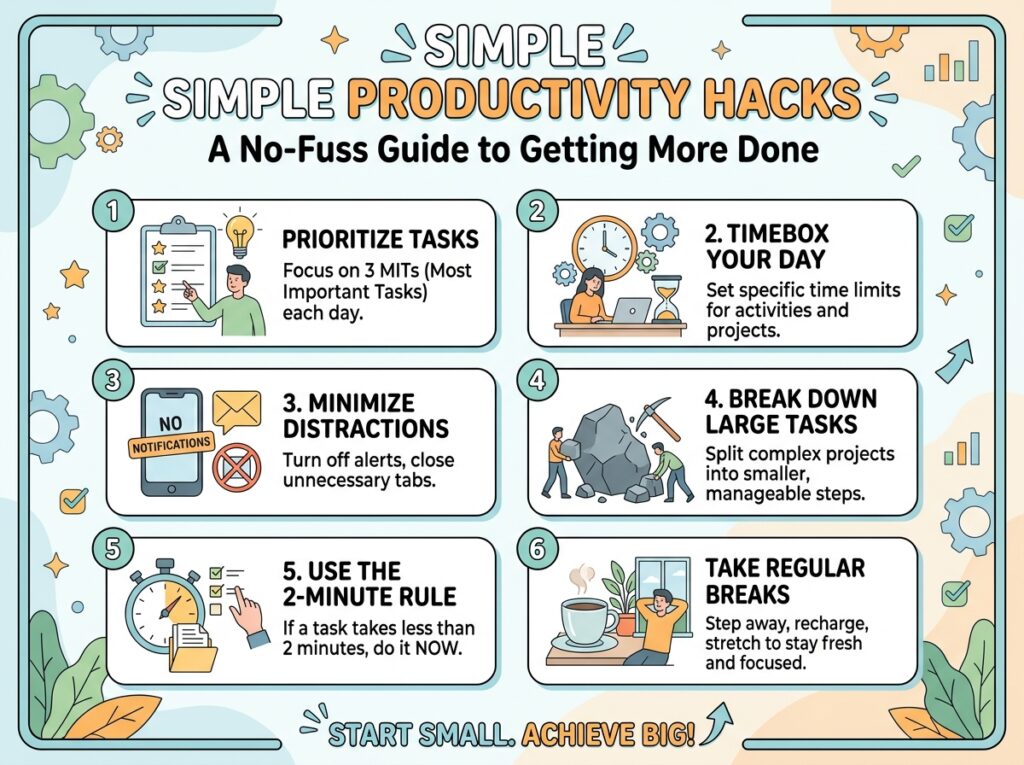
Instead of just listing what you need to do, decide when you are going to do it. Time blocking is the practice of assigning specific tasks to fixed slots on your calendar.
How to implement it:
- Identify your tasks: Write down everything you need to do.
- Block your time: Schedule blocks of time for specific activities. For example, “9–11 a.m. for project research,” “11 a.m.–12 p.m. for emails,” and “1–3 p.m. for creative work”.
- Protect your blocks: Treat these time blocks like important meetings. Use the “do not disturb” feature to protect your focus and minimize distractions.
This technique is a simple productivity hack that creates structure in your day, reduces decision fatigue, and ensures that your most important work gets the focused attention it needs. It helps you be realistic about how much time tasks take and prevents that “where did the day go?” feeling.
The 1-3-5 Rule: A Daily Focus Framework
When you have an endless list of things to do, it can be hard to know where to start. The 1-3-5 Rule is a simple framework for prioritizing your daily tasks.
The framework:
- 1 Big Task: Choose one primary, high-impact project or task that will move the needle on your top priorities.
- 3 Medium Tasks: Identify three other important tasks that support your big goal or are critical to complete that day.
- 5 Small Tasks: List five smaller, quick tasks that you can fit in around your other work.
By limiting your daily focus, you ensure that your most important work gets done instead of being buried by a mountain of minor tasks.
Overcoming Overwhelm
Sometimes, a task is so big it feels impossible to even start. These simple productivity hacks are designed to help you build momentum by starting small.
The ‘One More’ Trick: The Power of Momentum
If you’re feeling overwhelmed by a big project, the “one more” approach can be a game-changer. Instead of looking at the whole task, break it down into the smallest possible pieces and focus on doing just “one more”.
Examples:
- Emails: Don’t look at a list of 50 emails. Just ask yourself, “Can I answer one more?”.
- In the gym: Instead of worrying about the time left, ask “Can I do one more rep or one more minute?”.
- Cleaning: Finish one small task, then ask, “Can I do one more thing?”.
Why it works: Every time you complete a small piece of the puzzle, you get a boost of confidence and motivation. This momentum makes it easier to keep going.
The ‘One Bite’ Technique: Eat the Elephant
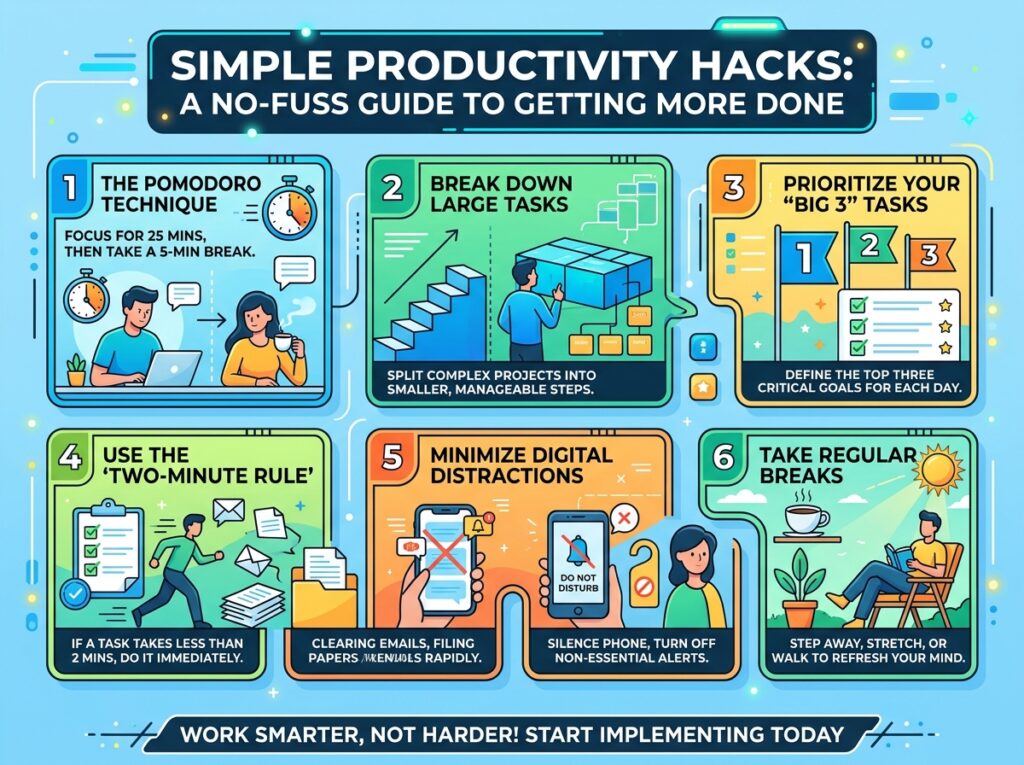
Similar to “one more,” the one-bite technique involves breaking a large, daunting project down into the smallest possible tasks. This is a simple productivity hack where you focus on one “bite” at a time.
How to do it:
- Write down your big task: For example, “Run a large meeting”.
- Break it down: Break it down into smaller steps, like “Coordinate attendees,” “Set an agenda,” and “Check the tech.”
- Keep breaking it down: Continue to break those steps down until you have tiny, actionable “bites”.
This technique is an effective way to overcome the anxiety of a large project by turning it into a series of small, manageable wins.