Table of Contents
Welcome to HabitHack.fun, your trusted resource for mastering the art of habit formation and personal growth. We all have habits we wish we could break—whether it’s doomscrolling, stress eating, or procrastinating. The challenge isn’t a lack of willpower; it’s that we’re often fighting against how our brains are wired. Research shows that habits are controlled by two distinct brain systems: one that triggers automatic responses to familiar cues and another that allows for conscious, goal-directed control . Habits form when the automatic system consistently overrides the conscious one. This guide provides a science-backed, step-by-step approach to permanently breaking bad habits by working with your brain, not against it.
Understanding Why Bad Habits Are So Stubborn
The Habit Loop
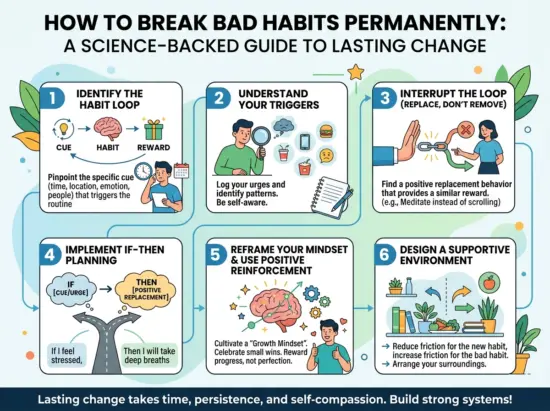
Before you can break a habit, you need to understand its structure. Every habit follows a three-part neurological pattern called the habit loop: cue, routine, reward.
- Cue (Trigger): The signal that initiates the behavior. This can be a specific time, a location, an emotional state, or a preceding action.
- Routine (Behavior): The actual action you perform in response to the cue.
- Reward: The positive feeling or outcome you get from performing the routine, which reinforces the loop.
When you repeat this loop, your brain releases dopamine, the “feel-good” neurotransmitter, creating a positive association between the behavior and your experience. Over time, more and more neurons fire to reinforce the habit until it becomes a deeply etched memory . This explains why bad habits feel automatic and why willpower alone is often insufficient.
The Brain’s Role
Specific brain regions, particularly the dorsolateral striatum, take over as behaviors become more automatic with practice . The myelin sheath—the insulating layer wrapped around neurons—allows signals to travel faster and more efficiently along these established pathways . This means the more you practice a bad habit, the stronger its neural pathway becomes, making it harder to break.
Why Willpower Alone Fails
Willpower is a prefrontal cortex function—conscious, effortful decision-making. But habits live in the basal ganglia, which operates below conscious awareness. This is the critical mismatch: you’re trying to use a “slow, deliberate” brain system to override a “fast, automatic” one . You can be 100% committed to change in the morning and still find yourself repeating the habit by afternoon because the habit loop activates faster than your prefrontal cortex can intervene.
12 Proven Strategies to Break Bad Habits Permanently

1. Map Your Habit
Before you can change a habit, you need to understand it. This involves identifying the specific components of your habit loop. Most people stay vague—”I eat when I’m stressed”—which isn’t specific enough. To map your habit, ask yourself:
- Trigger: What exactly happened right before? (A notification? A thought? A time of day?)
- Behavior: What did you do, step by step? (Reached for phone, opened app, scrolled for 20 minutes?)
- Reward: What did you get? (Distraction? Relief? Novelty?)
2. Notice the Actual Reward
Instead of trying to stop the behavior, investigate what you’re actually getting from it. When the trigger appears, pause and ask: “What am I getting from this, right now?” People who pay close attention often discover their habit isn’t delivering the reward they predicted. For example:
- Worrying doesn’t solve problems; it creates more tension.
- Stress-eating doesn’t relieve stress; it adds guilt and physical discomfort.
- Scrolling doesn’t satisfy curiosity; it leaves you more restless.
When your brain learns the behavior isn’t delivering the reward it predicted, the loop weakens naturally.
3. Replace the Routine (Habit Substitution)
You can never truly extinguish a bad habit, but you can replace it with a healthier one . The key is to keep the same cue and reward while changing only the routine. This is called habit substitution.
Examples:
- If you bite your nails when anxious (cue), try sitting on your hands (new routine) to get the same tension release (reward).
- If you snack mindlessly while watching TV (cue), try knitting or doing a puzzle (new routine) to keep your hands busy (reward).
4. Use Habit Reversal Training
This technique involves finding a competing reaction to make the old habit harder to perform . If you’re trying to stop nail-biting, clench your fists or sit on your hands when you feel the urge.
5. Implement Sensory Pattern Interruptions
Sometimes it takes a physical sensation to interrupt the neural circuits of your brain. Pressing an ice pack to your cheek or splashing cold water on your face may jolt you out of a craving . “A sensory pattern interruption acts like an emergency brake,” explains Dr. Collin Vas. “By introducing an intense physical sensation, you force the brain to instantly redirect its resources.”
6. Change Your Environment
Your environment plays a significant role in how you behave. We take cues from the people and events around us . To break a habit:
- Make the cues invisible: If you want to stop mindless snacking, move unhealthy snacks to the back of the cupboard or out of the house entirely.
- Limit your exposure: If you have a habit of mindless social media scrolling when you’re home alone, try relocating to a library or moving your phone to another room .
- Use friction: Make bad habits harder to do. Log out of social media apps so you have to enter your password each time.
7. Use the 10-Minute Rule (Urge Surfing)
Telling yourself “later” instead of “no” is much easier for the brain to handle . When you feel the urge, set a timer for 10 minutes and find an attention-absorbing task to engage in. When the timer is up, you may find the urge has passed. Dr. Vas explains: “Urges are like waves, peaking before eventually subsiding. The trick is to ride out the urge.”
8. Practice Mindfulness
Being mindful of your triggers and behaviors helps disrupt the automatic habit loop, giving you more control over your actions . Dr. Jud Brewer, a psychiatrist and neuroscientist at Brown University, has shown that awareness itself—without any effort to change—predicts behavior change. Why? Because awareness interrupts the autopilot.
9. Use If-Then Planning
Some people are better prepared to confront their bad habits when they have a plan in place . Think of alternative options to redirect your attention. Dr. Vas advises: “Instead of relying on willpower in the heat of the moment, decide the detour you want to take in advance. If I start craving a cigarette, for example, I will get up and take a lap around the house.”
10. Start Gradually
One of the most common mistakes is trying to change everything at once. Instead, make small, incremental adjustments . Dr. Heidi Allison Bender recommends: “If you hit the snooze button five times each morning, try four times the next day. The next week, try three times, and so on until you’re able to go without snoozing.”
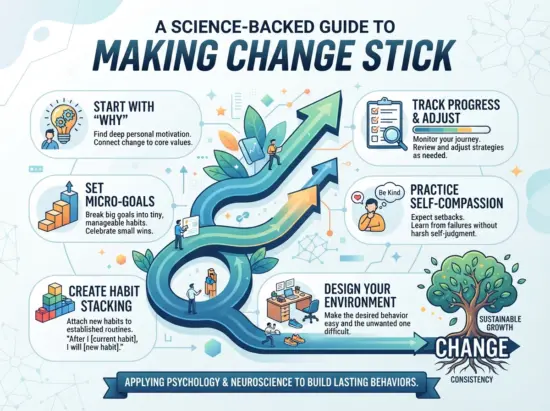
11. Forgive Yourself and Practice Self-Compassion
Beating yourself up for slipping up only fuels negative emotions and makes you more likely to give up . Research shows that students who were able to forgive themselves for procrastinating on one exam ended up procrastinating less on their next one . Instead of harsh criticism, be kind to yourself—you’re more likely to persist if you approach setbacks with self-compassion.
12. The “Never Miss Twice” Rule
When you miss a day, simply start again the next day. As long as you don’t let one missed day become two, you’re still on track . The key is to maintain the pattern, not achieve perfection.