Table of Contents
Welcome to HabitHack.fun, your go-to resource for mastering the art of habit formation and personal productivity. In today’s fast-paced world, being “busy” is often confused with being productive. However, true productivity isn’t about cramming more into your day—it’s about making intentional choices to focus on what truly matters and achieving meaningful results without burning out. This comprehensive guide will provide you with research-backed productivity tips, from quick wins you can implement today to long-term strategies that will transform how you work and live.
Understanding Productivity: Why It Matters
Before diving into specific tips, it’s important to understand why productivity is essential. Productivity isn’t about working longer hours; it’s about creating a smarter, more focused way of working that reduces stress and drives meaningful progress.
Key Reasons Why Productivity Matters:
- Reduces Stress and Overwhelm: When your workload feels scattered, even simple tasks can become stressful. An organized approach to productivity helps you determine what should be done first and what can wait, avoiding the last-minute rush that often causes pressure and anxiety.
- Increases Focus and Quality of Work: True productivity is less about multitasking and more about concentrating on one task at a time. When you give focused attention to high-value work, the quality of your output improves dramatically.
- Creates More Time for What Matters: Being productive means completing necessary tasks efficiently so you have time for other priorities—not working nonstop. This balance between professional and personal life is what keeps productivity sustainable in the long run.
- Protects Against Burnout: A global survey by Boston Consulting Group found that nearly 48% of workers are struggling with burnout, which is a clear sign that long hours and constant busyness don’t translate to meaningful results.
Quick Wins to Kickstart Your Day
Starting your day with momentum makes it easier to stay focused and productive. These quick wins are simple to apply yet powerful enough to set the tone for everything that follows.
1. Start Your Day with a Plan
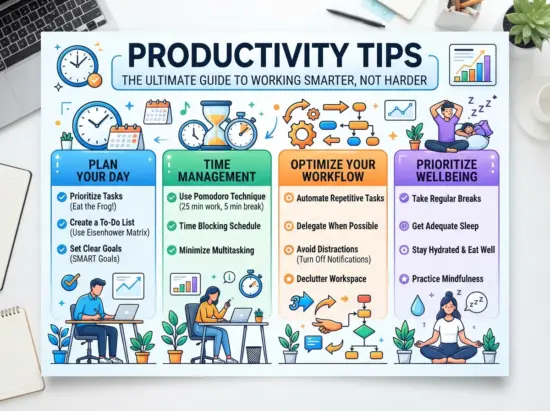
The first 10 minutes of your day can set the tone for everything that follows. Instead of jumping straight into emails or meetings, use this time to map out your priorities. Write down your top three tasks, identify which ones require the most focus, and decide when you’ll tackle them. This simple ritual reduces decision fatigue later in the day and ensures you’re proactive rather than reactive.
2. The Two-Minute Rule
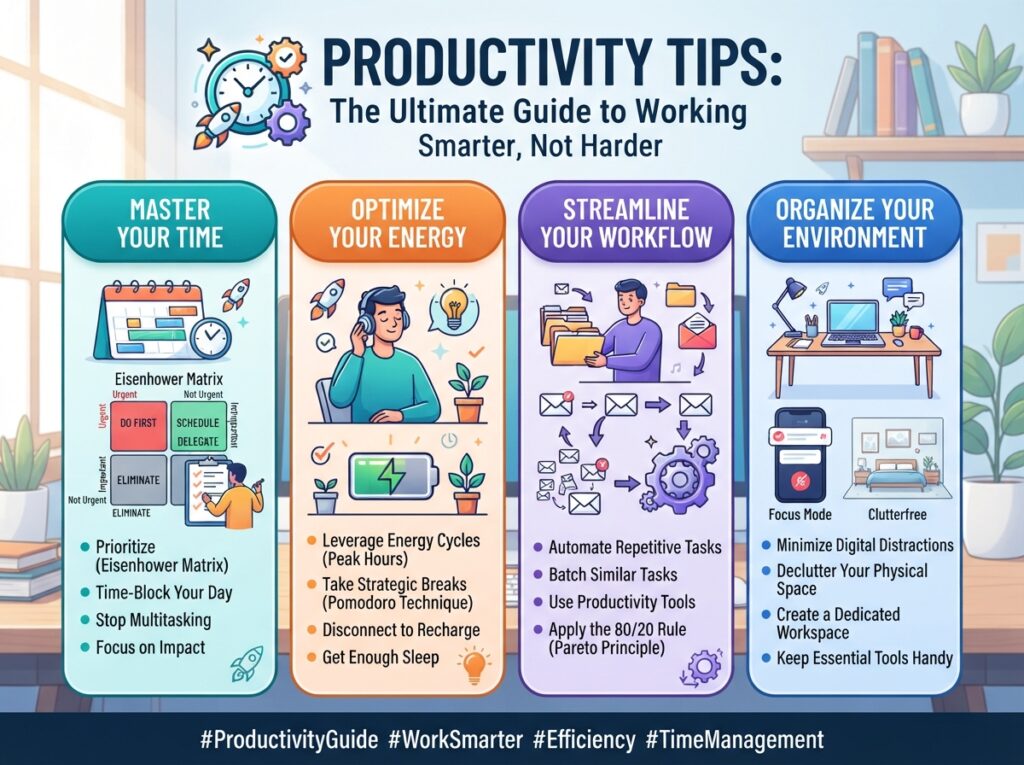
Made popular by productivity expert David Allen, the two-minute rule is simple: if a task can be done in two minutes or less, do it immediately. This could be replying to a short email, filing a document, or scheduling a quick call. Instead of letting these small tasks pile up and clutter your mind, clear them out quickly. Over time, this practice creates a sense of momentum and keeps your task list leaner, leaving more room for meaningful work.
3. Protect Your Mornings
Your mornings are often when your energy and focus are at their peak, yet many people waste this time on reactive tasks like checking emails or scrolling through social media. Instead, protect this window for deep, meaningful work. Schedule creative or strategic tasks first, and leave administrative tasks or inbox management for later in the day. By aligning your highest-value work with your natural energy peaks, you ensure that your mornings are spent making real progress rather than reacting to other people’s priorities.
4. Track Your Time
Do you know how you spend your time? If not, how do you expect to get more out of it? Start by tracking your time for a minimum of two weeks—the first week you’re too aware of what you’re doing, but the second week gives a more accurate representation. You can use a time log, automated apps like RescueTime or Rize, or even simple time estimates. The most important step is to review how you spent your time and reflect on whether that’s how you want to spend it.
Structuring Your Time for Deep Work
Building long stretches of uninterrupted focus is key to producing high-quality work. Instead of letting your day be dictated by random interruptions, these strategies help you create a structure that protects your concentration and maximizes output.
1. Time Blocking
Time blocking is a method where you assign specific tasks to fixed blocks of time in your calendar. Instead of keeping a long, open-ended to-do list, you decide when each task will be done. For example, you might block 9:00–11:00 a.m. for project research and 2:00–3:00 p.m. for client follow-ups. This approach creates accountability, reduces multitasking, and ensures you always have protected space for deep work. As Trivago’s CEO Johannes Thomas puts it: “I just focus on a problem, think it through, and really go into deep thinking”.
2. Batch Similar Tasks
Mental energy can be depleted by constantly switching between different types of tasks—creating a report, responding to emails, and preparing for a presentation. Task batching solves this by grouping similar activities together. Dedicate one 30-minute slot to respond to emails instead of checking them throughout the day. Handle all your calls or administrative work in a single block. By reducing context switching, you conserve mental energy and maintain a smoother workflow.
3. The Pomodoro Technique
The Pomodoro Technique uses 25-minute focus sessions followed by short 5-minute breaks. After four rounds, you take a longer 15–20 minute break. This method helps maintain consistent concentration while preventing fatigue. Knowing that you only need to focus for 25 minutes at a time reduces resistance to starting, which is especially helpful for tasks that feel overwhelming.
4. Know Your Biological Prime Time
Everyone has windows of peak focus. Productivity expert Chris Bailey refers to this as your “Biological Prime Time”—the daily period when your energy, clarity, and productivity are highest. Align your most cognitively demanding tasks to that window. Axios CEO Jim VandeHei starts his day between 4:30 and 5 a.m. to capture hours of uninterrupted thinking and writing before the demands of the day set in.
Minimizing Distractions and Decision Fatigue
Distractions are productivity killers, and constant decision-making can drain your mental energy before you’ve even reached your most important work.
1. Limit Notifications
Every ping, buzz, or popup pulls your attention away from deep work and forces your brain to refocus. Research shows it can take up to 23 minutes to regain full concentration after an interruption. Silence non-urgent alerts across email, messaging apps, and social media. Set specific times to check them instead of letting notifications dictate your day.
2. Set Clear Boundaries
Productivity often suffers when your day is filled with back-to-back meetings or constant interruptions. Establish boundaries by creating “no meeting” zones in your calendar or setting “do not disturb” hours when you’re unavailable. Communicate these boundaries to colleagues so they know when you’re focused and when you’re free. Clear boundaries not only protect your time but also signal to others that deep work is a priority.
3. Simplify Choices
Decision fatigue—the mental exhaustion caused by making too many choices—lowers the quality of your decisions over time. Simplifying routine choices helps conserve mental energy for more important tasks. This could mean meal prepping for the week, adopting a simple work wardrobe, or using standardized workflows.
4. Use Tools to Block Distractions
If you know you’re easily distracted by websites, use tools to proactively block yourself. Chrome extensions like Stayfocusd can prevent you from visiting distracting sites during work hours, while Strict Workflow can lock you out of distracting sites during Pomodoro work phases.
Boosting Energy and Motivation
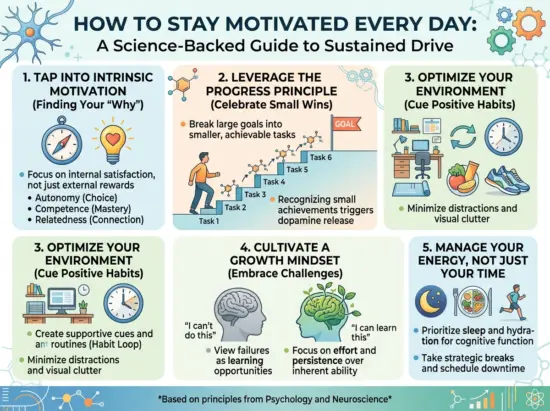
Being productive involves more than just time management—it also involves energy management and maintaining a high level of motivation.
1. Take Purposeful Breaks
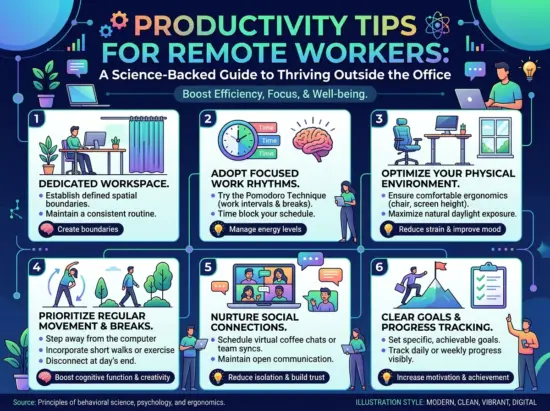
It may sound counterintuitive, but stepping away from your desk can sometimes be better than powering through. Research shows that short, regular breaks improve focus and reduce decision fatigue. Whether it’s a quick walk, stretching, or a five-minute chat with a teammate, breaks give your brain the reset it needs to come back stronger. The key is to make breaks intentional—choose an activity that clears your head and re-energizes you.
2. Move More
At least one break per day should involve getting out of your chair and moving for a while. Prolonged sitting is bad for both your productivity and your physical health. Walking is the simplest way to combat it, and researchers at Stanford University have shown that walking promotes creativity. Make it a habit to walk for 30–40 minutes during your lunch break to split up your workday.
3. Reward Yourself
When you finish a task early, reward yourself. Buy a coffee, read a bit of news, or message a friend. Rewards reinforce the behavior and make you more likely to repeat it. As productivity expert James Clear explains, the “reward” portion of the habit loop is what seals the deal and makes your brain think, “Let’s do this again”.
4. Create a “Done” List
Sometimes acknowledging your triumphs can help you through your challenges! Think about what you’ve accomplished this week or even in a day. Write it all down—every meeting attended, every task completed, every small win. Recognizing what you’ve already accomplished can get you in a more productive mindset for what’s next.
The Power of Habit Stacking for Productivity
One of the most effective strategies for building productive habits is habit stacking—linking a new habit to an existing one. Coined by productivity expert James Clear, the formula is simple: After [CURRENT HABIT], I will [NEW HABIT] .
Why Habit Stacking Works
Habit stacking works because it taps into the brain’s habit loop—cue, craving, response, and reward. Instead of starting from scratch, you’re using an existing behavior as a trigger for the new one, making it much easier to remember and follow through.
This technique is particularly powerful because “about 40% of our daily behaviors are driven by habit,” according to habit formation expert Nir Eyal. By piggybacking on existing neural pathways, you reduce decision fatigue and make new habits stick more easily.
Habit Stacking Examples for Productivity
- “After I pour my morning coffee, I’ll write down my top three priorities for the day”.
- “After I sit down at my desk, I’ll spend five minutes organizing my day”.
- “After I brush my teeth at night, I’ll review tomorrow’s calendar”.
- “After I start my car, I’ll take a deep breath to center myself before driving”.
The Science Behind It
Habit stacking is supported by research from sources including the NHS, NICE, and the Royal College of Psychiatrists, which recommend linking new responsibilities to established routines to make them “automatic” and easier to sustain. A 2025 study found that pairing tasks or stacking habits supports consistency and productivity by triggering small dopamine rewards with each completion, reinforcing success and helping new habits “stick”.
Daily Habits to Strengthen Your Task Management
Beyond specific productivity techniques, there are daily habits that can transform how you manage your tasks and time.
1. Capture Everything in One Place
Your brain is for having ideas, not holding them. Write down every task, idea, and follow-up in one central list—no sticky notes, no scribbles in emails. Use a digital task manager to dump everything the moment it crosses your mind. This keeps mental clutter at bay and prevents dozens of mental interruptions later in the day.
2. Process Your Inbox at Set Intervals
Instead of reacting to emails and messages all day, check them at specific times—for example, 10 a.m., 1 p.m., and 4 p.m. Turn new inputs into tasks in your system. This prevents the habit of dropping everything every time a notification appears and helps you reclaim focus.
3. End the Day with a Shutdown Ritual
Before you close your laptop, review what got done, move unfinished items to tomorrow’s list, and write down three wins. This creates psychological closure and stops work from bleeding into your evening. It also sets you up for a smoother morning, because tomorrow’s priorities are already defined.
4. Review Your Week
Look at the bigger picture. Are you moving toward your goals? Did your daily habits stick? Adjust next week’s priorities. This habit turns task management into a skill that evolves—you’re not just executing, you’re improving your system week over week.