Table of Contents
In a world where our attention is constantly under siege and our willpower is spread thin, the ability to build good habits and break bad ones has never been more critical. Welcome to HabitHack.fun, your ultimate destination for mastering the art and science of habit formation. This guide will delve deep into the psychology of habits, provide actionable hacks to transform your daily routine, and explore the fascinating and sometimes unsettling world of how habits are engineered in the digital age.
The Science Behind Habits: Why We Do What We Do
Before we can hack our habits, we must first understand them. At its core, a habit is a learned behavior that, through repetition, becomes automatic and is triggered by specific cues in our environment. It’s a powerful labor-saving device for our brains, allowing us to perform routine tasks without expending conscious mental energy. An estimated 40% of our daily actions are performed habitually, not through deliberate decision-making.
The Habit Loop: Cue, Routine, Reward
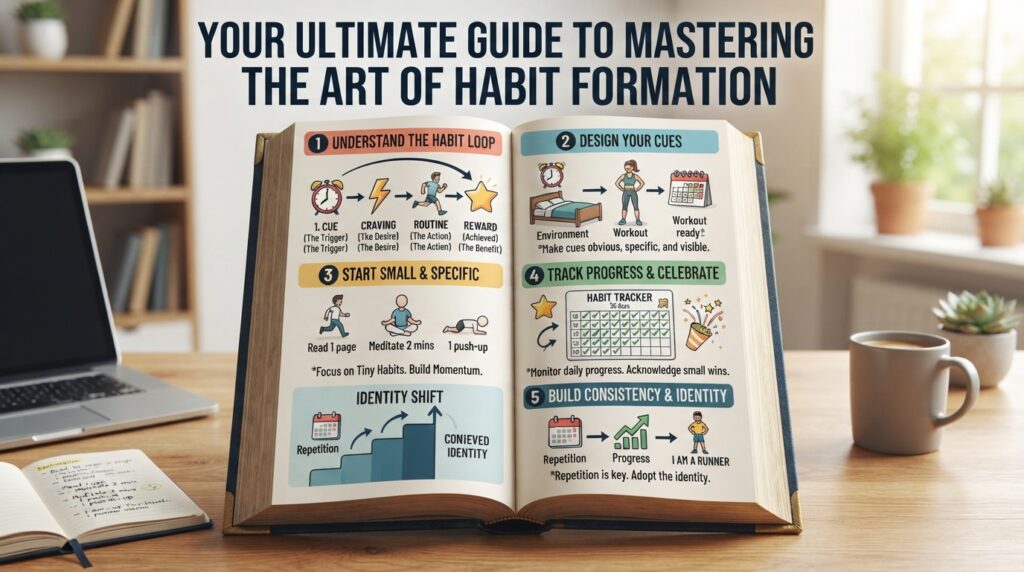
The foundational model for understanding habits is the “habit loop,” a concept popularized by Charles Duhigg in his book, The Power of Habit. This framework breaks down any habit into three essential components:
- The Cue (Trigger): This is the signal that initiates the habit. It can be a specific time of day, a location, an emotional state, the presence of other people, or an immediately preceding action. For example, your phone buzzing (cue) might trigger you to check it (routine).
- The Routine (Behavior): This is the actual habit or action you perform in response to the cue. It can be physical (like eating a snack), mental (like worrying), or emotional (like feeling stressed).
- The Reward: This is the positive feeling or outcome you get from performing the routine. The reward is what reinforces the habit loop and creates a neurological craving that makes you want to repeat it. The reward for checking your phone could be the satisfaction of a new message or social media like.
The habit loop becomes powerful because our brains start craving the reward as soon as the cue appears. This craving is what drives automatic behavior, often overriding our conscious intentions.
The Neurology of Habit Formation
From a neurological perspective, habit formation is a fascinating process of brain reorganization. As you learn a new behavior, you engage your prefrontal cortex, which is responsible for decision-making and working memory. However, as you repeat the behavior in a stable context, the information shifts to the basal ganglia, specifically the sensorimotor loop, which supports automatic, cue-response associations. This is why habits become rigid and difficult to change; the brain has essentially offloaded the behavior to an area that operates largely outside of conscious awareness.
The “Brain Hacking” Phenomenon: Habits in the Digital Age
In recent years, the science of habit formation has been weaponized by the tech industry. The term “brain hacking” describes the use of psychological principles—many of which we’ve discussed—to engineer apps, websites, and social media platforms to be as addictive as possible.
Former Google product manager Tristan Harris famously compared smartphones to slot machines, explaining that every time we check our phone, we’re “playing the slot machine to see, ‘What did I get?'” This is a prime example of operant conditioning and intermittent variable rewards. When you don’t know if you’ll receive a like, a comment, or nothing at all, the unpredictability of the reward makes the behavior (checking your phone) more addictive.
Apps also use Pavlovian conditioning. The chime of a notification acts like Pavlov’s bell, triggering a conditioned response to check our phones, even if the notification is nothing important. Companies like Instagram have even been known to hold back likes to deliver them in a “big burst,” creating a powerful surge of dopamine that reinforces the habit loop. This constant cycle of engagement is designed to keep you scrolling, collecting data, and viewing ads.
Practical “Habit Hacks” for Lasting Change
Understanding the science is the first step. Here are some powerful, research-backed strategies to “hack” your habits and take control of your behavior.
1. The “Habit Loop” and Cue Identification
Start by identifying the cue, routine, and reward for a habit you want to change. For example, you might want to stop mindlessly snacking at night. What’s the cue? Is it a specific time, feeling bored, or watching TV? By identifying the cue, you can then work on changing the routine while keeping the same reward. For example, you could replace the routine of eating with a short walk or drinking a glass of water. Experiment with different routines until you get the same feeling of satisfaction or relaxation.
2. Leverage Consistency with Habit Stacking
One of the most effective hacks is habit stacking, a method popularized by James Clear in his bestselling book, Atomic Habits. This involves taking a new habit you want to build and stacking it on top of an existing one. The formula is simple:
After/Before [CURRENT HABIT], I will [NEW HABIT].
For example:
- “After I pour my morning coffee, I will meditate for one minute.”
- “Before I brush my teeth at night, I will write down three things I’m grateful for.”
- “After I take a shower, I will apply moisturizer.”
Habit stacking works because you’re piggybacking on a neural pathway that is already well-established. Your existing habit serves as a powerful cue for the new one, making it much easier to remember and perform consistently. This technique can even be expanded to create larger “stacks” by chaining small habits together.
3. The Power of Tiny Changes
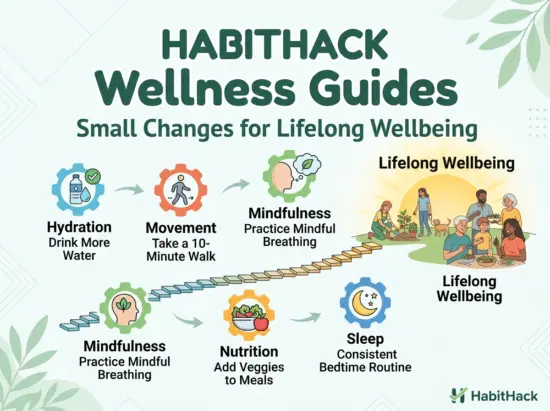
Another related concept from BJ Fogg’s Tiny Habits program is to start absurdly small. The goal isn’t to radically change your life overnight but to build momentum. If you want to start running, start by simply putting on your running shoes and stepping outside for two minutes. Over time, this tiny behavior becomes a natural part of your day and makes it easier to extend the duration. This method reduces the friction of starting a new habit.
4. Focus on Context and Consistency
Research strongly suggests that the context (or cues) in which you perform a behavior is critical for habit formation. It’s often easier to build a new habit when there is a disruption to your normal routine, such as moving to a new city or starting a new job. When your old cues are removed, you have a “window of opportunity” to create new patterns.
If you can’t change your environment, make small changes to it. For example, to eat healthier, move unhealthy snacks to the back of the cupboard or a high shelf, and put fruits and vegetables at eye level. A recent study also found that consistency in internal cues like the time of day and your mood was highly correlated with stronger habit formation, while external cues like place and people were less impactful. This means that practicing a new habit at the same time each day, perhaps when you’re in a particular mood (e.g., feeling focused), can be more effective than just doing it in the same location.
5. The “Rule Hack” for Breaking Bad Habits
For breaking a bad habit, you can use an unconventional approach known as the “rule hack.” This method, often used by hypnotherapists, involves putting a bizarre, conscious rule on the unwanted behavior.
For example, if you want to quit smoking, you could make a rule that whenever you want a cigarette, you must first put on an absurd hat or hold the cigarette with your pinkie and ring finger. This adds friction and a layer of conscious awareness to a previously automatic behavior. The habit no longer feels the same; it becomes awkward and less rewarding. This can help break the pattern. However, be aware that if you don’t replace the habit with a healthier one, the underlying need for a reward (like stress relief) may transfer to another habit, such as overeating.
6. Be Patient: Repetition is Key
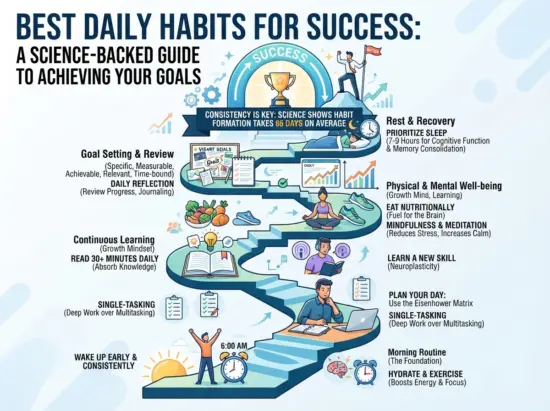
Finally, remember that habits take time to form. There’s no magic number of days. Research shows it can take anywhere from 18 to 254 days for a new behavior to become automatic, depending on the individual and the complexity of the habit. Don’t get discouraged if you miss a day; the key is to get back on track and focus on consistent repetition.