Table of Contents
Welcome to HabitHack.fun, your trusted resource for building habits that unlock your full potential. We often think that meaningful change requires grand gestures. Yet, the most profound transformations in our lives rarely come from dramatic overhauls; they come from the small, consistent actions we take every day. This is the essence of the “compound effect” of habits—the idea that a 1% improvement each day can lead to remarkable results over time . In the words of James Clear, “Every action you take is a vote for the type of person you wish to become” .
This guide explores a collection of small habits that can make a big difference, backed by insights from behavioral science and experts at institutions like Stanford Medicine and Cleveland Clinic.
The Secret: “Microsteps” and “Keystone Habits”
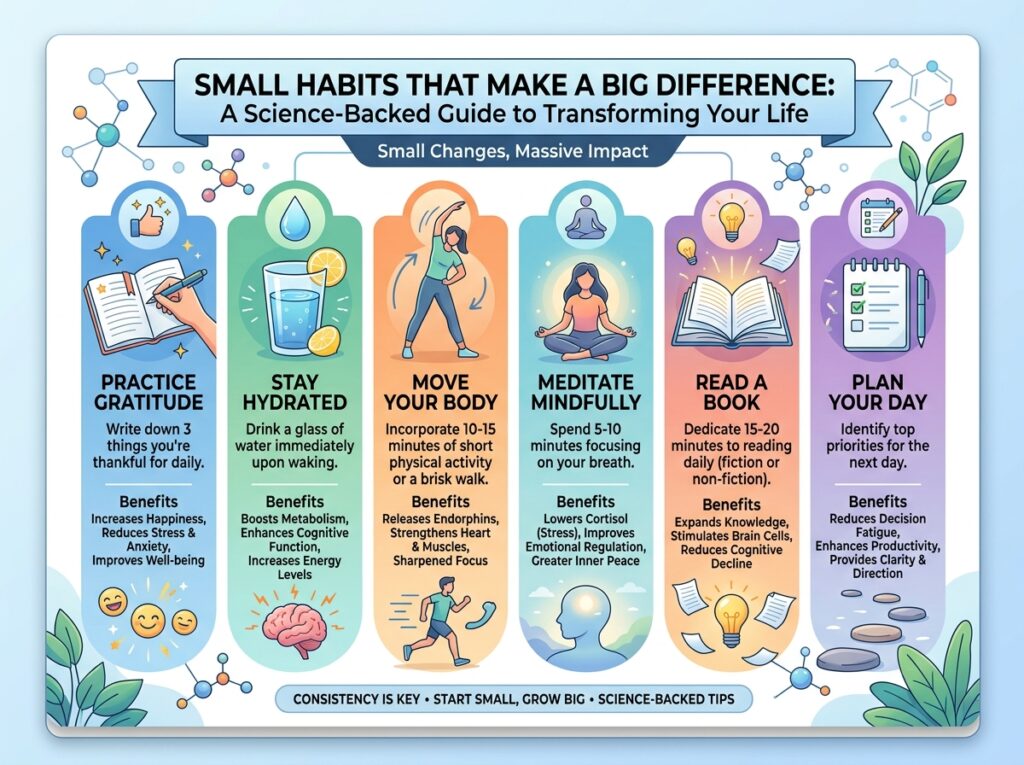
The most effective small habits are built on a foundation of two powerful concepts: microsteps and keystone habits.
Microsteps: Too Small to Fail
A microstep is an action that is so small and simple that it is almost impossible not to do it . Arianna Huffington, who popularized this concept, explains that the science shows the best way to start a new habit is to start as small as possible . The goal is to lower the “friction” and make the healthier choice the easier choice. By taking just one small step and celebrating the win, you slowly gain momentum .
Keystone Habits: The Domino Effect
A keystone habit is a routine that, once established, creates a chain reaction, sparking other positive behaviors that you may not even be consciously trying to improve [citation:2, citation:4, citation:8]. For example, when people start exercising regularly (a keystone habit), they often begin to eat healthier, sleep better, and feel more productive . Charles Duhigg, author of The Power of Habit, explains that these habits “start a process that, over time, transforms everything” . One of the most powerful examples of a keystone habit is simply making your bed every morning [citation:2, citation:9, citation:11].
How Long to Form a Habit?
It’s important to be patient. While the “21 days” myth is popular, research suggests it can take an average of 66 days to form a new habit, and sometimes up to 254 days . The key is consistency and self-compassion.
Small Habits with a Big Impact
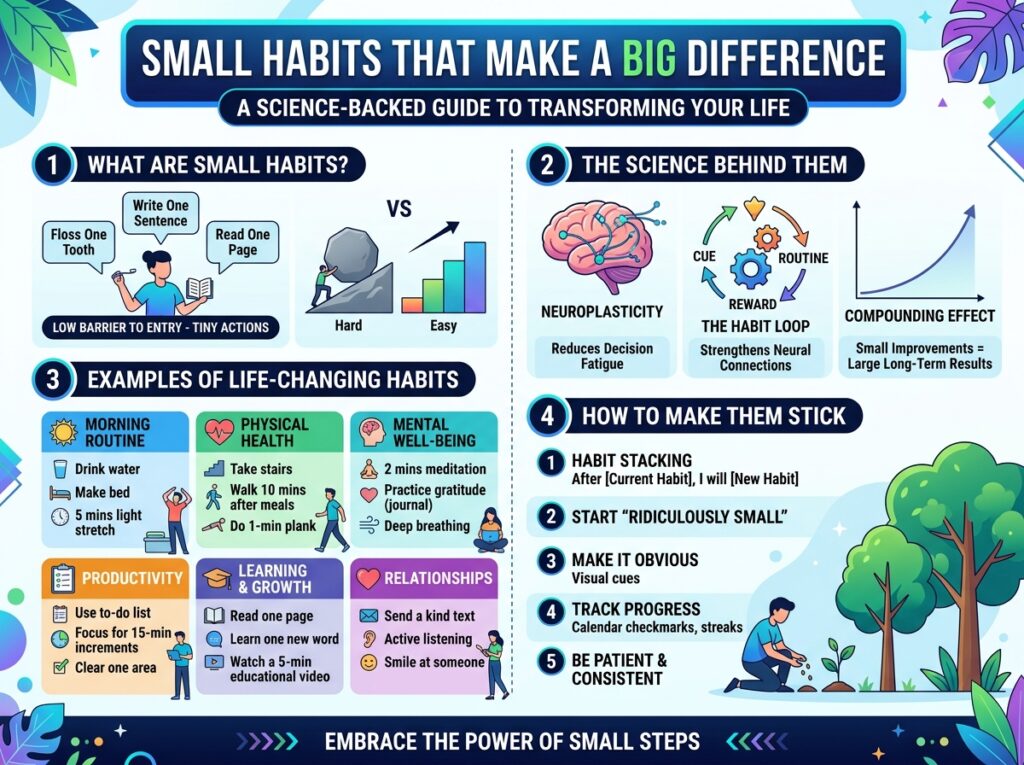
Here is a collection of small habits, recommended by experts, that can create a significant positive impact in your life.
| Small Habit | Why It Makes a Big Difference | How to Start Today |
|---|---|---|
| Make Your Bed | This simple act provides a “small win” first thing in the morning, building momentum and a sense of accomplishment [citation:2, citation:6]. It is a powerful keystone habit [citation:2, citation:8, citation:11]. | Spend two minutes smoothing your comforter and fluffing your pillows as soon as you get up. |
| Step Outside for Morning Light | Morning sunlight regulates your circadian rhythm, improving sleep quality, mood, and energy levels [citation:6, citation:12]. It suppresses melatonin and increases serotonin . | Spend 5-10 minutes outside within the first hour of waking, without sunglasses . |
| Drink Water Before Your Coffee | After sleeping, your body is dehydrated. Starting your day with water rehydrates you, boosts energy, and aids focus [citation:5, citation:6]. | Place a glass of water on your nightstand and drink it before you have anything else. |
| Move for Five Minutes | Consistent movement is a cornerstone of good health [citation:1, citation:4, citation:12]. Experts at Cleveland Clinic recommend small actions like taking the stairs, parking further away, or a quick stretch . It reduces the risk of heart disease, diabetes, and cognitive decline . | Do a few squats while brushing your teeth, or take a short walk after a meal [citation:1, citation:12]. |
| Practice Mindful Breathing | Even 60 seconds of conscious breathing can shift your nervous system from “fight-or-flight” to a relaxed state, reducing stress . | At work, take a “Reset” break: focus on your breath, and images that bring you joy for one minute . |
| Declutter a Small Surface | Visual clutter competes for your attention and can be a source of stress. Clearing one small surface lowers your stress and restores a sense of control [citation:6, citation:7]. | Spend five minutes every evening clearing the kitchen counter or your desk [citation:2, citation:6]. |
| Write Down Tomorrow’s One Thing | This simple habit reduces decision fatigue in the morning. It helps you start your day with clarity and a sense of purpose [citation:1, citation:6]. | Before bed, write down one priority task that would make the day successful if completed. |
| Take the 10-Minute Clean | Spending just 10 minutes a day tidying up prevents messes from becoming overwhelming, keeps your space more organized, and reduces stress . | Set a timer for 10 minutes each evening and focus on one small area . |
| Send a Thoughtful Message | Social connection is vital for mental health [citation:5, citation:6]. A simple check-in message can strengthen relationships and build your support network [citation:6, citation:7]. |