Table of Contents
Welcome to HabitHack.fun, your trusted resource for building habits that unlock your full potential. While we focus on personal growth, understanding key digital marketing concepts like long-tail SEO keywords can be a powerful tool for career development, especially if you’re involved in content creation, digital marketing, or running your own business.
Long-tail SEO keywords are specific, multi-word search phrases that capture a user’s clear intent, attracting highly qualified traffic that is often ready to convert. This guide provides a practical overview of what long-tail keywords are, their strategic importance, and how to find and use them effectively for SEO in 2026.
What Are Long-Tail SEO Keywords?
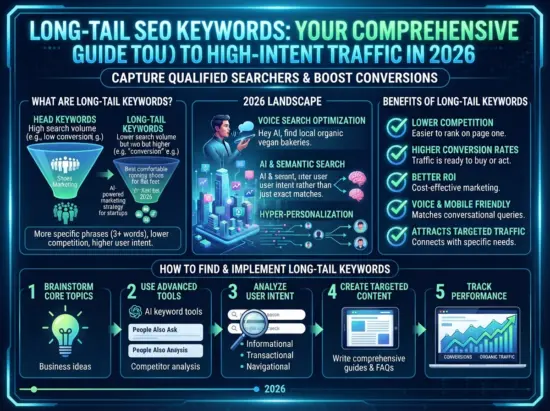
At their core, long-tail keywords are the exact opposite of the short, generic search terms most people think of. They are longer, more descriptive, and target a very specific need or niche. A common misconception is that any phrase with three or more words qualifies, but the true defining metrics are specificity and intent. The term “long-tail” comes from the shape of the search demand curve, where a few high-volume “head” terms sit at one end, and a vast, endless “tail” of low-volume, highly specific queries makes up the majority of all searches.
While a broad keyword like “shoes” or “software” might have massive search volume, its user intent is vague. Is the searcher browsing, researching, or ready to buy? The intent is often unclear.
In contrast, a long-tail keyword like “best running shoes for flat feet” or “loyalty platform for small business” reveals a searcher who knows exactly what they want. These users are further along in their journey and are often closer to a purchase decision. This high specificity is what makes long-tail keywords so valuable for SEO, as they lead to significantly higher conversion rates than broad, generic terms.
Why Long-Tail SEO Keywords Are Critical in 2026
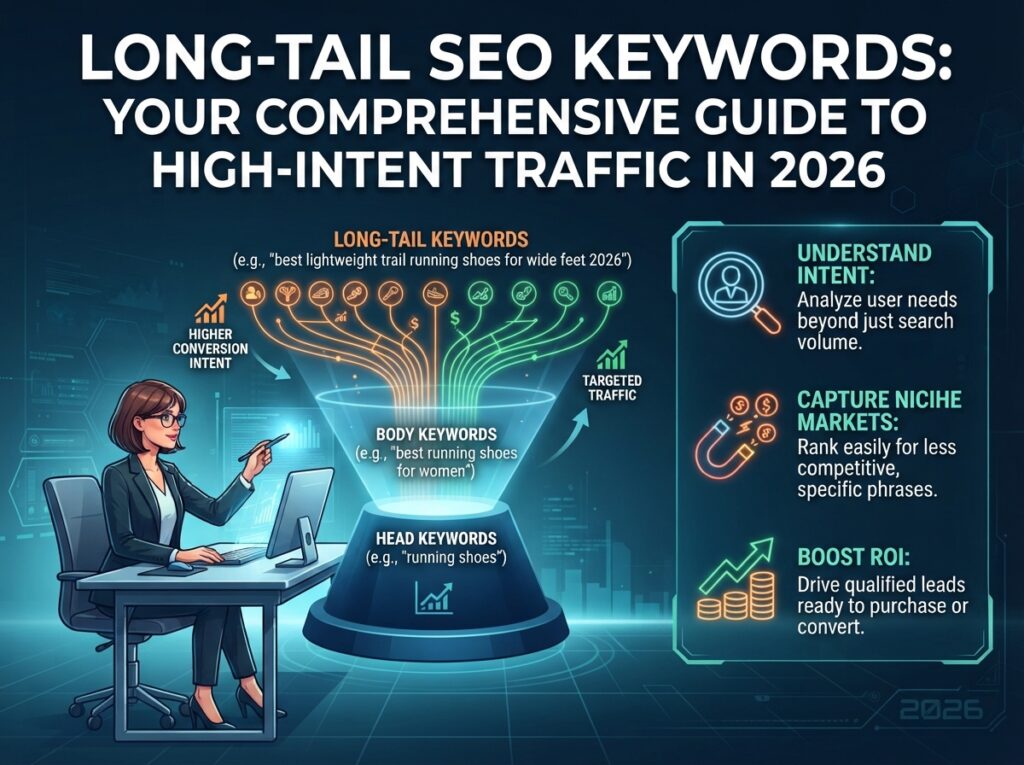
The SEO landscape has changed drastically. With the rise of Google AI Overviews answering broad queries directly in search results, relying only on high-volume “head” keywords has become less effective. Here’s why long-tail keywords are more important than ever.
1. Lower Competition, Faster Wins
Competing for a short-tail keyword like “boots” puts you in direct competition with global giants. It is a resource-intensive battle. By targeting “vegan leather chelsea boots for women,” you narrow the field, making it far easier to rank. These keywords have a lower “keyword difficulty,” meaning you can start attracting traffic more quickly without needing a massive domain authority or thousands of backlinks.
2. Higher Conversion Rates
This is the most significant benefit. A user searching for a general term is browsing; a user searching for a specific model, feature, or use case is often looking for a checkout button. Long-tail keywords typically have a conversion rate 2.5 times higher than head terms. The high relevance ensures that the traffic you attract is already “pre-qualified.”
3. Dominance of Voice Search and AI
How do you interact with a smart speaker or an AI assistant? You don’t say keywords; you ask full questions. Voice search is inherently long-tail, and as more consumers use tools like ChatGPT or Google’s AI Overviews, optimizing for natural, conversational language becomes essential. The goal is to answer the specific question the keyword represents.
How to Find Long-Tail SEO Keywords: A Step-by-Step Guide
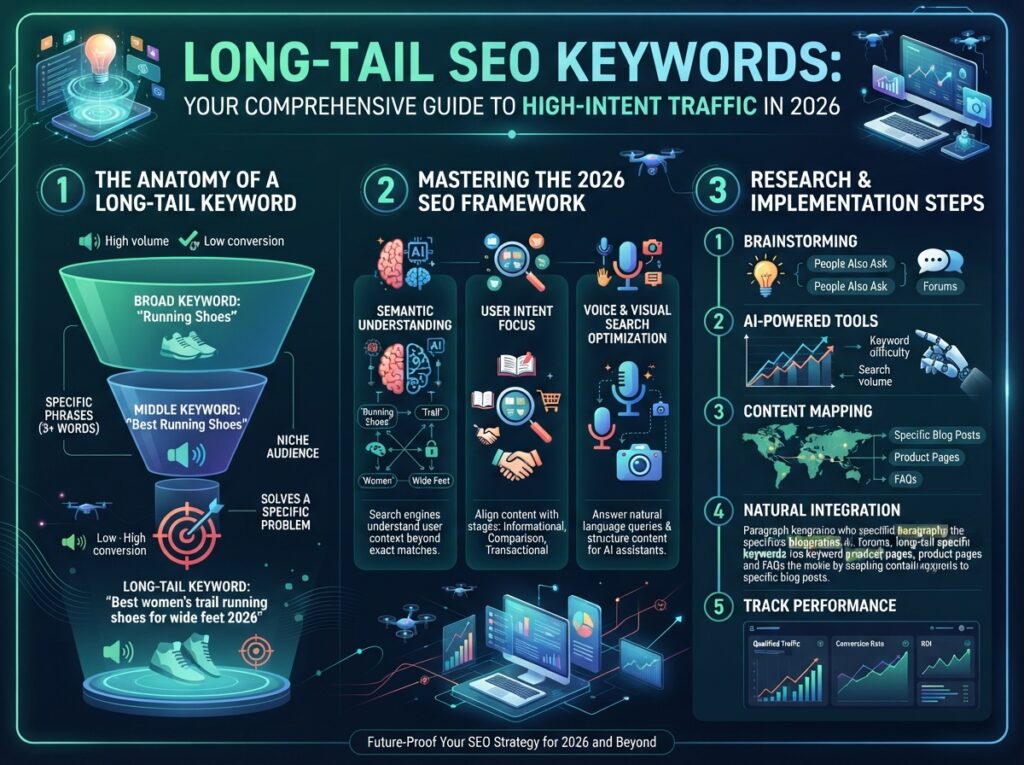
Effective long-tail keyword research is a process of discovery, using a combination of free and paid tools.
Step 1: Start with Your “Seed” Keywords
Before you can find long-tail keywords, you need to know your main topics. These are your “seed” keywords—usually one to two words long, like “shoes,” “coffee,” or “SEO”.
Step 2: Leverage Google’s Native Features
Google provides free, real-time insights into user intent:
- Autocomplete: Type your seed keyword into Google and see the dropdown suggestions. This is a great source for common long-tail queries. Try the “Alphabet Soup” method: type your keyword followed by “a,” then “b,” then “c” to see all the suggestions.
- People Also Ask (PAA): These boxes reveal the exact questions users are asking. If you see “How do I clean suede boots?”, that is a signal to create a guide on that topic.
- Related Searches: Located at the bottom of the results page, these terms show what users search for after their initial query, offering insight into their next step in the journey.
Step 3: Use Professional Keyword Research Tools
While Google is great, professional tools can speed up the process. Platforms like Semrush, Ahrefs, Surfer SEO, or SE Ranking allow you to filter keyword lists by word count (e.g., 4+ words) or keyword difficulty. This helps you instantly identify low-competition opportunities that are relevant to your seeds.
Step 4: Tap into Forums and Online Communities
Your audience is already having conversations about your niche on platforms like Reddit and Quora. Look for threads in your industry. Titles like “Is a 4070 Ti good for 4k gaming?” are perfect long-tail topics. These forums give you direct insight into the language your customers use and their pain points.
Step 5: Analyze Your Own Customer Data
Your most reliable data comes from your existing audience:
- Google Search Console: Review your performance report for queries with high impressions but lower rankings (positions 11-20). These are opportunities where you are already visible but need more targeted content to win.
- Customer Reviews and Support Logs: What questions do your customers frequently ask? Every specific question (e.g., “Do you ship to P.O. boxes?”) is a potential long-tail keyword. Reviews are a goldmine, as customers use natural, descriptive language that others will search for.
How to Use Long-Tail SEO Keywords Effectively
Finding the keywords is only half the battle. You need to use them correctly.
1. Build Topic Clusters, Not Separate Pages
Instead of creating a separate page for every single long-tail keyword, organize them by intent using the Topic Cluster model:
- The Pillar Page: A comprehensive guide on a broad topic (e.g., “The Ultimate Guide to Skincare”).
- The Cluster Content: Articles answering specific long-tail questions (e.g., “Best moisturizer for oily skin,” “How to use Vitamin C serum”).
- The Links: Link all cluster articles back to the pillar page, and vice versa, to build topical authority.
2. Place Them Naturally in Your Content
Do not “stuff” keywords into your text. Search engines use semantic analysis to understand topics; they care about the meaning behind your words. Instead, naturally integrate long-tail keywords into your:
- Page Title & H1 Heading: Your primary long-tail keyword should be in your title and main heading.
- Body Text: Use them naturally as you answer the user’s question.
- Meta Descriptions: This helps improve click-through rates.
- Internal Links: Use long-tail keywords as anchor text within your site to improve keyword rankings.
3. Don’t Forget About PPC
Long-tail keyword strategy isn’t limited to organic content. It is a powerhouse for PPC. By bidding on these specific phrases, you can attract more qualified clicks at a lower cost-per-click (CPC) because of the reduced competition. This is the secret to making your paid search campaigns profitable.