Table of Contents
Welcome to HabitHack.fun, your trusted resource for building habits that unlock your full potential. Learning is not a passive process—it is an active skill you can develop and refine. Research shows that effective learners are aware of how they learn and use a wide range of strategies for different tasks . By consciously designing your approach to learning, you can improve retention, reduce study time, and achieve deeper understanding.
What Are Learning Strategies?
Learning strategies are the methods and techniques you choose to learn new subject content—whether memorising vocabulary, understanding complex theories, or developing practical skills . Sometimes we can see learners using strategies as they work (like underlining key terms), but other strategies operate behind the scenes (like making mental associations between new and existing knowledge) .
The most effective learners are metacognitive—they think about how they learn and consciously select strategies that work best for different tasks . This self-awareness transforms studying from a chore into a deliberate, purposeful activity.
The Science of Learning: How Your Brain Actually Learns
The Science of Learning draws from cognitive science, neuroscience, and education research to understand how people acquire, retain, and apply knowledge . Here are the key principles.
Working Memory vs. Long-Term Memory
Your working memory is where learning begins—it’s the mental space where you actively manipulate information. But it has severe limits: most people can only hold about 4±1 pieces of information at any one time, and that information can be lost quickly without repetition and practice . To move information into long-term memory, where it becomes stable and accessible, you need deliberate, structured strategies like chunking, retrieval practice, and elaboration .
Neuroplasticity: Your Brain Can Change
One of the most exciting discoveries in neuroscience is neuroplasticity—the brain’s remarkable ability to reorganise itself in response to learning and experience. Far from being hard-wired, your brain remains adaptable throughout life, making lifelong learning not only possible but biologically supported . This means every time you learn something new, your brain physically changes.
Science-Backed Learning Strategies
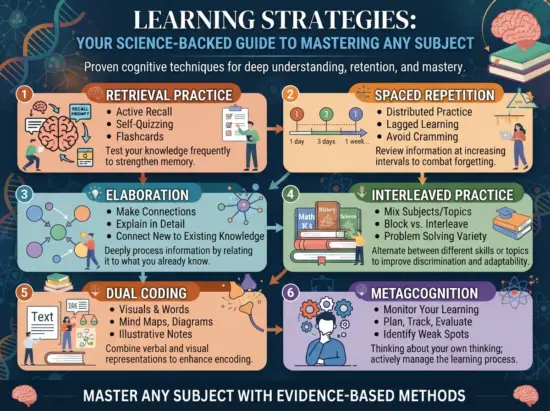
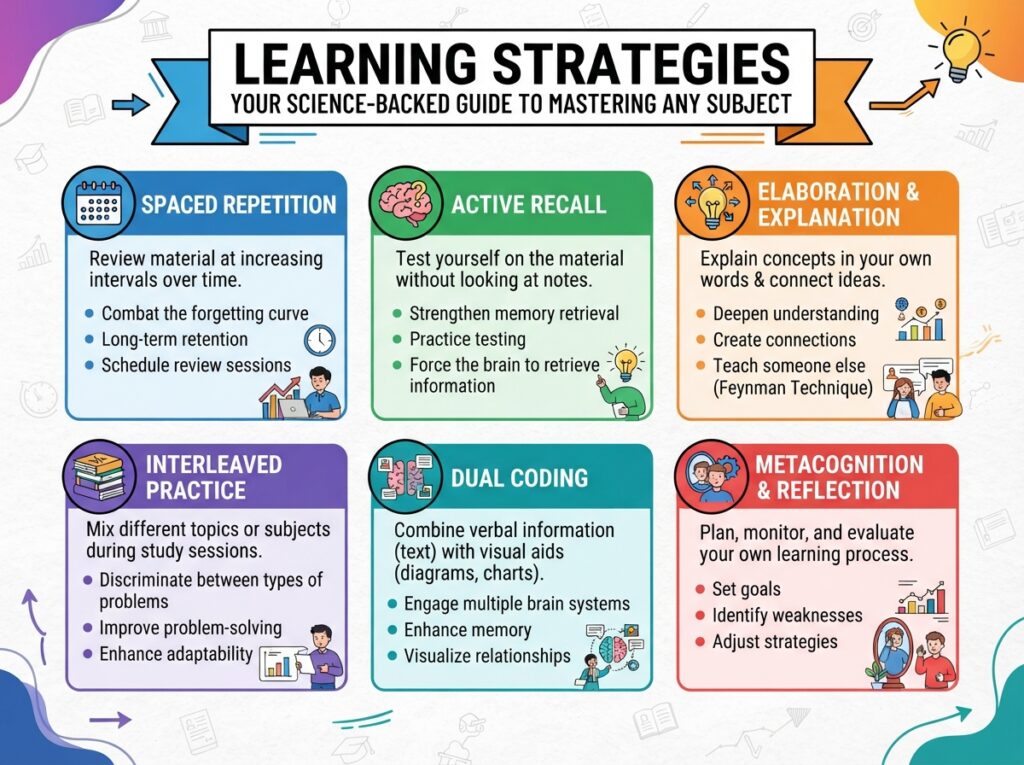
1. Retrieval Practice: Pull Information Out, Don’t Just Put It In
Instead of passively rereading your notes, actively test your memory . When you try to recall information from memory, you strengthen the neural pathways associated with that knowledge. This is why quizzing yourself is far more effective than re-reading.
How to use it:
- Close your book and write down everything you remember about a topic
- Use flashcards to test yourself, not just flip through them
- Take practice tests or answer past exam questions without referring to notes
- The “blurting” method: read a topic, close the book, and write down everything you remember—then check what you missed and repeat
2. Spaced Practice: Spread Out Your Learning
Spacing out your study sessions over time leads to better retention than cramming everything into one marathon session . Your brain needs time to consolidate memories, and returning to material after a gap forces your brain to work harder to retrieve it—strengthening the memory.
How to use it:
- Revisit topics at strategic intervals (e.g., after 1 day, 3 days, 1 week, 2 weeks)
- Don’t study one subject for hours—switch between subjects in shorter blocks
- Review class notes shortly after taking them, and again before the next class
3. Interleaving: Mix Up Related Topics
Mixing different but related topics or problem types helps you make connections and apply knowledge more flexibly . For example, when practising math, mix up addition, subtraction, multiplication, and division problems rather than doing all of one type at once .
4. The Feynman Technique: Teach to Learn
The Feynman Technique involves explaining a concept in simple terms as if you were teaching it to someone else . If you can’t explain it clearly, you haven’t truly understood it.
How to use it:
- Learn a topic, then explain it out loud (to yourself, a friend, or record yourself)
- Identify gaps in your explanation—these are gaps in your understanding
- Go back to the material and fill those gaps
- Repeat until you can explain the concept simply and clearly
5. Elaborative Interrogation: Ask “Why?”
As you read, ask yourself “why” questions about the material—why is this concept true? Why does this relate to that? . This technique forces you to make connections and build a deeper understanding rather than just memorising facts.
How to use it:
- When you encounter a fact or statement, ask “Why is this like it is?”
- Write down your answer, then check it against your notes
- This works best for factual data and conceptual understanding
6. Concept Mapping and Visual Organisation
Concept maps are visualisations of knowledge organised by the relationships between topics . At its core, a concept map consists of concepts connected by lines labelled with the relationship between them. This helps you see the big picture and how ideas fit together.
7. Self-Explanation and Summarising
Explain what you’ve learned in your own words—create explanations for what you’re studying and understand how each piece relates to the larger picture . This activates deeper cognitive processing than simply re-reading or copying notes.
Learning Strategies by Subject and Learning Style
Different subjects benefit from different approaches.
For theory-heavy subjects (history, literature, social sciences):
- Use spaced repetition to revisit key concepts over time
- Create timelines or storyboards for historical events
- Summarise key events and characters to solidify understanding
For math and science:
- Work through varied practice problems (interleaving)
- Break complex problems into smaller steps
- Explain concepts out loud (Feynman Technique)
- Use flowcharts to illustrate relationships between concepts
For language learning:
- Practise speaking and listening through conversations
- Use acronyms to remember vocabulary lists
- Label objects in your home with the new words
- Watch movies or listen to music in the target language
By learning style:
- Visual learners: Use diagrams, charts, mind maps, and colour-coded notes
- Auditory learners: Record lectures, create audio summaries, study in groups
- Kinesthetic learners: Use hands-on activities, physical objects to represent concepts, take short movement breaks
- Reading/writing learners: Take detailed notes, rewrite material in your own words, write practice essays
Metacognition: The Key to Self-Directed Learning
Metacognition—thinking about your own thinking—is one of the most powerful learning strategies . It enables you to become aware of what you need to do to initiate and persist in tasks, evaluate your learning strategies, and invest the mental effort needed to succeed .
Metacognitive practices include:
- Preparing and planning for learning: Before you start, set clear goals and choose your approach
- Selecting and using strategies: Make conscious decisions about which methods to use
- Monitoring learning: Check in with yourself—do you actually understand this?
- Evaluating learning: After studying, assess what worked and what didn’t
A simple metacognitive habit: at the end of each study session, ask yourself: “What do I understand well? What is still unclear? What will I do differently next time?”