Table of Contents
Welcome to HabitHack.fun, your trusted resource for building habits that unlock your full potential. Exam preparation can feel overwhelming, but the difference between success and struggle often comes down to one thing: habits. As Benjamin Franklin famously said, “By failing to prepare, you are preparing to fail” . This guide combines insights from academic experts and cognitive science to help you build exam preparation habits that work.
The Foundation: Why Habits Matter for Exam Success
Many students assume exam failure means they are “bad at the subject.” In reality, most failures stem from how a student prepares . The most common pitfalls include procrastination, lack of a study plan, passive study habits (like simply re-reading notes), underestimating the workload, and avoiding weak areas . These habits create a cycle: weak preparation leads to low scores, which undermines confidence, making students even less likely to prepare properly next time .
Preparation for an exam is not glamorous. It’s easy to find other things to do that are more interesting and fun. As one university guide puts it: “Students wanting to be successful have to have the self-discipline to schedule time to study well in advance of the exam” .
Core Exam Preparation Habits
1. Start Early and Plan Strategically
The most important habit is starting earlier than you think you need to . Cramming the night before leads to shallow understanding and heightened stress . Your brain needs time to process and retain information.
How to build this habit:
- Create a study plan: As soon as you find out your test date, break down your syllabus into manageable sections. Prioritize topics based on difficulty and importance .
- Use time-blocking: Allocate specific times for each subject or topic. For example, dedicate one hour to one subject and another hour to a different topic .
- Set daily goals: Keep them realistic so you feel a sense of achievement at the end of each day .
- Download a revision planner: Use digital tools or printable planners to map out your study schedule .
2. Use Active Learning, Not Passive Reading
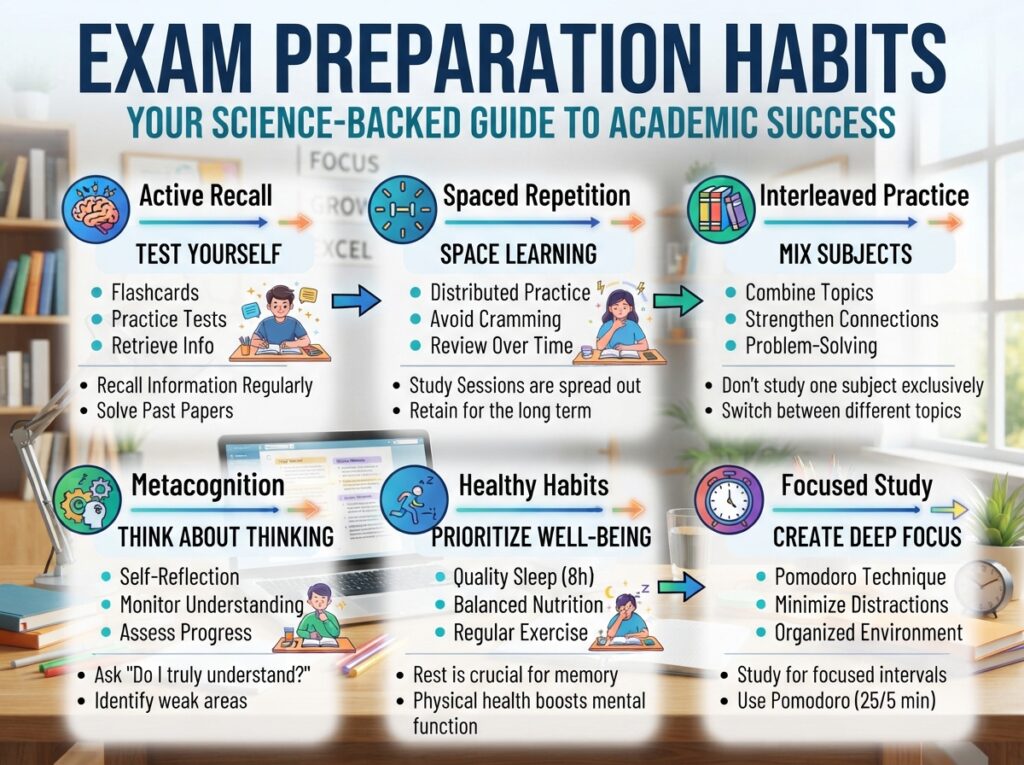
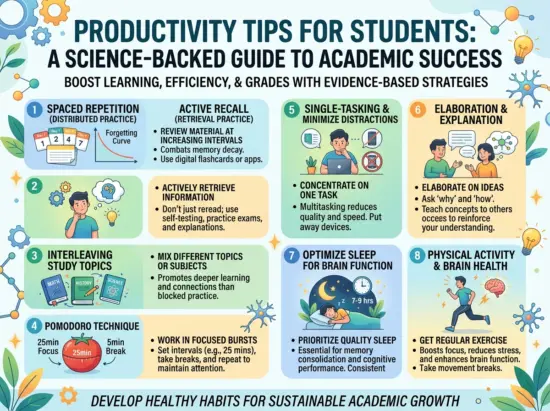
One of the biggest mistakes students make is confusing activity with productivity. Reading and highlighting feels productive but does little for long-term memory. Without active practice, information is quickly forgotten . Passive studying relies on familiarity rather than understanding, creating an illusion of mastery .
Effective active learning techniques :
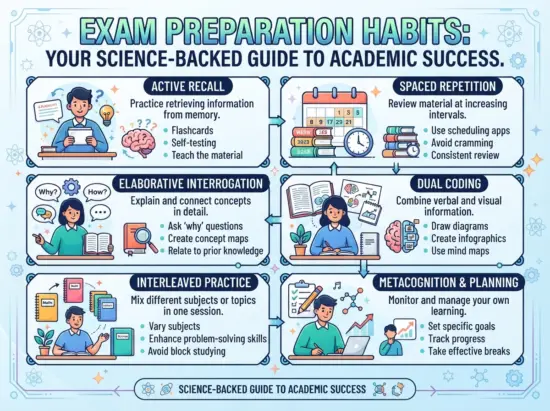
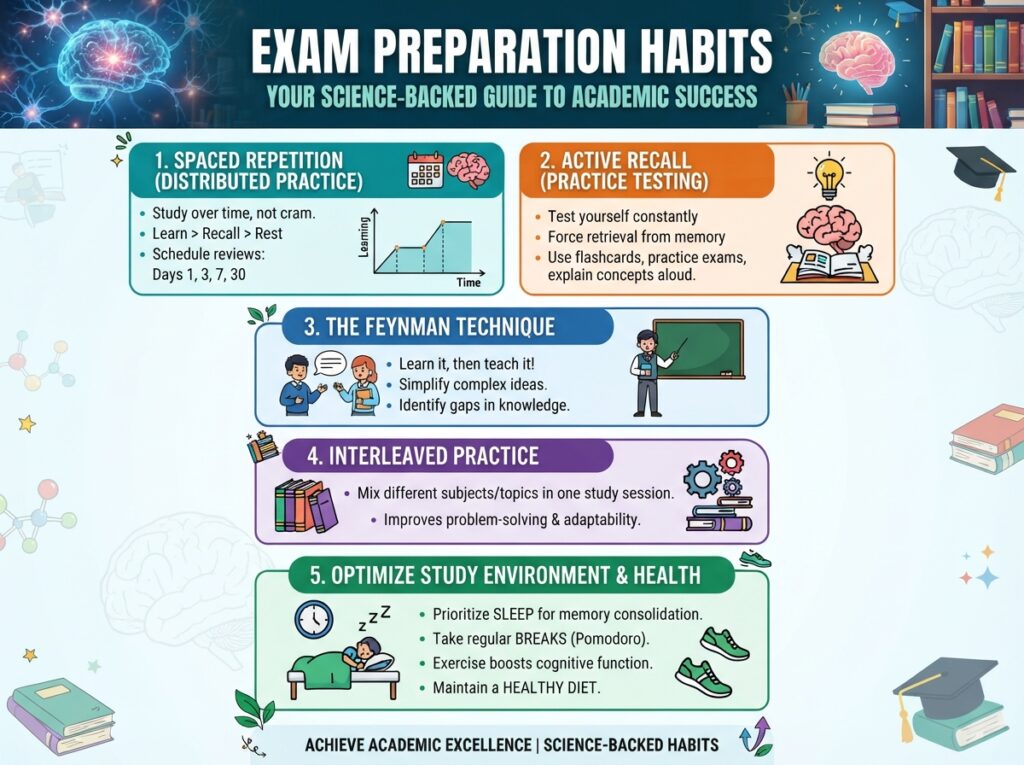
- Active recall: After reviewing a concept, close your book and try to write it out or say it out loud from memory. The effort of retrieving information strengthens memory pathways.
- Flashcards: Use apps like Anki or Quizlet. Put the question on one side and the answer on the back. Break complex concepts into smaller, digestible parts .
- Teach someone else: If you can explain a concept to someone else in simple terms, you probably understand it. Teaching is one of the fastest ways to spot gaps in your understanding .
- Practice problems: Work through practice problems or past exam papers . The more you practice pulling information from your brain, the more likely you are to remember it during the test .
3. Practice Under Exam Conditions
Dr Kevan Jones, an Academic Skills Advisor, explains that “exams are testing more than just what you know, but also the way you think” . Your exam preparation should be more than just learning the content.
How to build this habit:
- Find past exams: Past exams are available for some courses. Use them to guide your study and test whether you’ve been learning effectively .
- Simulate exam conditions: Set a timer and complete practice papers without distractions . This gets you used to the time limit and helps you understand how much time to allocate to different questions .
- Analyze mistakes: After practicing, review your mistakes and focus on improving weak areas . Log mistakes by concept and error type—calculation errors, conceptual errors, formula misapplication, or misreading the question .
- Repeat until mastery: For problem-solving courses, rework missed questions until you consistently get them right. Take additional full-length tests until you achieve a perfect score .
4. Take Care of Your Body and Mind
Your physical health directly impacts your academic performance. As one university guide emphasizes, “preparation is key, but so is self-care” .
Essential habits :
- Get enough sleep: Aim for 7-9 hours of sleep to improve memory retention and focus .
- Eat well: Opt for brain-boosting foods like nuts, fruits, and leafy greens. Avoid too much caffeine or junk food .
- Stay hydrated: Drink plenty of water throughout the day to keep your brain functioning optimally .
- Take purposeful breaks: Use the Pomodoro Technique—25 minutes of focused study followed by a 5-minute break .
- Manage stress: Practice deep breathing, meditation, or mindfulness . Even five minutes can help relieve anxiety.
5. Avoid Procrastination
Procrastination is one of the biggest obstacles students face . It often stems from fear of failure, lack of motivation, feeling overwhelmed, or distractions .
How to overcome it :
- Break tasks into smaller chunks: Instead of “I will study the entire syllabus,” say “I will revise Newton’s laws from 3:00 PM to 4:00 PM, then solve 10 related questions.”
- Set clear goals: Use SMART goals—Specific, Measurable, Achievable, Relevant, Time-bound.
- Eliminate distractions: Put your phone on airplane mode or in another room. Use website blockers like Forest or Freedom.
- Use the 5-Minute Rule: If you don’t feel like studying, tell yourself you’ll study for just 5 minutes. Starting is often the hardest part.
- Find an accountability partner: A study buddy or online study group helps you stay committed.
6. Know Your Exam Format and Strategize
Preparation is more than knowing the content—it’s knowing how to approach the exam itself.
Key strategies :
- Ask questions in advance: Find out as much about the exam as you can—number of questions, format, time allowed, what will be covered, and how it will be scored .
- Use perusal time effectively: Scan the whole paper, plan your time, prioritize questions, and mentally outline essay answers .
- Show your workings: In calculations, always show your working out. Even if the final answer is wrong, you can still be awarded method marks .
- Understand command words: If a question says “explain,” you must say what happens AND why. If it says “state,” you can just say what happens .
How Long Until These Habits Stick?
Building any new habit takes time, and exam preparation habits are no different. The key is consistency. Even small, intentional changes—like starting your revision a week earlier or using active recall instead of passive reading—can make a significant difference in your performance.
As Dr Jones reminds us: “There’s always benefit to study, no matter how late you start or how small the task might seem” .