Table of Contents
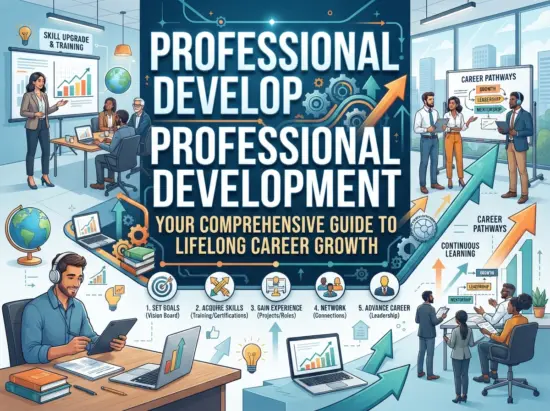
Welcome to HabitHack.fun, your trusted resource for mastering the art of habit formation and personal growth. In today’s rapidly evolving workplace, professional development is no longer optional—it is essential for career sustainability and success. As one expert puts it, “We are in an era of ‘what got you here, won’t get you there'” . This comprehensive guide explores what professional development truly means, why it matters, and provides actionable strategies to help you grow throughout your career.
What Is Professional Development?
Professional development is the ongoing process through which individuals maintain, enhance, and extend their professional knowledge, skills, and competencies throughout their working lives . It goes far beyond listing skills on a resume—it is about continuously learning, adopting a curious mindset, and approaching situations as opportunities to practice your abilities and achieve better outcomes .
Professional development encompasses several key areas:
- Soft skills development: Communication, teamwork, leadership, and emotional intelligence that help you work effectively with others
- Certification programs and courses: Formal learning that provides new knowledge and proof of your skills
- Coaching and mentoring: One-on-one guidance to help you grow and navigate your career
- Self-directed learning: Taking control of your own development through online courses, reading, and practical experience
Why Professional Development Matters

For Individuals
When you prioritize professional development, you are not just doing better at your job—you are empowering yourself to grow, learn, and feel more engaged. Professional development helps you achieve career goals, strengthen key soft skills, boost motivation and job satisfaction, and gain the confidence that comes with learning new skills .
Lifelong learning also sends an important signal to employers. As Dan Whitehead, Founder and Career Coach at City Career LAB, explains: “Those are the individuals that firms will feel can adapt to whatever’s coming down the road in five or ten years’ time, and they can redeploy those people as needed” .
For Organizations
Companies that prioritize employee development generate significantly better business outcomes. Gallup data reveals that organizations investing in employee development are 11% more profitable than their competitors and retain talent at twice the rate of companies that do not invest in development . Supporting employee development also builds a more skilled and flexible workforce, helps teams stay ahead of industry changes, and creates a culture of continual learning that keeps employees engaged .
Core Professional Development Strategies
1. Audit Your Skills and Identify Gaps
Before you can grow, you need to understand where you stand. Start by listing the skills you practice every day, month, and quarter. Use sources like your resume, LinkedIn, performance reviews, and feedback from colleagues to identify your key strengths and areas needing improvement .
Compare your skills list to job postings for roles you aspire to, and read up on market trends from organizations like the World Economic Forum and LinkedIn to understand what employers are looking for . A skill gap is the discrepancy between the skills you have and the skills you need to reach a goal—identifying these gaps gives you the opportunity to correct them before they derail your development .
2. Set SMART Goals for Professional Growth
A professional development plan should be built on SMART goals: Specific, Measurable, Attainable, Relevant, and Time-bound . A vague goal like “learn how to code” is not effective because it’s not specific, measurable, or time-bound. A better goal is: “Obtain the PCEP — Certified Entry-Level Python Programmer credential by Dec. 31, 2026” .
Once you identify your goals, break each one into a series of objectives—small actions designed to help you reach your goal. For example, if you want to pass a certification exam, your objectives might include completing practice questions every night, finishing an online study course weeks before the exam, and publishing examples of your work .
3. Embrace Structured Learning and Formal Certification
While casual learning has its place, a structured approach allows you to practice specific skills diligently rather than approaching a subject casually . As Jim Pyke, CFA, Managing Director at TCB Advisors, explains: “Using a sports analogy, you could learn to play soccer by joining a game where most of your time is spent running around and you don’t have the ball, or you could do specific, targeted drills, with very focused training. If you are not doing deliberate practice to get better, your development is going to be slow” .
The logical extension of a structured approach is to seek relevant certification. Certifications provide knowledge that has been verified and published by experts, and they demonstrate your value to others in a way that is independently validated . The discipline of structured learning that leads to a defined qualification acts as a powerful incentivizing force and helps you stay on track .
4. Find a Mentor and Build Your Network
Having a mentor can be an invaluable way to enhance your skill set . A mentor can provide real-world advice, access to resources, industry connections, and feedback . As one expert notes, “It can take time to find the right mentor and the process requires time commitment from both sides, as well as clear alignment on expectations from the outset” .
If you’re unsure how to approach a potential mentor, consider asking for advice on a specific question rather than asking someone to be a mentor. This strategy enables you to start building a relationship naturally .
Building your professional network is equally important. By connecting with others at industry events, participating in professional communities online, and joining alumni networks, you can stay up-to-date on emerging trends, uncover new opportunities, and meet important people in your industry . Professional networking has evolved to encompass sophisticated relationship building strategies that create mutual value and sustained professional connections .
5. Learn on the Job and Embrace Diverse Experiences
Your skills are best honed when they are practiced. Corporate training programs, job rotations, secondments, and internal upskilling initiatives are valuable ways to pick up new skills or dive deeper into a particular skill area .
As Berry Schrijen, CFA, Group Chief Financial Officer at Alliance Nutrition Group, explains: “Upskilling lets you work smarter, not harder, and that efficiency gives you back hours to focus on what really matters — strategy, people, and ideas” . The discipline of making time to study can also result in long-term advantages, such as becoming more comfortable with delegation and identifying redundancy in your job .
6. Build Learning into Your Daily Routine
Busy professionals can be time-poor, and this can become an excuse for dismissing the idea of incorporating learning into your life. The secret to success is to keep learning manageable .
Key strategies include:
- Use micro-learning: Listen to podcasts on your commute, while walking your dog, or during other routine activities
- Identify “leaking time”: Look for pockets of time you might otherwise fritter away, such as airplane time or waiting periods
- Prioritize ruthlessly: Focus on the parts that are most relevant and critical first
- Create a schedule: Treat learning like any other important appointment—if you schedule it, you will make time for it
The Role of Career Management Skills
Beyond technical skills, effective career management requires a range of capabilities that help you navigate workplace challenges and pursue meaningful career objectives . These include:
- Strategic career planning: Understanding yourself, analyzing market trends, and developing scenario plans for different possible futures
- Networking and relationship building: Building authentic professional relationships that create mutual value and sustained connections
- Communication and leadership: Executive communication, cross-cultural capabilities, conflict resolution, and influence skills
- Transition planning: Preparing systematically for career changes while maintaining current performance