Table of Contents
Welcome to HabitHack.fun, your trusted resource for building habits that unlock your full potential. As a student, you’re juggling lectures, assignments, exams, and often work or family commitments. The key to success isn’t working harder—it’s working smarter. Productivity is a skill you can learn, and once you master the right strategies, you’ll study more effectively, stress less, and actually enjoy your free time without guilt . This guide provides proven, science-backed productivity tips to help you thrive in your academic journey.
The Foundation: Why Productivity Matters for Students
Productivity isn’t about working yourself into the ground. It’s about getting better results with less stress . When you’re productive, you absorb information more effectively, feel more in control of your workload, and create proper free time for the things you enjoy . Research suggests that by setting clear goals and using proven techniques, you’ll enjoy greater goal attainment and feel more satisfied when you achieve them .
Top Productivity Tips for Students
1. Set SMART Goals for Your Study Sessions
Vague goals lead to vague results. “Study biology” isn’t a plan—it’s a wish. SMART goals are:
- Specific: Exactly what you’ll do
- Measurable: You’ll know when you’ve finished
- Achievable: Realistic for one session
- Relevant: Actually helps with your exams
- Time-bound: Has a deadline
Example: Instead of “revise maths,” try “Complete 10 practice questions on quadratic equations by 5pm” .
2. Use a Study Schedule or Weekly Planner
Your brain can’t hold everything, so write things down. A weekly planner shows you exactly what you need to do and when, stopping you from wasting energy trying to remember tasks or decide what to work on .
Try this: Sunday evening, plan your week. Assign subjects to specific days and times, and include breaks and free time too. Apps like Google Calendar, Notion, or a simple paper planner work brilliantly—pick whatever you’ll actually use .
3. Break Tasks Into Manageable Chunks

Large projects can feel overwhelming. Break them down into smaller, manageable steps . Instead of “write history essay,” try:
- Research three sources (20 minutes)
- Create essay plan (15 minutes)
- Write introduction (20 minutes)
- Write first paragraph (20 minutes)
Suddenly, that overwhelming essay becomes a series of simple steps, and each small win builds momentum . This technique, called “chunking,” is one of the most effective ways to beat procrastination .
4. Try the Pomodoro Technique
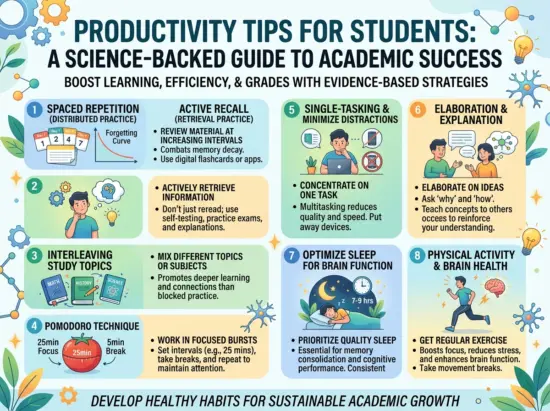
Work for 25 minutes with complete focus, then take a 5-minute break. After four “Pomodoros,” take a longer 15-30 minute break . This technique works because it matches your brain’s natural attention span and prevents mental fatigue. Those short breaks aren’t slacking off—they’re essential for maintaining concentration as your brain needs recovery time to process information .
5. Eliminate Distractions (Especially Your Phone)
Your phone is designed to grab your attention. Every notification is a potential distraction . Stephen King, in his memoir On Writing, advises: “If possible, there should be no telephone in your writing room… For any writer, but for the beginning writer in particular, it is wise to eliminate every possible distraction” .
What works:
- Put your phone in another room whilst studying
- Use app blockers like Freedom to manage screen time
- Turn off all notifications during study time
- Use website blockers for social media on your computer
6. Create the Right Study Environment
Your environment shapes your productivity more than you think . Your study space should be:
- Quiet: Loud noises are distracting
- Well-lit: Natural light is best
- Organised: Clear desk, materials ready
- Comfortable but not too cosy: Not your bed
Libraries and dedicated study spaces work well because your brain associates them with work. Your bedroom often signals relaxation, which can make focus harder .
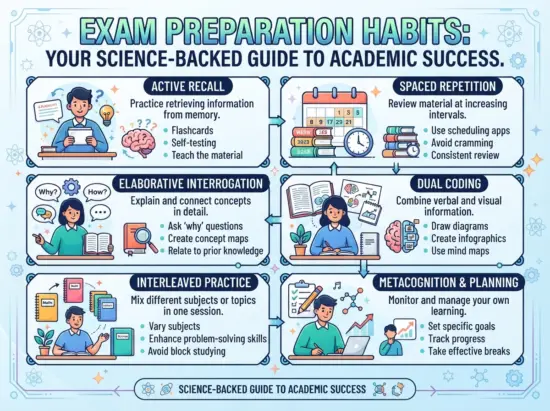
7. Use Active Recall and Spaced Repetition
Information sticks when you actively retrieve it rather than just reading your notes . Instead of passively re-reading, try:
- Active Recall: Test yourself with flashcards or practice questions
- Spaced Repetition: Review information at increasing intervals (1 day → 3 days → 7 days → etc.) using tools like Anki
The goal is to strengthen memory retrieval and combat forgetting .
8. Prioritize Your Responsibilities
Not all tasks are created equal. Use the Eisenhower Matrix to categorize tasks into four quadrants: urgent and important, important but not urgent, urgent but not important, and neither . Start each day with a list of the top 3-5 most important things to focus on .
9. Take Meaningful Breaks
Think of breaks as essential parts of the learning process, not rewards for working hard . Harvard Business Review research suggests meaningful breaks produce physiological and psychological benefits, reducing stress, recharging energy, and restoring perspective .
Make breaks intentional:
- Set a timer so they don’t stretch too long
- Move your body (walk, stretch, quick exercise)
- Get away from your desk
- Practice a short meditation break to rest your mind
10. Stay Hydrated, Eat Well, and Get Enough Sleep
This sounds basic, but it’s non-negotiable. Dehydration of just 2% can impair concentration and cognitive performance . Keep water at your desk and actually drink it. Aim for 8-10 hours of sleep—a well-rested mind learns and retains information better .
11. Don’t Multitask
Research suggests that when people attempt to multitask, they take longer to complete their work and make more errors . Instead of trying to juggle multiple tasks simultaneously, focus on one task at a time . This allows you to concentrate better and complete tasks more efficiently.
12. Start Long-Term Assignments Early
That end-of-semester assignment might seem a lifetime away in September, but time moves quickly . Starting academic tasks earlier than you think necessary gives you plenty of time to complete, review, and refine them, allowing you to submit high-quality work with less stress .