Table of Contents
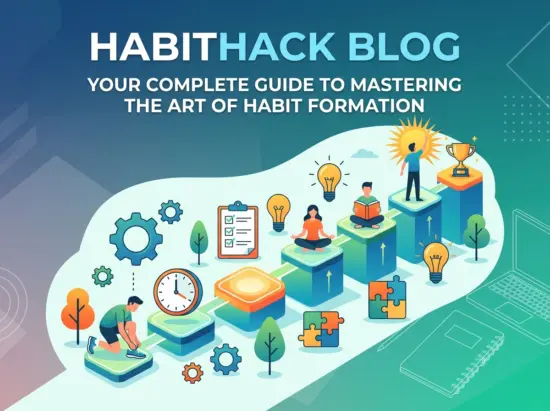
Welcome to HabitHack.fun, your trusted resource for mastering the art of habit formation. Starting a new habit is easy—the real challenge is staying consistent. Research shows that over 80% of people who set New Year’s resolutions abandon them by February . But consistency isn’t about willpower alone. It’s about building systems that work with your brain, not against it. This guide provides science-backed strategies to help you stay consistent with your habits for the long haul.
Why Consistency Is the Key to Habit Success
Consistency is the bridge between intentions and results. Without consistency, even the best intentions fail to produce lasting change. As James Clear writes in Atomic Habits, “You do not rise to the level of your goals. You fall to the level of your systems” .
When you perform a behavior consistently, you strengthen the neural pathways associated with that behavior. Over time, the behavior becomes automatic—requiring less mental effort and willpower. This is why consistency, not intensity, is the secret to lasting change.
Why We Struggle with Consistency
The Motivation Myth
One of the biggest misconceptions about consistency is that you need to feel motivated to take action. But motivation is an emotion—it’s fleeting and unreliable. Relying on motivation to stay consistent guarantees inconsistency because motivation inevitably ebbs and flows .
The All-or-Nothing Trap
Many people believe that if they can’t do a habit perfectly, they shouldn’t do it at all. This all-or-nothing thinking leads to giving up entirely after one missed day . But consistency isn’t about perfection—it’s about showing up regularly, even when you don’t feel like it.
The Habit Formation Timeline
Habit formation takes longer than most people expect. It takes an average of 66 days to form a new habit, with a range of 18 to 254 days depending on the person and the behavior . Understanding this timeline helps you stay patient when progress feels slow.
Core Strategies to Stay Consistent
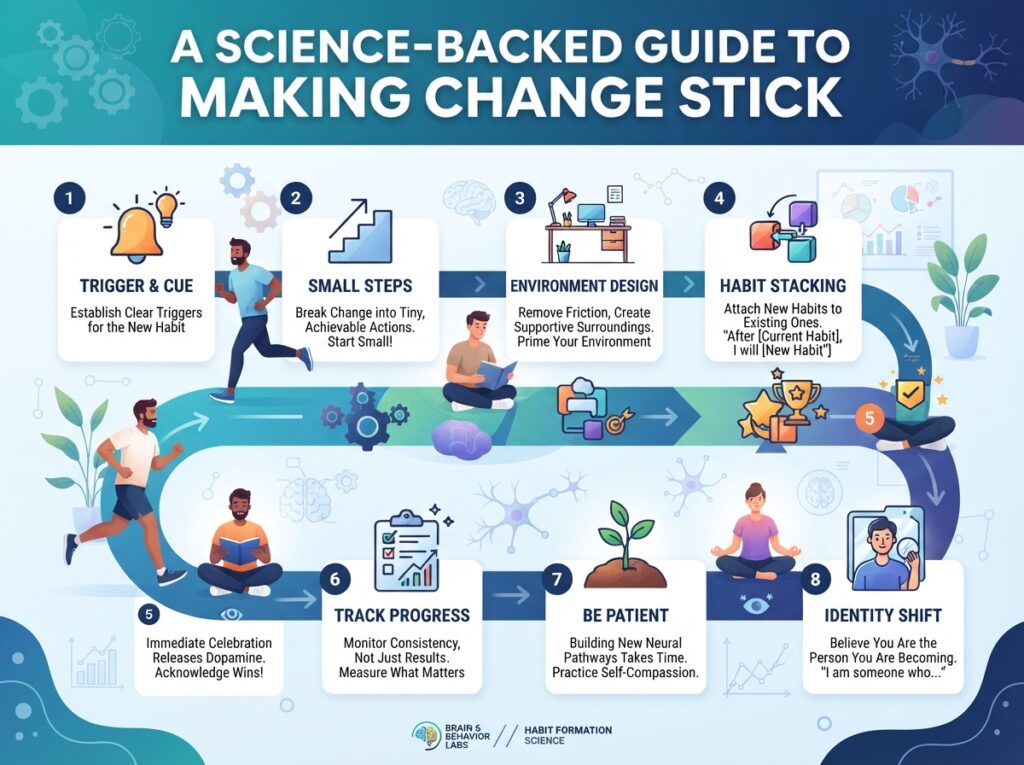
1. Start Small and Scale Gradually
One of the most effective ways to stay consistent is to start so small that you can’t fail . This approach, known as the Two-Minute Rule, makes habits so easy that skipping them feels harder than doing them.
Examples:
- “Read before bed” becomes “Read one page”
- “Exercise” becomes “Put on my workout clothes”
- “Meditate” becomes “Take three deep breaths”
By starting tiny, you build the habit of showing up. Once the habit is established, you can gradually increase the intensity.
2. Use Habit Stacking
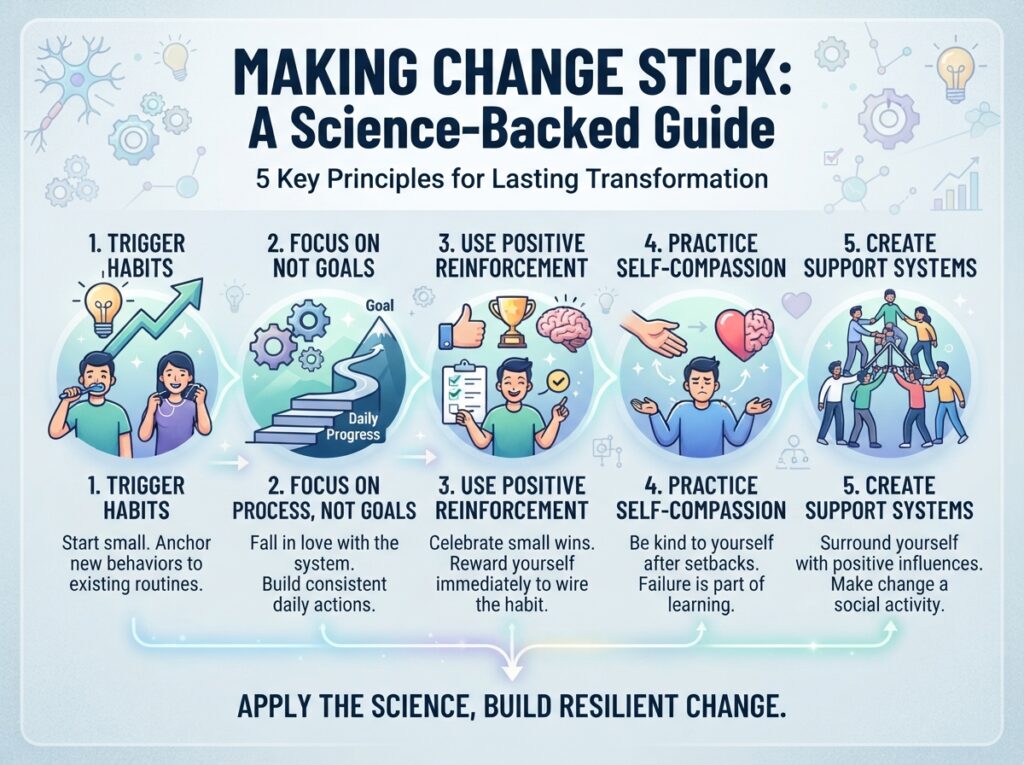
Habit stacking is a powerful technique that makes consistency easier by piggybacking new habits on existing ones . The formula is simple:
After [CURRENT HABIT], I will [NEW HABIT]
Examples:
- “After I pour my morning coffee, I will write down my top priority”
- “After I brush my teeth, I will do 10 squats”
- “After I sit down at my desk, I will review my goals”
By anchoring new habits to existing routines, you eliminate the need to remember to do them.
3. Track Your Progress
Tracking your habits provides visual evidence of your consistency . Each day you mark off your habit, you release a small dose of dopamine—the reward chemical that makes you want to keep going .
Tracking methods:
- Use a habit-tracking app like Streaks or Loop
- Mark an X on a calendar for each successful day
- Keep a simple checklist in a journal
The “don’t break the chain” method, popularized by comedian Jerry Seinfeld, is a simple but effective way to stay consistent.
4. Focus on Identity, Not Outcomes
Instead of focusing on what you want to achieve, focus on who you want to become . Identity-based habits are more sustainable because they align with your self-concept.
Examples:
- Instead of “I want to run a marathon,” think “I am a runner”
- Instead of “I want to write a book,” think “I am a writer”
- Instead of “I want to eat healthier,” think “I am someone who nourishes their body”
When you believe you are the type of person who does a behavior, consistency follows naturally .
5. Design Your Environment for Consistency
Your environment has a powerful influence on your behavior . Make good habits easy and bad habits difficult by designing your surroundings:
- For good habits: Place your workout clothes next to your bed. Keep a water bottle on your desk. Put healthy snacks at eye level.
- For bad habits: Hide your phone in another room. Move junk food to the back of the cupboard. Uninstall distracting apps.
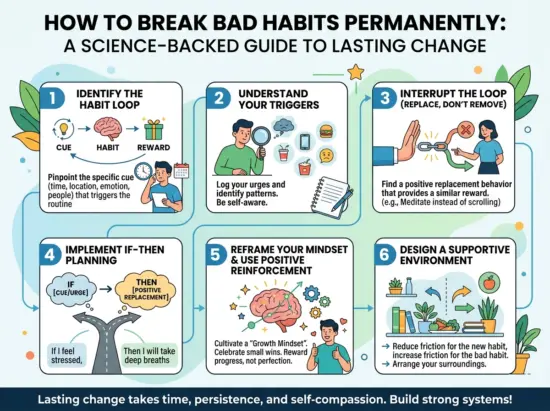
6. Use If-Then Planning
If-then planning prepares you for obstacles before they arise . The formula is simple:
If [OBSTACLE], then I will [ACTION]
Examples:
- “If I feel too tired to exercise, I will do a 5-minute walk”
- “If I’m tempted to check my phone during work, I will put it in the other room”
- “If I miss a day of my habit, I will get right back on track the next day”
7. Find an Accountability Partner
Accountability partners provide external motivation and support . When you know someone else is expecting you to show up, you’re more likely to follow through.
How to use accountability:
- Tell a friend about your habit goal and ask them to check in
- Join a group with similar goals
- Post your progress on social media
- Hire a coach or join a program
8. Build in Rewards
Positive reinforcement is a powerful way to stay consistent . Reward yourself for maintaining your habit—especially in the early stages when the behavior isn’t yet automatic.
Examples:
- After a week of consistent workouts, treat yourself to a massage
- After a month of daily writing, buy a new notebook
- After a streak of 30 days, take yourself out to dinner
9. Practice Self-Compassion
The “never miss twice” rule is a powerful mindset shift . When you miss a day, simply start again the next day. As long as you don’t let one missed day become two, you’re still on track.
Self-compassion tips:
- Forgive yourself for slip-ups
- Focus on getting back on track quickly
- Remind yourself that perfection isn’t the goal
- Reflect on what caused the slip and adjust your approach
10. Understand Your “Why”
Connecting your habit to a deeper purpose makes it easier to stay consistent . When you know why you’re doing something, you’re more likely to persist through challenges.
Ask yourself:
- Why is this habit important to me?
- Who will benefit from my consistency?
- What will my life look like if I stick with this habit?
11. Prepare for the Inevitable Dip
Between days 7 and 10, the excitement usually wears off . Whenever you feel like giving up, remind yourself that this is a part of the process. If needed, make your habit smaller for a while. Focus not on how you feel while you’re doing it, but on how you feel afterward .
12. Schedule “Catch-Up” Days
Life inevitably disrupts your routine. Instead of feeling defeated, schedule “catch-up” days where you can get back on track . This proactive approach helps you stay consistent even when life gets busy.
The Power of Systems Over Goals
Goals are about the results you want to achieve. Systems are about the processes that lead to those results . By focusing on your systems—the daily habits and routines that support your goals—you make consistency easier.
Examples:
- Instead of “I want to lose 10 pounds,” create a system of daily healthy eating and exercise
- Instead of “I want to write a book,” create a system of writing 500 words each day
- Instead of “I want to get a promotion,” create a system of building skills and networking