Table of Contents
Welcome to HabitHack.fun, your trusted resource for mastering habit formation and personal growth. A well-designed daily routine is one of the most powerful tools you can create for yourself. It reduces decision fatigue, lowers stress, boosts productivity, and provides a sense of structure and control in an unpredictable world. Research shows that people with structured routines experience lower levels of anxiety and depression compared to those who live without them . This comprehensive guide provides a step-by-step framework to help you create a daily routine that works for you.
Why a Daily Routine Matters
The Science Behind Routines

A routine is a set of behaviors performed regularly, often daily, that provide structure and predictability to your life. Routines act as a powerful “planned default”—when healthy behaviors are part of your routine, you make better choices without exhausting your willpower.
Key Benefits of a Routine:
- Reduced decision fatigue: Every decision consumes mental energy. A routine eliminates countless small choices, freeing cognitive resources for important decisions.
- Lower stress and anxiety: Routines provide a sense of security and control. A 2025 study found that regular sleepers with consistent bedtimes had a 38% lower risk of depression and a 33% lower risk of anxiety compared to irregular sleepers.
- Better physical health: When you schedule exercise, meals, and sleep into your routine, these healthy behaviors become automatic rather than optional.
- Increased productivity: A routine helps you work with your energy rhythms, not against them.
The Step-by-Step Process to Create Your Routine
Step 1: Assess Your Current Reality
Before you can design your ideal routine, you need to understand your current patterns. Take an honest look at how you actually spend your time.
How to do it:
- Track your time: For one week, write down everything you do in 30-minute increments. This reveals where your time actually goes versus where you think it goes.
- Identify your energy patterns: Notice when you feel most alert, focused, and energized—and when you experience slumps.
- List your non-negotiables: What activities are fixed in your day? Work hours, school drop-offs, meals, and exercise.
- Identify time-wasters: What activities consume time without adding value? Excessive social media, aimless scrolling, or unproductive meetings.
Step 2: Define Your Priorities
What do you want your routine to support? Before you can design a routine, you need to know what matters most to you.
How to do it:
- Define your top 3-5 life priorities: These could be health, family, career growth, fitness, or personal development.
- Set specific goals: What do you want to achieve in each area? Make them SMART—Specific, Measurable, Achievable, Relevant, and Time-bound.
- Identify your “keystone habits”: A keystone habit is a routine that, once established, triggers a cascade of other positive behaviors . Exercise is a classic example—it often leads to better eating, improved sleep, and reduced stress.
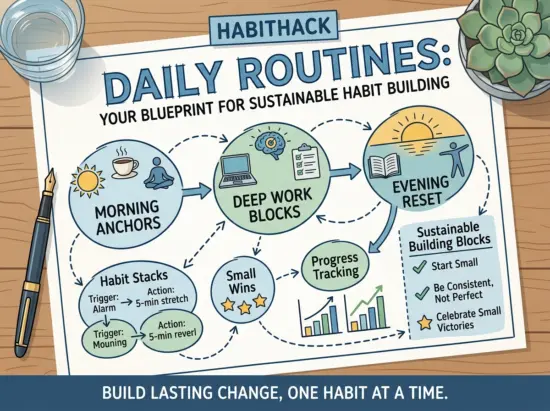
Step 3: Design Your Morning Routine
The first hour of your day sets the tone for everything that follows. A thoughtful morning routine transforms your entire day.
Key Elements of a Strong Morning Routine:
- Wake at a consistent time: A consistent wake time is more important than a consistent bedtime, as it reinforces your body’s sleep-wake cycle.
- Avoid your phone first thing: Many high achievers are “militant” about not checking their phones first thing—they want to know what they think before the world tells them what to think.
- Hydrate: Drink water immediately upon waking to rehydrate your body after a night-long break.
- Move your body: Even a 10-minute walk or gentle stretching boosts energy and mood.
- Set intentions: Take a few minutes to write down your top three priorities for the day.
- Practice mindfulness: A few minutes of meditation, deep breathing, or gratitude can set a positive tone.
Sample Morning Routine:
6:00 AM – Wake up, drink water
6:05 AM – 10 minutes of stretching or meditation
6:15 AM – 15 minutes of reading
6:30 AM – Plan the day, write top three priorities
6:45 AM – Breakfast
7:00 AM – Get ready for the day
Step 4: Design Your Work/Productivity Block
Your workday should be structured around your energy rhythms, not arbitrary hours.
Key Principles:
- Schedule high-cognitive work during peak energy times: For most people, this is in the morning. Protect these blocks for your most important work.
- Use time blocking: Assign specific tasks to specific time slots. Instead of a vague to-do list, schedule “9-11 AM: Project research” and “2-3 PM: Client follow-ups.”
- Batch similar tasks: Group emails, calls, and administrative work into single blocks to minimize context switching.
- Take breaks: The Pomodoro Technique (25 minutes work, 5 minutes break) can help maintain focus and prevent burnout.
Step 5: Design Your Evening Routine
Your evening routine is just as important as your morning one. It helps you decompress, reflect, and prepare for tomorrow.
Key Elements of a Strong Evening Routine:
- Reflect on the day: What went well? What could you improve? A nightly reflection session helps you learn from your day.
- Practice gratitude: Write down three things you’re grateful for. This shifts your focus from what you lack to what you have.
- Plan for tomorrow: Write down your top priorities for the next day. This allows you to start the next morning with clarity.
- Disconnect from screens: Aim for at least 30 minutes without screens before bed.
- Prepare your environment: Lay out clothes, pack your bag, and prepare for the next day to reduce morning friction.
Sample Evening Routine:
9:00 PM – Disconnect from screens
9:15 PM – Light stretching or reading
9:30 PM – Journal (reflection and gratitude)
9:45 PM – Prepare for tomorrow (plan, lay out clothes)
10:00 PM – Bedtime
Step 6: Start Small and Build
The biggest mistake in routine-building is trying to do too much at once . A routine should take shape gradually, one habit at a time.
How to build gradually:
- Add one new habit at a time
- Start with just two minutes (Two-Minute Rule)
- Link habits together using habit stacking: “After I [existing habit], I will [new habit]”
- Give it at least 30 days before adding more
Step 7: Build Flexibility into Your Routine
A rigid routine can become a source of stress when life inevitably interferes . Build flexibility into your routine and accept that some days will go differently than planned.
How to build flexibility:
- Include “buffer time” between tasks
- Don’t schedule every minute
- Accept that you’ll miss days
- Practice the “never miss twice” rule: if you miss one day, get right back on track
The 21/90 Rule
The 21/90 rule suggests a two-phase process: 21 days for initial habit development and 90 days for lifestyle integration .
Phase 1: The First 21 Days
During these 21 days, your brain is learning. Each time you repeat your chosen action, your brain remembers it better. The first weeks are often the hardest. You’ll need to remind yourself to do your new habit, and you might forget some days. This is completely normal.
Phase 2: Continuing to 90 Days
By day 90, your new habit will be normal and easy. You just do it—like how you don’t think about brushing your teeth in the morning. Your sense of self starts to change. You will no longer think “I’m trying to exercise more,” but “I am someone who exercises regularly.”