Table of Contents
Welcome to HabitHack.fun, your ultimate destination for mastering the art of habit formation. Success isn’t a matter of luck or talent alone—it’s the result of consistent, intentional actions practiced daily. The world’s most accomplished individuals, from billionaires to thought leaders, share common habits that set them apart. This comprehensive guide explores the science-backed good habits that can propel you toward your goals.
Understanding the Connection Between Habits and Success
The philosopher Will Durant captured this beautifully: “We are what we repeatedly do. Excellence, then, is not an act, but a habit” . Good habits shape our behaviors and improve the quality of our days, which stack up to become weeks, months, and years, affecting every aspect of our lives .
A JPMorgan report surveying over 100 billionaires with a collective net worth exceeding $500 billion identified seven key habits contributing to their success: reading, exercise, consistency, waking up early, prioritizing tasks, goal setting, and deep thinking time . One anonymous billionaire leader in the report noted: “The currency of life is time. It is not money. You think carefully about how you spend one dollar. You should think just as carefully how you spend one hour” .
Core Good Habits for Success
1. Read and Learn Continuously
Lifelong learning is arguably the most common habit among successful people. Bill Gates reads roughly 50 books a year, while Warren Buffett spends 80% of his day reading . Elon Musk, who is largely self-taught in rocket science, credits books for much of his knowledge .
Why it matters: Reading expands knowledge, enhances thinking, creativity, and decision-making. Buffett’s advice is ambitious but revealing: “I just read and read and read. I probably read five to six hours a day” .
How to build this habit:
- Read for at least 15 minutes daily
- Listen to educational podcasts during commutes
- Take online courses to develop new skills
- Use habit stacking: “After I finish lunch, I will read one chapter”
2. Move Your Body Daily
Exercise is a consistent habit among high achievers. It improves memory, prevents cognitive decline, enhances sleep, and boosts productivity . There is a direct connection between physical health, mental health, and wealth—becoming successful takes energy and stamina .
How to build this habit:
- Take a 10-15 minute walk daily
- Exercise for at least 20 minutes each day
- Start small with activities you genuinely enjoy
3. Wake Up Early and Protect Your Mornings
Waking up one hour earlier than usual gives you 30 extra full workdays per year to invest in yourself . Early risers tend to compact more work and productivity into their day. Many successful people, including Oprah Winfrey and Jeff Bezos, prioritize a structured morning routine .
How to build this habit:
- Gradually shift your wake-up time earlier
- Avoid your phone first thing in the morning—know what you think before the world tells you what to think
- Use morning time for quiet reflection, planning, or learning
4. Practice Consistency and Discipline

Success is created through consistency turned into repetition . Conscientiousness is the #1 personality trait predicting success—showing up, even when you don’t feel like it, builds trust in yourself and from others .
How to build this habit:
- Focus on doing one small thing consistently rather than many things sporadically
- Use the “never miss twice” rule—one missed day is a mistake; two is a pattern
- Build systems, not just goals
5. Set Clear Goals and Prioritize Effectively
Goal setting helps program your brain to filter in opportunities related to that outcome. The SMART framework ensures your goals are Specific, Measurable, Achievable, Relevant, and Time-bound .
How to build this habit:
- Write down your top three priorities each day
- Use the formula: “I will [BEHAVIOR] at [TIME] in [PLACE]”
- Focus on fewer things and do them better
6. Cultivate a Growth Mindset and Resilience
A growth mindset—the belief that abilities can be developed through effort—is foundational to success . Resilience, or grit, is the process of continuing to apply what you learn and setting it into practice even when faced with obstacles .
How to build this habit:
- View failures as learning experiences, not final verdicts
- Use the word “yet”: “I can’t do this yet”
- Celebrate effort, not just outcomes
- Give yourself grace when setbacks occur—acknowledge your effort, even when outcomes aren’t what you intended
7. Practice Deep Work and Protect Your Focus
Hyperfocus means working on high-leverage activities and ignoring the noise—it’s not about being busy but being ruthlessly effective . Successful people know when it’s time to zoom in and eliminate distractions .
How to build this habit:
- Set specific times to check email and social media
- Turn off notifications on your phone and computer
- Create “no meeting” zones in your calendar
- Use time blocking for deep work sessions
Proven Techniques for Building Success Habits
The 1% Improvement Rule
James Clear’s Atomic Habits explains how even minuscule, barely noticeable improvements can lead to dramatic outcomes in the long run . Improving by just 1% each day leads to remarkable results over time .
Habit Stacking
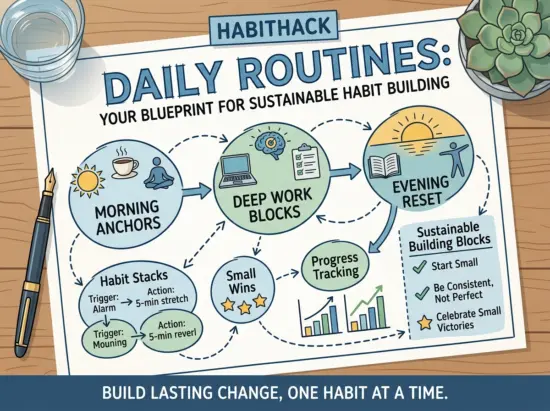
Habit stacking involves pairing a new habit with an existing one . The formula is simple: “After I [your existing habit], I will [new habit]” .
Examples:
- After I check my morning emails, I will write down three priorities for the day
- After I finish lunch, I will spend five minutes learning something new
- After I brush my teeth, I will do 10 squats
Keystone Habits
Keystone habits are healthy habits that automatically lead to multiple positive behaviors and effects in different areas . Common keystone habits include getting enough sleep and regular exercise . These “small, strategically placed practices give us large returns because they stabilize the nervous system, strengthen self-trust and increase behavioral consistency” .
The 10-Minute Non-Negotiable
A daily micro-ritual you commit to that, due to its simplicity and size, overrides all internal resistance . This could be a short walk, half a page of journaling, mindful breathing, or reading 10 pages a day . This ritual builds personal accountability and shapes your identity