Table of Contents
Welcome to HabitHack.fun, your ultimate destination for mastering the art of habit formation. We all have habits we wish we could break. Whether it’s doomscrolling, procrastinating, or reaching for unhealthy snacks, these behaviors can quietly drain our energy, productivity, and overall well-being. This comprehensive guide explores the science behind bad habits, identifies the most common ones to quit, and provides proven strategies to replace them with healthier alternatives.
What Are Bad Habits and Why Are They So Hard to Break?
A bad habit is a routine that persists even when it’s harmful to your well-being . These behaviors can range from consciously engaging in procrastination despite its importance, to more subtle urges like constantly checking emails or social media when faced with challenging tasks .
The challenge of breaking bad habits is rooted in neuroscience. According to experts at UT Southwestern Medical Center, when an action is repeated, the myelin sheath—the insulating layer wrapped around neurons—allows signals to travel faster and more efficiently along established pathways . Over time, these behaviors rely less on conscious decision-making and become reflexive. As Dr. Collin Vas explains, “Specific brain regions – particularly the dorsolateral striatum – take over as behaviors become more automatic with practice” .
The Habit Loop
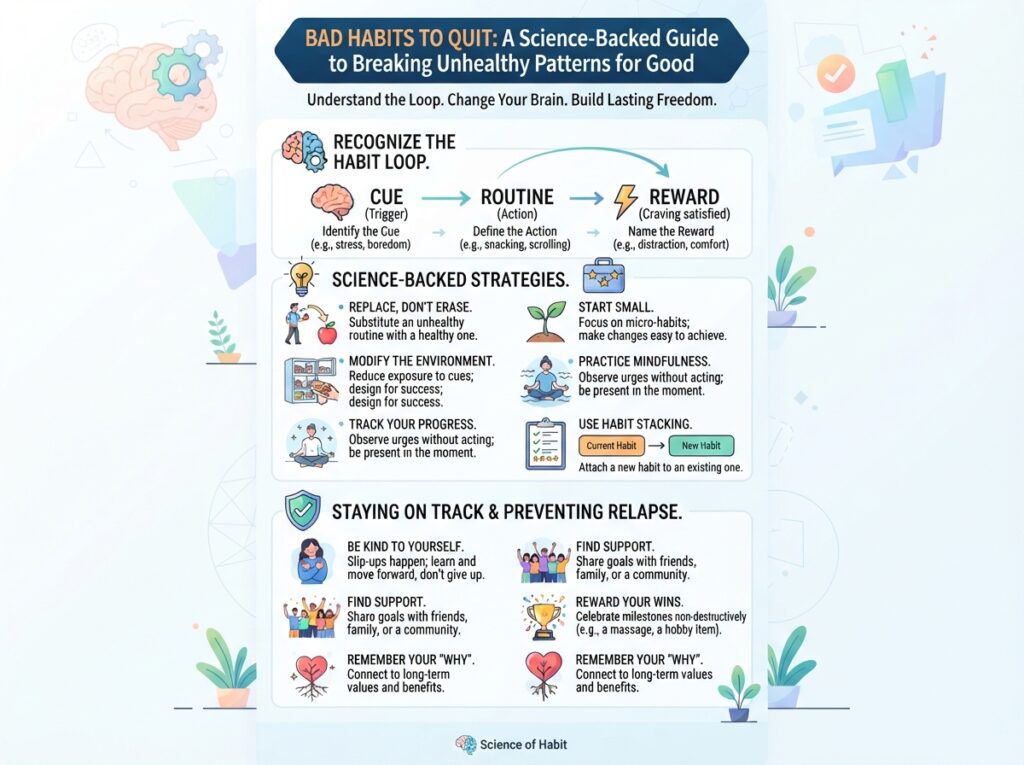
Every habit follows a three-part neurological pattern called the habit loop :
- Cue: A trigger that initiates the behavior—this can be external (like a time of day) or internal (like a feeling of stress or boredom)
- Routine: The specific behavior you perform in response to the cue
- Reward: The positive reinforcement or satisfaction that helps build the routine until it becomes a habit
When you repeat this loop, your brain releases dopamine, the “feel-good” chemical, creating a positive association between the behavior and your experience. Over time, more and more neurons fire to reinforce the habit until it becomes a memory—etched into your neural pathways . This explains why bad habits feel automatic and why willpower alone is often insufficient to break them.
Common Bad Habits to Quit
1. Smartphone Addiction and Doomscrolling
A 2025 study found that 41% of people feel they spend too much time on their devices . Checking apps, social media, or notifications constantly can significantly reduce productivity, heighten stress, and blur the lines between work and personal life . Many find themselves picking up the phone even when no one has messaged them, simply out of habit or nervousness .
2. Unhealthy Snacking and Poor Eating Habits
Poor eating habits—like grabbing fast food or snacking on unhealthy items throughout the day—can lead to energy crashes, decreased focus, and negative impacts on physical health . When we feel stressed, bored, or anxious, many of us turn to food for comfort. The problem is that these behaviors provide short-term relief but cause long-term problems .
3. Procrastination
Procrastination isn’t poor time management or laziness—it stems from a wish to avoid difficult feelings such as boredom, frustration, anxiety, or overwhelm . Chronic procrastinators often share perfectionism and an all-or-nothing mindset that creates a barrier to beginning a task . While putting off vital tasks might offer temporary relief, it results in rushed, often subpar work and amplified stress as deadlines approach .
4. Inconsistent Sleep Patterns
Insufficient sleep is a major contributor to poor health and productivity. A study published in Population Health Metrics found that insufficient sleep duration and poor sleep quality were associated with significant quality-adjusted life-year (QALY) losses . Regularly compromising on sleep quantity affects cognitive abilities, mood, and overall health . Dr. Heidi Allison Bender, a neuropsychologist at NewYork-Presbyterian, notes that habits are a way for the brain to increase efficiencies, but poor sleep patterns undermine this efficiency .
5. Physical Inactivity
Over 40% of people report poor physical activity levels . Lack of movement can lead to a host of health problems and lower energy levels. Personal trainer Nick Finney notes, “People put too much pressure on themselves to exercise. They think ‘I don’t have it in me today’ and cancel, but even 20 minutes of stretching is better than nothing. You don’t need to push yourself to the limit, you just need to keep coming” .
6. Nail Biting
Onychophagia, or chronic nail biting, affects 20-30% of people—with children and teenagers the most likely to suffer . This habit often serves as a coping mechanism for boredom or anxiety, and can even affect dental health .
7. Excessive Alcohol Consumption
Drinking too much can lead to health problems and diminished well-being. Rosamund Dean, author of Mindful Drinking, notes that “moderate drinking can actually be harder than abstinence because it requires more decisions” . Creating clear rules—like limiting drinking days per week—can help control consumption.
8. Vaping
The growing prevalence of vaping has created a new habit many want to break. Many people start vaping to stop smoking but find that vapes are just as hard—and in some cases harder—to give up .
9. Skipping Meals (Especially Breakfast)
Breakfast skipping is associated with significant health impacts. A study published in Population Health Metrics found breakfast-skipping was associated with a QALY loss of -2216.55 per 100,000 persons per year . This behavior can lead to energy dips and poor food choices later in the day.
10. Canceling Plans
Being a serial “bailer” can harm relationships and social connections. Psychotherapist Anna Mathur suggests that this behavior often stems from people-pleasing, FOMO, or social anxiety . Identifying the root cause is key to addressing it.
The Neuroscience of Breaking Bad Habits
Understanding why bad habits are so stubborn is the first step to breaking them. The brain’s structure is fundamentally designed to make habits efficient. According to researchers at UT Southwestern Medical Center, we cannot completely erase existing neural circuits. However, we can forge stronger alternatives . The key is to replace the old behavior with a new one, rather than simply trying to stop.
The habit system in the brain is driven by two key systems: one elicits automatic responses to familiar cues (like social media scrolling due to boredom), while the other facilitates goal-directed control (like stopping scrolling to focus on a task) . Habits are created when automatic responses triumph over conscious control. An imbalance results in daily slip-ups and compulsive behaviors .
What this means is that willpower alone is fighting a losing battle. According to Dr. Jud Brewer, a psychiatrist and neuroscientist at Brown University, willpower-based approaches fail for most people not because they lack discipline, but because they’re fighting the wrong battle . Habits aren’t controlled by conscious intention; they’re driven by reward-based learning at a neural level .
Proven Strategies to Break Bad Habits
1. Map Your Habits (Identify the Loop)
The first step is to make the unconscious conscious. “Mapping” your habit involves identifying the three parts of your habit loop :
- Trigger: What sets off the behavior? Be specific—not “stress,” but “email from my boss” or “seeing my phone on the nightstand”
- Behavior: What do you do automatically? Not “I procrastinate,” but “I open Instagram and scroll for 30 minutes when I should be working”
- Reward: What does your brain think it’s getting? Relief from discomfort? Distraction? A dopamine hit?
Most people have never done this exercise. They experience the behavior as automatic and assume it’s part of their personality. But habits aren’t who you are—they’re learned patterns .
2. Use the 10-Minute Rule (Urge Surfing)
Telling yourself “later” instead of “no” is much easier for the brain to handle . When you feel the urge, set a timer for 10 minutes and find an attention-absorbing task to engage in, such as puzzles or crosswords. When the timer is up, you may find the urge has passed .
As Dr. Vas explains, “Urges are like waves, peaking before eventually subsiding. The trick is to ride out the urge” .
3. Try Habit Reversal Training
Sometimes letting go of one habit involves finding a new one. If you’re trying to stop biting your nails, one way is to find a competing reaction—like sitting on your hands or clenching them into fists . Dr. Courtney Sanders, a clinical psychologist, emphasizes that this technique provides a physical alternative that makes the old habit harder to perform .
4. Implement Sensory Pattern Interruptions
Sometimes it takes a physical sensation to interrupt the neural circuits of your brain. Pressing an ice pack to your cheek or splashing cold water on your face may jolt you out of a craving . “A sensory pattern interruption acts like an emergency brake,” Dr. Vas says. “By introducing an intense physical sensation, you force the brain to instantly redirect its resources” .
5. Tap Into Curiosity (Update the Reward Value)
Once you’ve mapped your habit loop, the next step is getting curious about what the reward actually feels like—not intellectually, but experientially . What does this habit actually deliver right now?
Dr. Brewer’s research on smoking cessation found that participants who paid close attention to what smoking actually felt like often had breakthrough moments. One participant said, “It smells like stinking cheese and tastes like chemicals”—she had smoked for 20 years but never actually paid attention . Once she did, her brain updated the reward value in real-time.
6. Change Your Environment
Where you are plays a significant role in how you behave. We take cues from the people and events around us, and stressful situations influence our actions . Dr. Sanders recommends “limiting your exposure to the things that reinforce those bad habits” . For example, if you have a habit of mindless snacking in the afternoon when you are home alone, try relocating to a library or moving to another neutral space .
7. Use If-Then Planning
Some people are better prepared to confront their bad habits when they have a plan in place. Think of alternative options to redirect your attention . Dr. Vas advises: “Instead of relying on willpower in the heat of the moment, decide the detour you want to take in advance. If I start craving a cigarette, for example, I will get up and take a lap around the house” .
8. Practice Mindfulness with the 5-4-3-2-1 Method
Because many habits are automatic, mindfulness helps keep your body off autopilot. Dr. Vas explains the 5-4-3-2-1 method: “Look around and name five things that you see, four things that you can touch, three things that you hear, two things that you smell, and one thing that you taste” . This grounding technique redirects your brain from its automatic pattern.
9. Journal and Practice Self-Awareness
Mindfulness is often the first step in changing behaviors. Dr. Sanders typically starts with gentle probing questions during intake sessions :
- What time of day are you most likely to fall back on bad habits?
- What is running through your mind?
- Where are you?
- What emotions are you experiencing?
“Increasing your self-awareness and writing down your thoughts and feelings can be helpful,” she says. “It’s key to understanding everything that goes into the behavior because no behavior exists in a vacuum” .
10. Replace, Don’t Just Remove
When it comes to breaking bad habits, most people make the mistake of attempting to simply stop the behavior. But your brain needs a reward, or it will keep wanting to do the old thing . Finding a healthy, satisfying alternative is key.
Dr. Brewer calls this finding the “Bigger Better Offer.” It’s not a substitute behavior; it’s a shift in what your brain finds rewarding . The intrinsic reward of awareness itself—presence, clarity, and curiosity—replaces the extrinsic reward of the old habit .
11. Start Gradually and Build Speed
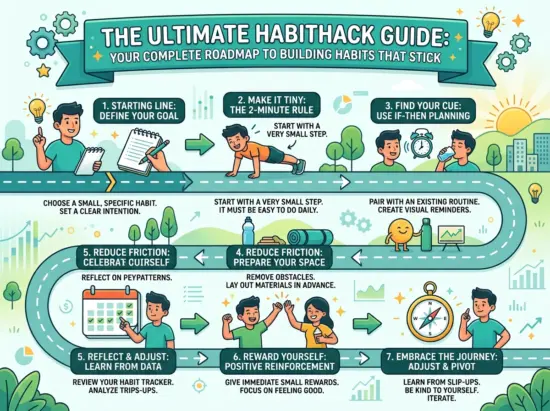
One of the most common mistakes is trying to change everything at once. It’s better to have mini-habits. Instead of making big changes, try making small, incremental adjustments .
Dr. Bender recommends making small, manageable changes: “If you hit the snooze button five times each morning, try four times the next day. The next week, try three times, and so on until you’re able to go without snoozing” .
12. Track Your Progress
Visual reminders of your progress—like a habit tracker—can help keep you on track. Consistent repetition is better than intensity. A small change every day is better than a big change once in a while because your brain creates new neural pathways by repetition, not grand movements .
13. Learn to Be Resilient and Practice Self-Compassion
Be honest about challenges that come up. They are going to happen. Breaking habits is difficult for almost everyone. This isn’t failure; it means you’re human .
Dr. Sanders cautions against falling into an all-or-nothing mentality: “Most of the time, there are going to be some lapses, especially at the beginning of this process. That’s normal, and it does not undo the progress you’ve made up to that point” .
Studies have shown that students who were able to forgive themselves for procrastinating when studying for a first exam ended up procrastinating less for their next one . Instead of beating yourself up, be kind to yourself. You’re more likely to give up if you criticize yourself harshly .
14. Use Habit Stacking to Replace Bad Habits
Habit stacking can be a great way to make good habits part of your regular routine while saying goodbye to bad ones . Here are some examples:
- If you normally reach for your phone to scroll TikTok after your lunch break, try to stack a 15-minute walk around the block on top of your lunch instead
- Replace looking for a quick snack between meetings with a 5-minute exercise snack as soon as your meeting ends
How Long Does It Take to Break a Habit?
Medical literature indicates it can take up to 66 days on average to make a new habit, with a broad range of 18 to 254 days . Breaking a habit is similar—it requires consistent effort over time.
The key is taking smaller, incremental steps. “You can’t expect to create a dramatic lifestyle overhaul in a matter of days,” Dr. Bender notes. “Celebrating that small victory is key to reinforcing the habit and making sure you’re continuing to make those gains” .
When to Seek Professional Help
If you regularly smoke, drink heavily, use illegal drugs, or engage in other harmful behaviors that feel impossible to control, speak with a healthcare professional . They can help develop an appropriate treatment plan and provide resources and guidance .
In some cases, therapy or medication may be helpful. As Dr. Sanders notes, therapists can help patients understand “everything that goes into the behavior because no behavior exists in a vacuum