Table of Contents
Welcome to HabitHack.fun, your trusted resource for mastering the art of habit formation. Developing effective study habits is one of the most important skills you can build—not just for academic success, but for lifelong learning. Research suggests that around 43% of our daily actions are performed out of habit. By consciously designing study routines that work with your brain, you can reduce stress, improve retention, and achieve more with less effort.
What Makes a Habit “Effective”?
Effective study habits are not about how much time you spend studying—they are about how you study. A top-performing student shares that “preparing in advance and starting to study long before exams approached allowed me to absorb material at a steady pace without the pressure of cramming”. The key is to build routines that make studying feel automatic, so you don’t have to rely on motivation alone.
The Cost of Ineffective Study Methods
Many students default to passive methods like re-reading and highlighting. While these feel productive, they give a false sense of confidence—you recognize the material, but that is not the same as remembering it. Cognitive psychology research shows that how you revise is far more important than how much you revise.
Core Study Habits to Build
1. Active Learning and Self-Testing
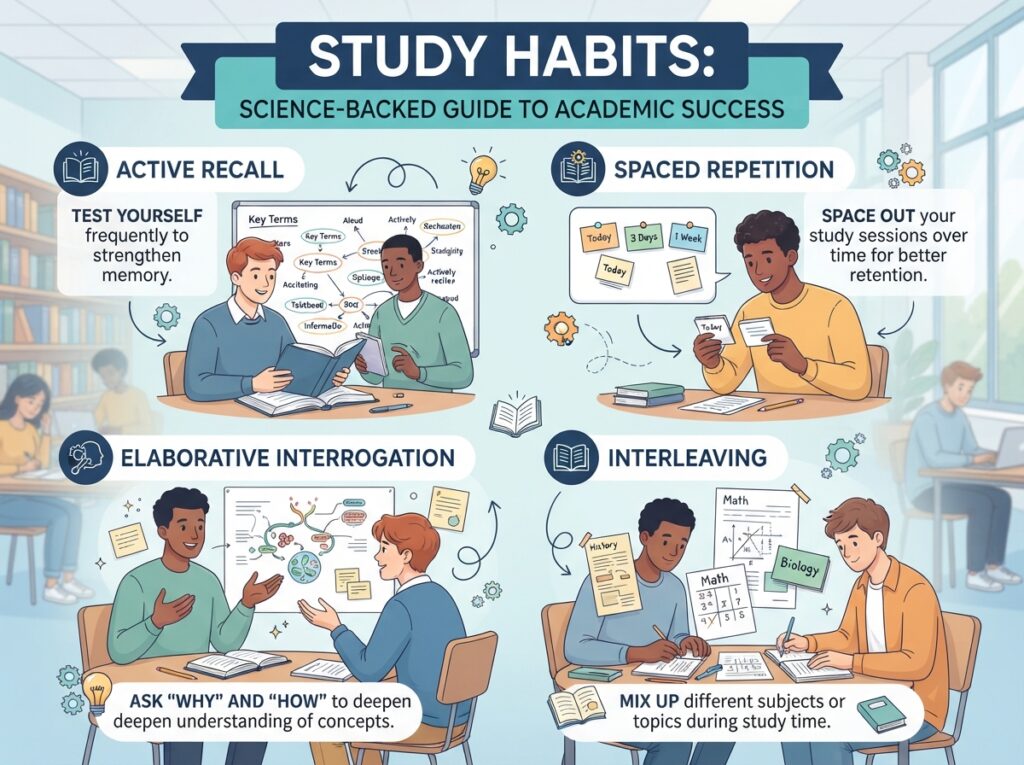
Instead of passively reading or listening, engage with the material actively.
Key strategies:
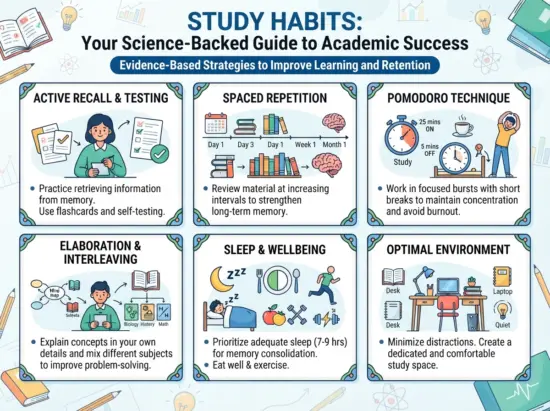
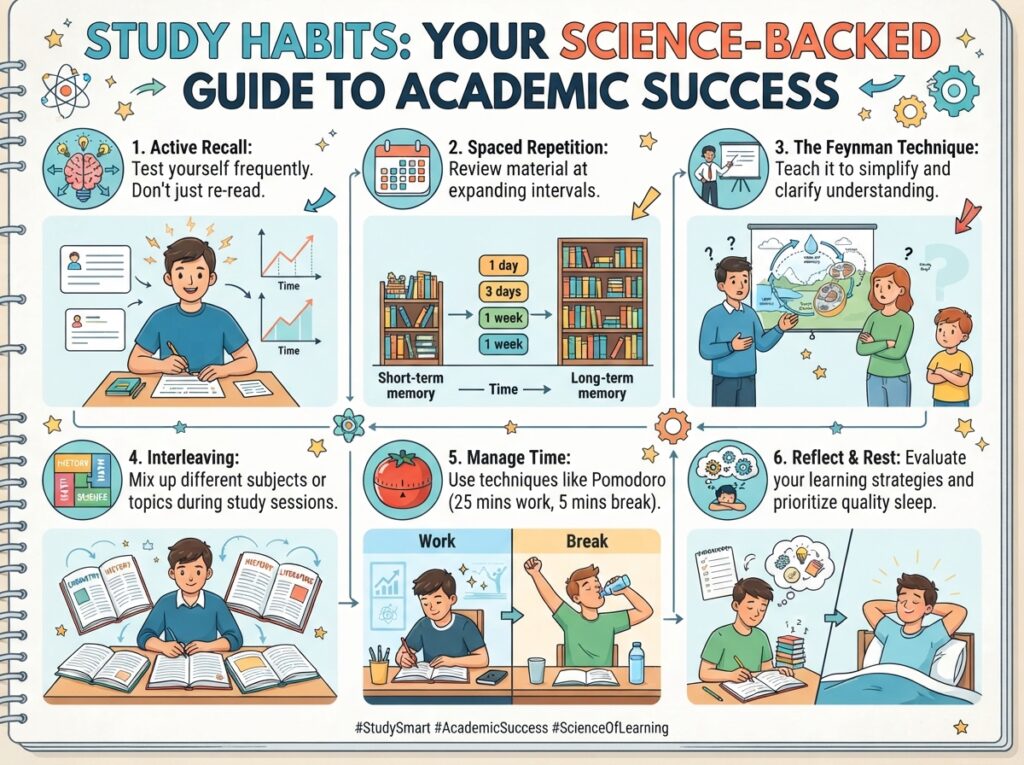
- Active recall: Cover your notes and write down what you remember. Create flashcards and quiz yourself. Studies show active recall is one of the most effective ways to embed information into long-term memory.
- Teaching others (Feynman Technique): Explain concepts in simple terms as if teaching someone else. This forces your brain to retrieve, organize, and simplify information, highlighting gaps in your knowledge.
- Ask questions: While studying, ask yourself: “Why is this important? How does it relate to what I already know?”
- Self-quizzing: Use mock questions that mimic the style and type of exam you are sitting. This helps you practice selecting and constructing convincing answers.
Why this works: The effort of retrieving information strengthens memory pathways. It might feel harder than re-reading, but that is exactly why it works.
2. Spaced Repetition and Interleaving
Spreading out your study sessions over time leads to improved learning compared to massed study (cramming).
Key strategies:
- Spaced repetition: Revisit information at strategic intervals over days or weeks. Each time you revisit a topic after a gap, your brain works harder to recall it, helping the material stick. Use apps like Anki or Quizlet to automate this process.
- Interleaving: Mix up different types of information or problems during study sessions. This helps you build deeper understanding by making connections between topics.
- Review regularly: Go over your notes shortly after taking them and periodically thereafter.
Why this works: Spaced learning seems to be particularly effective when combined with self-testing. It does mean planning ahead—dividing study topics and spacing them out rather than cramming.
3. Break Tasks into Manageable Steps
Procrastination often happens when a task feels overwhelming, boring, or difficult. The best way to overcome this is to break a big task down into tiny, achievable steps.
Practical example – writing an essay:
- Understand the question
- Brainstorm ideas
- Look for reference material
- Skim-read reference material
- Make an essay plan
- Read material in detail and take notes
- Write a first draft
- Edit and proofread
- Submit your essay
If any step feels too big, break it down further. Even if you naturally do these steps, writing them down can help if you have a tendency to procrastinate. The small steps are less daunting than larger tasks.
The “one-step rule”: If a task feels impossible, ask “what is the very next physical action I can take?”
4. Use Time-Blocking and Structured Work Blocks
Treat study time like a non-negotiable appointment. Establish a regular study routine to manage your time better and reduce last-minute cramming.
Key strategies:
- Pomodoro Technique: Work in 25-minute focused intervals followed by a 5-minute break. Using a timer helps you concentrate fully and maintains momentum.
- Schedule study sessions: Dedicate specific times each day or week to studying. Treat these times as non-negotiable appointments.
- Know your peak times: Study during your “biological prime time”—the periods when you are naturally most alert and focused.
- Create artificial deadlines: Set your work deadlines three days before they are actually due.
5. Design a Conducive Study Environment
Your environment significantly impacts your ability to focus. Choose a setting that works for you—whether a quiet library, a dedicated room at home, or a café with background noise.
Key strategies:
- Minimize distractions: Put your phone on silent and move it away from your desk. Turn off notifications on your computer. Use apps like Forest or Freedom to block distracting sites.
- Ensure comfort: Make sure your chair is comfortable, your desk is clear, and your area is well-lit.
- Create a “parking lot”: Keep a notebook nearby to write down random thoughts that pop up, so you can address them later without losing focus.
- Use “body doubling”: Study with a friend or online focus group; social presence helps with accountability.
6. Take Purposeful Breaks and Care for Your Well-Being
Your brain needs breaks to process and store information. A productive study routine is not about nonstop work—it is about balance.
Key strategies:
- Schedule short breaks: Study for 50 minutes and take a 10-minute break. During breaks, stand, stretch, or walk.
- Exercise regularly: Physical activity decreases stress levels, supports motivation, and contributes to positive mental health.
- Eat well and stay hydrated: Regular meals and water provide the energy you need to focus.
- Prioritize sleep: You cannot expect to meet your goals if you experience burnout.
7. Reward Your Progress
Celebrating small wins reinforces positive behavior and releases dopamine, keeping momentum going.
Key strategies:
- Reward efforts, not just outcomes: “I worked for 30 minutes” is worth celebrating.
- Use breaks as rewards: Phone time can become a reward for a solid study session.
- Praise yourself: Specific praise is a great motivator.
Tailoring Study Habits to Your Learning Style
Everyone learns differently. Adapting your approach to how you learn best can make studying more effective and enjoyable.
| Learning Style | Recommended Techniques |
|---|---|
| Visual | Use diagrams, charts, mind maps, and color-coded notes |
| Auditory | Record lectures, create audio summaries, study in groups, listen to educational podcasts |
| Kinesthetic | Use hands-on activities, physical objects to represent concepts, and short movement breaks |
| Reading/Writing | Take detailed notes, rewrite material in your own words, practice writing essays |