Table of Contents
Welcome to HabitHack.fun, your trusted resource for mastering habit formation. How you start your day can shape everything that follows. A well-designed morning routine can boost your energy, sharpen your mind, and set a positive tone that lasts until bedtime . This guide provides science-backed strategies to create a morning routine that works for you.
The Science Behind a Productive Morning
The choices you make in the first hour of your day have a measurable impact. Research shows that a structured morning routine offers several key benefits:
- Reduced decision fatigue: Routines automate choices, saving your mental energy for more important decisions . As one researcher puts it, our brains are “cognitive misers” that prefer not to waste energy on trivial matters .
- Lower stress levels: A calm, predictable start can reduce anxiety and cortisol levels, helping you feel more in control .
- Enhanced productivity: Setting intentions and tackling priorities early in the day can lead to greater focus and accomplishment .
These benefits are underpinned by biology. Morning light exposure helps regulate your circadian rhythm, the internal clock that governs your sleep-wake cycle and mood .
Step-by-Step Guide to Building Your Routine

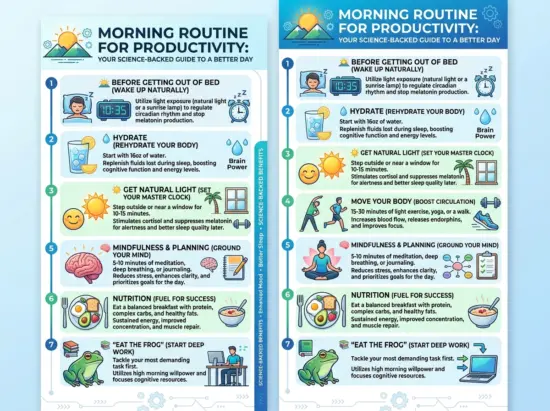
There is no single “perfect” routine. The key is to build one that fits your lifestyle and goals. Here are the core components supported by science.
1. Wake Up at a Consistent Time
A consistent wake-up time, even on weekends, is crucial for stabilizing your circadian rhythm and improving sleep quality . Going to bed and waking up at the same time each day strengthens your body’s internal clock .
Start small: If you’re not a morning person, don’t force a 5 a.m. wake-up . Wake up just 10-15 minutes earlier each week until you reach your goal .
2. Hydrate and Fuel Your Body
After sleeping, your body is dehydrated. Drinking water first thing rehydrates you, supports kidney function, and can provide natural energy .
Dietary guidance: Aim to eat a balanced breakfast within two hours of waking . A protein and fibre-rich breakfast can improve satiety and concentration . A simple example is beans on toast: it contains protein, fibre, and whole grains .
3. Get Moving
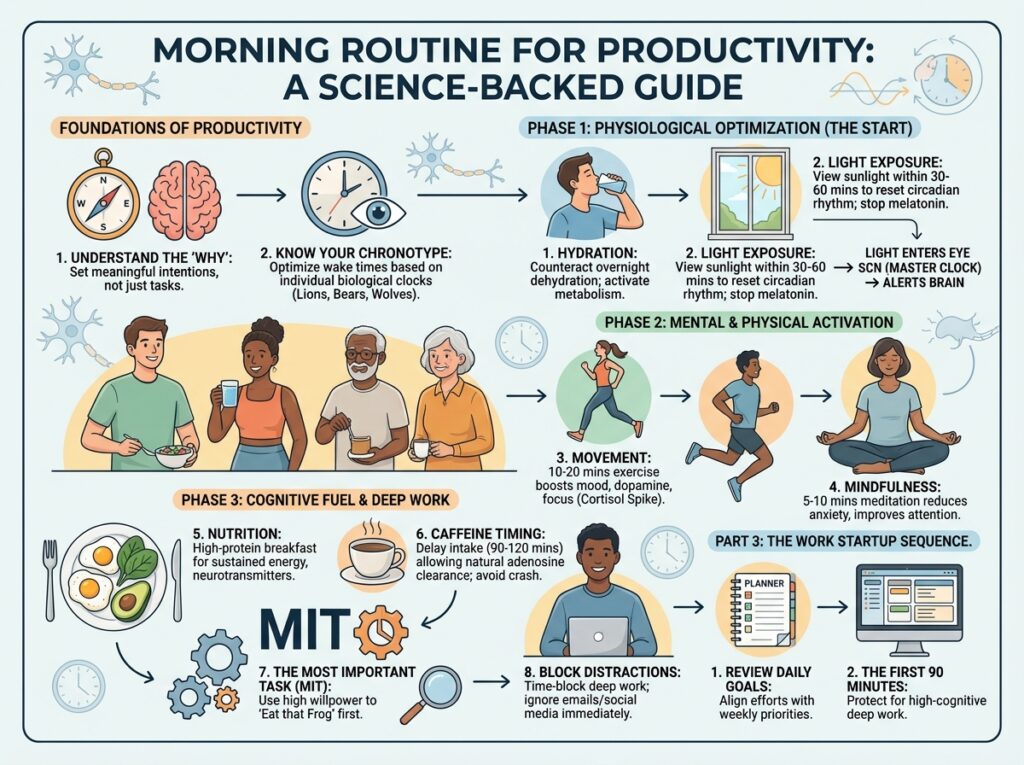
Physical activity in the morning can improve focus, mood, and energy levels . It may also help you be more active throughout the day . A study found that even moderate exercise creates a consistent, moderate-sized improvement in feelings of energy .
Choose activities you enjoy: You don’t need high-intensity exercise first thing. Gentle movement such as stretching, a brisk walk, or yoga can be highly effective . One CEO swears by a 6 a.m. run or workout class to “sharpen my mindset, fuel discipline and give me a win before most people are even up” .
4. Expose Yourself to Natural Light
Getting outside in the morning is one of the most powerful things you can do. Morning light exposure suppresses melatonin (the sleep hormone) and increases serotonin (linked to mood and alertness) . It also helps regulate your circadian rhythm, improving sleep quality .
Make it easy: A 10-15 minute morning walk is ideal. Even sitting outside on your porch can help .
5. Practice Mindfulness or Set an Intention
Taking a few minutes for quiet reflection can reduce stress and improve focus. This can be formal meditation, journaling, or simply setting an intention for the day .
Try gratitude journaling: Write down two or three things you’re grateful for. This simple habit can set a positive tone for the day .
Common Traps to Avoid
- Hitting the snooze button: This disrupts your sleep cycle and can lead to morning drowsiness . Instead, place your alarm away from your bed so you have to physically get up to turn it off .
- Checking your phone first thing: Messages and news can be an instant source of stress, pulling you into a reactive state rather than a proactive one .
- Forcing an early wake-up: If you’re a natural night owl, forcing a super early wake-up can cause “social jetlag” – a mismatch between your biological clock and your schedule, which can lead to poor health outcomes . A 2024 study found this mismatch is linked to higher rates of depression and anxiety .