Table of Contents
Welcome to HabitHack.fun, your trusted resource for building habits that transform your life. Your mental health isn’t just about how you feel—it’s a critical foundation for every aspect of your well-being, from your physical health to your relationships and career. While seeking professional help is a sign of strength when needed, there is a robust body of research showing that simple daily habits can be as effective as therapy for improving mood and reducing stress in many cases .
This guide explores eight powerful, science-backed habits that can significantly improve your mental health.
1. Build a Consistent Daily Routine
Why It Works: Reduces Anxiety and Decision Fatigue
Having a predictable rhythm to your day provides a sense of security that can reduce mental fatigue and decrease stress . Research shows that people with structured routines have lower levels of anxiety and depression than those who live without them . When your brain doesn’t have to waste energy on trivial decisions like “when should I eat?” or “will I exercise today?”, it frees up mental bandwidth for more complex tasks .
How to Start
- Focus on sleep: Your body’s inner clock, or circadian rhythm, is key. Sticking to a consistent bedtime and wake time is the single most critical part of a daily routine . A 2025 study found that regular sleepers had a 38% lower risk of depression than irregular sleepers .
- Start small: Don’t try to overhaul your life overnight. Pick one small thing to add to your routine each week .
- Use habit stacking: Add a new habit to an existing one. For example: “After I pour my morning coffee, I will practice a moment of mindfulness” .
2. Prioritize Restorative Sleep
Why It Works: The Foundation of Emotional Regulation
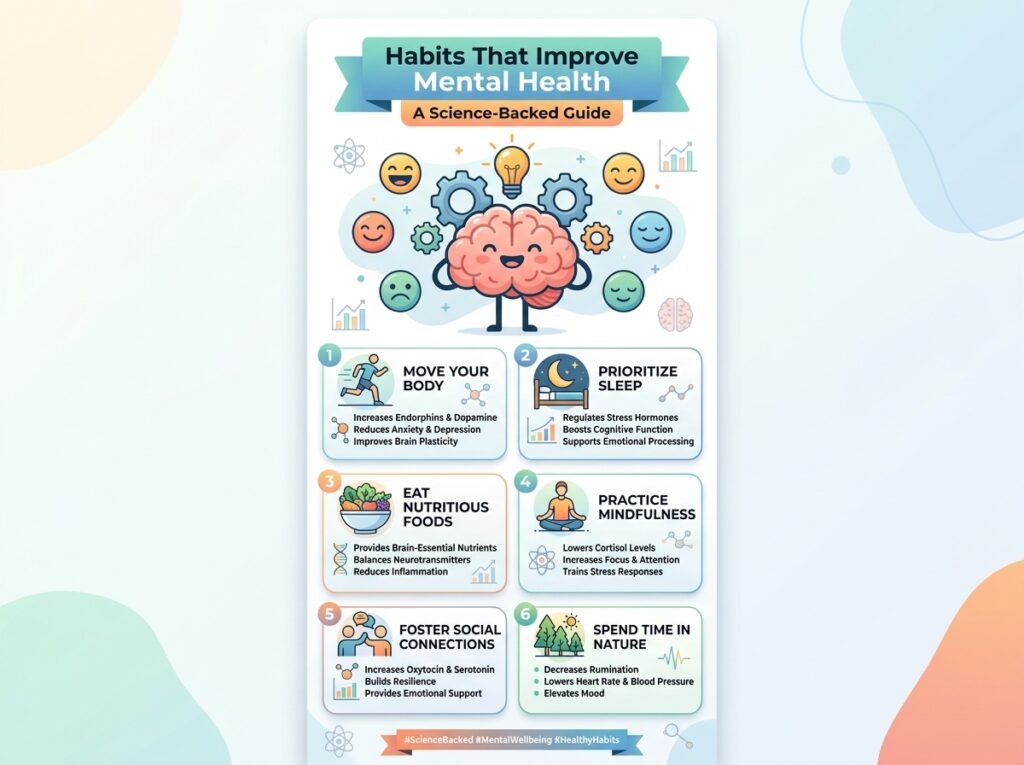
Sleep plays a major role in managing stress . Lack of sufficient sleep increases the risk of depression and other mental health issues . During sleep, the brain reorganizes, recharges, clears toxins, and boosts the immune system .
How to Start
- Create a night-time routine: Prepare to fall asleep more easily by going to bed in a relaxed state—read an enjoyable book instead of working late into the night .
- Optimize your environment: Keep your bedroom cool, dark, and quiet .
- Reduce screen time: Avoid social media, news, and other stimulating content at least an hour before bed . Put your phone on “Do Not Disturb” or in another room .
3. Move Your Body
Why It Works: A Natural Anti-Depressant
Physical activity is one of the quickest ways to influence your mood . It prompts the release of mood-supporting neurotransmitters like serotonin and dopamine . A large study of 1.2 million U.S. adults found that people who exercise report 1.5 fewer days of poor mental health per month . According to the American Psychological Association, walking for just 10 to 15 minutes daily may lower your risk of depression by 18% .
How to Start
- Find what you enjoy: Movement should be a celebration of what your body can do. Whether it’s dancing in your kitchen, yoga, or a walk, the key is to find something you enjoy .
- Keep it short: Even short bursts of physical activity can boost brain health . Aim for the “sweet spot” of 45 minutes of movement three to five times a week, but any movement is better than none .
4. Create a “Digital Sunset” and Reduce Screen Time
Why It Works: Protects Your Brain from Overstimulation
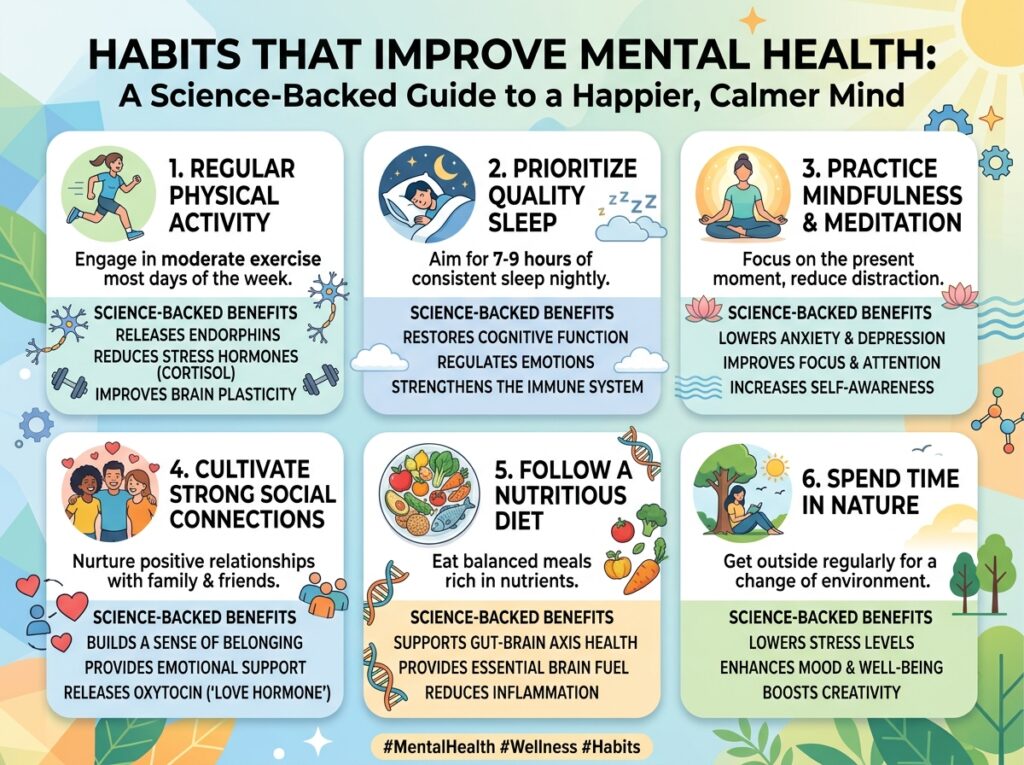
Excessive screen time can lead to depression, anxiety, and other mood disorders . Passive scrolling has the strongest negative influence, especially for adolescents . Dr. Amanda Ferguson from the University of Cambridge advises breaking the automatic social media loop by adding friction—like removing apps from your home screen .
How to Start
- Add friction: Small barriers, like logging out of social media apps, can help you break the automatic loop and engage more intentionally .
- Take a digital break: Try going device-free for an afternoon or a whole day .
- Notice the urge: Pause before you open an app. Name the emotion you feel and the associated urge (e.g., “I feel bored, I want to check Instagram”) to create a gap between the impulse and the behavior .
5. Practice Present-Moment Awareness
Why It Works: Reduces Overwhelm
Focusing on the here and now can make life feel more manageable, especially when everything feels overwhelming . It involves taking things one day, or even one hour, at a time and liberating yourself from having to handle everything right now .
How to Start
- Have a daily anchor: Create a centering practice that can fit into a busy day, like a 10-minute walk during your lunch break or mindfully enjoying your coffee in the morning .
- Do a “brain dump”: If your mind feels crowded, set a timer for two minutes and write freely to get the swirling thoughts onto paper .
- Turn chores into mini-meditations: Notice the sounds, sights, and smells while brewing your morning coffee .
6. Nurture Social Connections
Why It Works: Humans Are Built for Connection
Stress can be isolating, but connecting with others is a salve for the psyche . Even tiny interactions with casual acquaintances decrease loneliness and improve happiness and well-being . Social connection is a protective factor for mental health and can shift your nervous system out of “fight-or-flight” .
How to Start
- Intentional connection: Take a moment to laugh with colleagues, hug your pet, or smile at the barista .
- Small acts: Send a text to someone you love or put your phone aside to have a few undistracted minutes with a family member .
7. Practice Self-Compassion (and Stop “Self-Optimizing”)
Why It Works: Kindness is a Source of Resilience
Most of us have a harsh inner critic. But replacing negative self-talk with kindness is crucial for mental wellness . Research shows the opposite of what many fear: people who are self-compassionate are more likely to try harder in the face of failure and ultimately reach their goals . Dr. Olivia Remes from the University of Cambridge also warns against over-optimizing. When consistently tracking aspects of life starts to take over, it can block you from solving problems .
How to Start
- Treat yourself like a friend: When you make a mistake, speak to yourself with kindness rather than criticism. Instead of “How could you let it get to this point?,” try “You’ve got a lot on your plate, but you are capable and you’ll get it done” .
- Avoid avoidance: If you’re faced with a problem, try brainstorming ways of resolving it rather than blocking it out. Avoidance has been linked to depression and anxiety .
8. Embrace “Micro-Habits” for Quick Wins
Why It Works: Small Steps Lead to Big Changes
Lasting behavior change is often built on small, repeatable actions rather than sweeping transformations . These under-five-minute practices lower the barrier to entry while still supporting emotional regulation .
How to Start
- Free-write for 2 minutes: Instead of pushing thoughts away, invite them to move through .
- Tidy one small surface: Visual clutter competes for attention. Tidying one small area can restore a sense of control .
- Make your bed: This simple task gives you a “quick win” and a chance to experience some positive self-talk. It clears mental clutter and gives you a sense of order .