Table of Contents
Welcome to HabitHack.fun, your ultimate destination for mastering the art and science of habit formation. If you’ve ever struggled to make a new routine stick, you’re not alone. The problem isn’t a lack of willpower—it’s that we’re often starting from scratch, fighting against how our brains are naturally wired. Habit stacking offers a smarter approach. Instead of building new neural pathways from nothing, it piggybacks on the ones you’ve already created. This comprehensive guide will teach you everything you need to know about habit stacking, including how it works, why it’s so effective, and exactly how to implement it in your life.
What Is Habit Stacking?
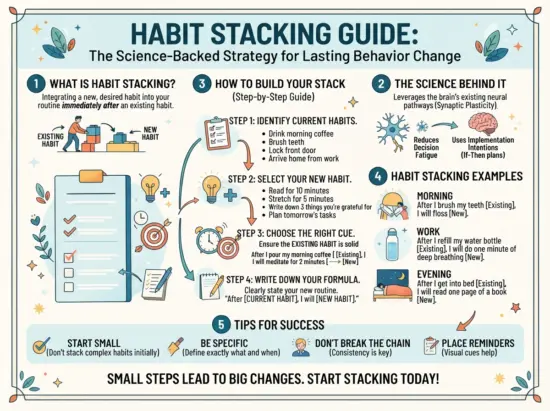
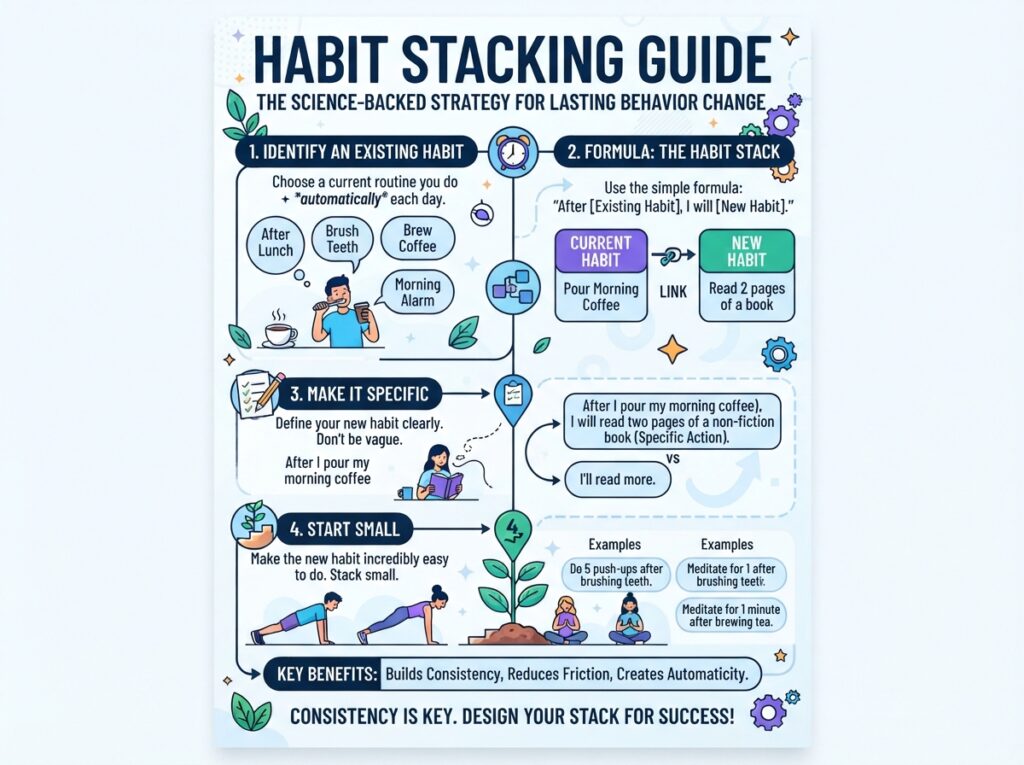
Habit stacking is a behavior change strategy where you pair a new habit you want to build with an existing habit that is already deeply ingrained in your routine . The idea is simple: instead of trying to remember to do something new, you attach it to something you already do automatically. Think of it as “piggybacking” a fresh, hard-to-set habit onto a well-established pathway that’s already second nature .
The formula, popularized by James Clear in his bestselling book Atomic Habits, is straightforward:
“After [CURRENT HABIT], I will [NEW HABIT].”
For example, “After I pour my morning coffee, I’ll write down my top three priorities for the day” or “After I brush my teeth at night, I will floss” . By using a consistent cue to trigger the new behavior, you’re making it far easier to remember and follow through .
Why Habit Stacking Works: The Science Behind It
Habit stacking is more than just a productivity hack—it’s grounded in how our brains function. Habits live in the part of the brain responsible for automatic behaviors . When something becomes a habit—like tying your shoes—it no longer requires decision-making. It’s just what you do .
Leveraging Existing Neural Pathways
When you perform a well-practiced behavior, specific neural pathways in your brain fire up and become activated . These connections are strengthened with each repetition, causing the behavior to become automatic over time . Habit stacking works because it takes advantage of these deep neural pathways that you’ve already built . Instead of creating entirely new synaptic connections, you’re using an existing neurological superhighway . By anchoring the new behavior to something you already do routinely, you create a strong, lasting habit more easily .
The Role of Dopamine
Habit stacking also leverages the brain’s natural reward system. Dopamine is a neurotransmitter that plays a key role in the pleasure feedback loop . When you perform an action that brings a positive feeling, your brain releases dopamine, making it more likely you’ll repeat that action . Following through on a habit stack—even something small—gives you a psychological win, releasing a jolt of dopamine and increasing your motivation to continue .
The Evidence for Habit Stacking
There’s growing clinical support and anecdotal evidence that habit stacking can move the needle on behavior change . A notable study on dental flossing habits, published in the British Journal of Health Psychology, demonstrated the power of this approach. Participants who flossed immediately after brushing their teeth (a habit-stacking technique) developed much stronger flossing habits than those who flossed before brushing . The existing habit of toothbrushing served as a perfect cue, leading to better long-term adherence.
A Step-by-Step Guide to Building Your Habit Stack
Ready to try habit stacking? Follow these steps to integrate a new habit into your daily routine.
Step 1: Take an Observation Day
First, figure out what your day actually looks like. Take one day to add notes to your digital calendar or jot down in a journal about how you spend each hour . What are the routines you do without thinking? List your current habits that occur at about the same time each day: “make my bed,” “brew a pot of coffee,” “take a lunch break,” or “brush my teeth” .
Step 2: Pin Down Your Specific New Goal
Be very clear about what new habit you want to adopt. Instead of a vague goal like “exercise more,” specify: “After I finish my lunch, I will take a 10-minute walk around the block” . If your cues are not specific enough, you will struggle with habit stacking . It can also be helpful to have a back-up plan in case plan A falls through .
Step 3: Stack It on Your List
Go back to the list you created in step one. Consider with which current habit your new goal might align best. Would it be better for your energy levels to drink that extra glass of water in the morning, rather than before bed? Arrange the anchor for your new activity at a time that sets you up for success .
Step 4: Start Small and Try It Out
Set a goal of starting to integrate the stacked habit into your routine for just seven days . Use the “Two-Minute Rule” if needed—make the new habit so easy you can’t say no. For example, “meditate for one minute” instead of “meditate for 20 minutes.” Take a moment to note at the end of each day: How do you feel with the new habit? Did you stick with it?
Step 5: Be Consistent and Give Yourself Grace
Habit formation takes time—typically about two months of consistent practice . There will be slip-ups along the way, but with practice over time, the new routine will feel as natural as the original one you stacked it on top of . The “never miss twice” rule applies here: one missed day is a mistake; two is a pattern . Instead of beating yourself up, be kind to yourself and get back on track.
Habit Stacking Examples for Real Life
Here are practical habit stacking ideas for different areas of your life .
For Physical Health and Fitness
| Existing Habit (Cue) | New Healthy Habit to Stack |
|---|---|
| After I pour my morning coffee | I will do 10 toe touches or jumping jacks . |
| After I put on my seat belt | I will take several slow, deep breaths . |
| After I finish dinner | I will go for a 10-minute walk around the block . |
| While I watch my favorite TV show | I will stretch my legs or do a simple yoga pose . |
For Healthy Eating and Nutrition
| Existing Habit (Cue) | New Healthy Habit to Stack |
|---|---|
| While I heat water for coffee or tea | I will wash and prepare a vegetable for snacking later . |
| After I sit down to eat | In my head, I will imagine a dinner plate divided in half and think about what fruits and veggies I have on hand . |
| While I’m cooking dinner | I will practice mindful breathing as I chop or wait for water to boil . |
For Mental Well-being and Mindfulness
| Existing Habit (Cue) | New Healthy Habit to Stack |
|---|---|
| After I pour my morning coffee | I will write down one thing I’m grateful for . |
| Before I go to bed | I will put my phone away at least 30 minutes prior . |
| After I brush my teeth at night | I will practice deep breathing exercises for one minute . |
Common Pitfalls to Avoid
- Trying to change too much at once: Focus on one habit stack at a time. This helps ensure that each habit is well established before adding another, reducing the risk of feeling overwhelmed or burning out .
- Choosing the wrong anchor habit: Make sure the existing habit is one you do with near-perfect consistency. Stacking onto a “maybe” habit sets you up for failure.
- Being too ambitious: If your new habit is too big, it will feel daunting. Downscale it until it can be done in two minutes or less.