Table of Contents
Welcome to HabitHack.fun, your trusted resource for mastering personal growth and habit formation. Meditation is one of the most transformative habits you can cultivate. Research shows that consistent meditation practice can reduce stress, improve anxiety and depressive symptoms, lower blood pressure, and enhance overall well-being . Yet, like many health behaviors, long-term maintenance of meditation is a significant challenge for many individuals . This comprehensive guide explores the science behind meditation habit formation and provides actionable strategies to build a sustainable practice.
Why Meditation Habits Are Hard to Build
Meditation is distinct from many other health behaviors. It requires significant effort, is often most impactful over longer time periods, and the results are not always apparent to others . This makes it challenging to stick with, especially when you’re not seeing immediate results.
The Neuroscience of Meditation
Understanding what happens in your brain during meditation can help you stay motivated. Neuroimaging studies have consistently shown that mindfulness-based interventions like MBSR (Mindfulness-Based Stress Reduction) increase functional connectivity between the ventromedial prefrontal cortex and the amygdala—a pathway central to emotion regulation . This means meditation literally rewires your brain to handle stress better.
Additionally, meditation strengthens connectivity within the default mode network, which is involved in self-referential processing . These changes help explain why practitioners often report better emotional control and less anxiety. Even a short 7-day meditation retreat has been shown to produce broad neural and molecular changes associated with enhanced neuroplasticity and metabolic reprogramming .
The Stages of Meditation Habit Formation
Researchers have mapped meditation habit formation into four stages using the Sussex Mindfulness Meditation (SuMMed) model :
| Stage | Description | % of US Adults |
|---|---|---|
| Pre-Intention | Not engaging with meditation, no intention to start | 69.7% |
| Preparation | Not meditating but intending to start soon | 19.1% |
| Action | Recently begun a practice, intend to continue | 2.3% |
| Maintenance | Established practice, intend to keep going | 9.0% |
Interestingly, a 2025 study of Calm app users found that only 39.5% of regular users maintained a temporally consistent meditation habit—meditating around the same time each day . The other 55.3% were inconsistent, yet still maintained their practice. This suggests that while consistency helps, it’s not the only path to building a lasting meditation habit .
8 Strategies to Build a Daily Meditation Habit
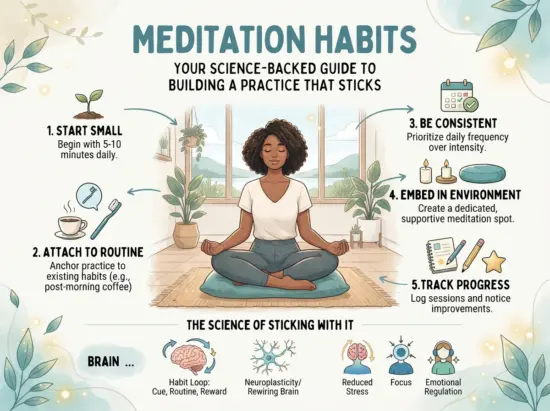
1. Start Extremely Small
Most beginners assume they need to meditate for long periods to get benefits. Research suggests that consistency is more important than session length . Begin with just 2 to 5 minutes per day . Even one minute of steady breathing is enough to settle your attention and build confidence .
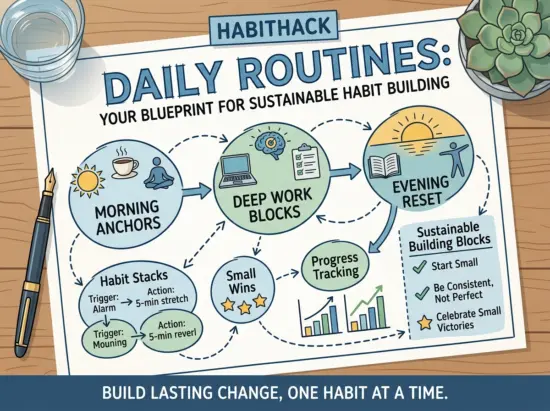
Habit stacking formula: “After I [existing habit], I will meditate for [time].”
- “After I brush my teeth, I will meditate for 2 minutes”
- “After I pour my morning coffee, I will do a brief breathing exercise”
This attaches meditation to something you already do, taking the mental friction out of remembering .
2. Choose a Comfortable Posture
Many people assume meditation requires sitting cross-legged on the floor with perfect posture. When building a daily habit, comfort comes first . You can sit in a chair with your back supported, lounge on the couch, lie down with a blanket, or sit cross-legged if that feels right . The goal is to be comfortable but awake so you can focus without distraction .
3. Use Guided Meditations
Guided meditations are especially helpful for beginners. A voice provides structure, pacing, and reassurance so you don’t spend the whole time wondering whether you’re “doing it right” . They work particularly well when you’re overwhelmed, your thoughts won’t settle, or you’re restarting after a break .
Guided meditations are widely available on apps like Calm and Headspace, on YouTube, and through various free resources . Search for terms like “5-minute meditation” or “beginner meditation” .
4. Focus on Your Breath, Not “Clearing Your Mind”
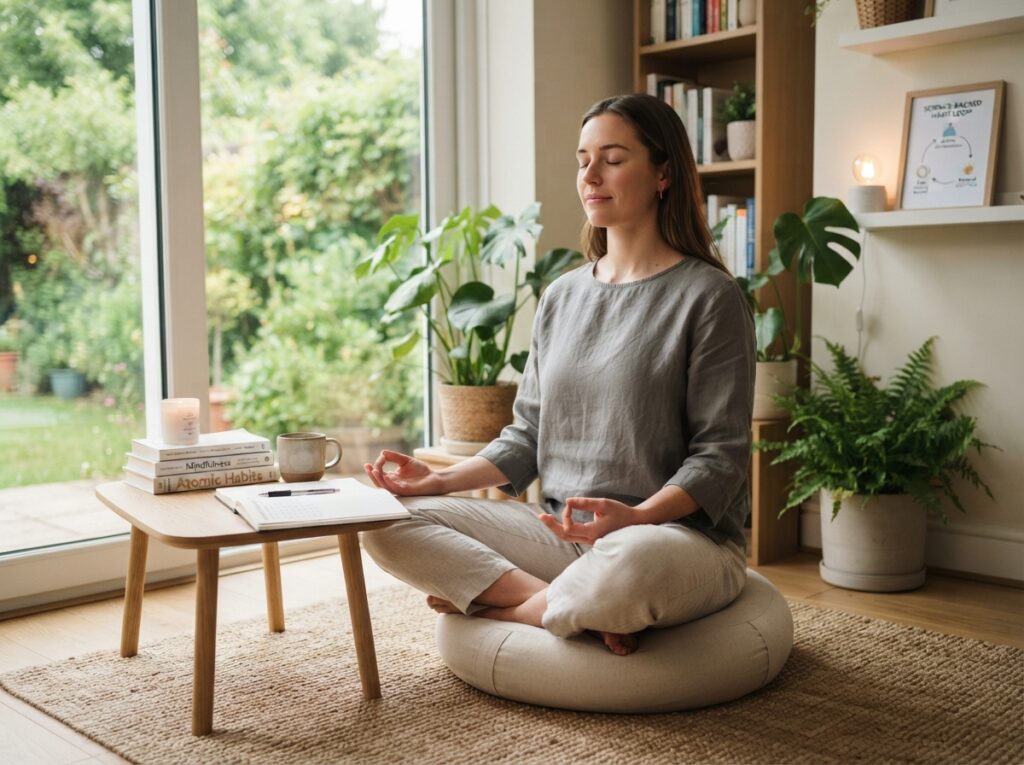
One of the biggest misconceptions about meditation is that you need to magically clear your mind of all thoughts . Meditation isn’t about having a completely empty mind—it’s about noticing when your mind wanders and gently returning your attention to your anchor . Your anchor could be your breath, a sound, physical sensations, or a word .
Try box breathing: Inhale for 4 counts, hold for 4, exhale for 4, hold for 4. This rhythmic pattern can be especially helpful when your mind feels scattered .
5. Carve Out a Peaceful Space
Having a special place where you meditate helps your brain learn to shift into a focused, calm state . This could be a separate room or just a corner of your bedroom. Add personal touches that feel peaceful—a candle, a small plant, a soft blanket, or calming music . When you sit in the same place each time, your mind starts associating that spot with concentration and peace .
6. Be Patient and Kind to Yourself
Meditation is called a “practice” for a reason—it’s something you work on consistently, without the need for perfection . Some days it will feel easy; other days your mind might race. Both experiences count .
If you miss a day, don’t be hard on yourself. Missing a day does not erase your progress. Learning to return without judgment is the real core of the practice . Think of meditation like brushing your teeth—if you miss a night, you don’t assume you’ve failed forever. You just pick up the toothbrush the next day .
7. Create a “Backup Version” for Hard Days
Consistency rarely comes from long sessions—it comes from having an ultra-simple version of the habit you can fall back on . A backup practice keeps you connected to meditation on days when everything feels heavy. Your backup could be:
- One slow inhale and one slow exhale
- Noticing five sounds around you
- Feeling your feet on the ground for ten seconds
- A 30-second body scan before bed
8. Join a Community
Joining a group of people who meditate together can increase your accountability . The sense of belonging to a group can help you stick to your practice. Search for meditation groups online or in person in your area .
How Long Until It Becomes a Habit?
Building any new habit takes time, and meditation is no different. The transition from Action to Maintenance in the SuMMed model—when meditation becomes a genuine habit—can range from 8 weeks to 6 months or more . This is consistent with the broader habit formation research showing that simple habits can form in about 18 days, while more complex routines take significantly longer.