Table of Contents
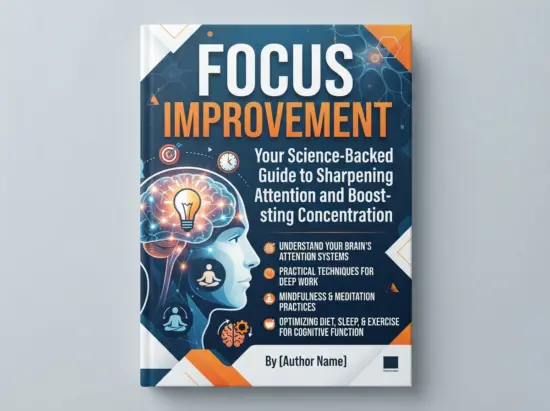
Welcome to HabitHack.fun, your trusted resource for mastering productivity and cognitive performance. In an era of constant notifications and endless distractions, the ability to focus has become one of the most valuable skills you can cultivate. The average attention span on screens has dropped to just 47 seconds according to recent research . Yet by understanding how your brain works and applying science-backed techniques, you can train your focus like a muscle and reclaim your cognitive performance. This comprehensive guide explores the neuroscience of attention, effective strategies, and practical techniques to improve your focus.
Understanding Focus: The Neuroscience of Attention
Before we dive into strategies, let’s examine why focusing feels so difficult. The human brain is wired to detect rewards, and our smartphones are designed to deliver them . Each notification provides a small dopamine hit, making us crave the next one . Once your brain becomes accustomed to these easy rewards, it becomes more difficult to perform the effortful, long-term thinking that demands focus and concentration .
What is Attention Residue?
When you switch tasks, part of your attention remains stuck on the previous activity. This phenomenon, known as “attention residue,” was first identified by University of Washington business professor Dr. Sophie Leroy in 2009 . This cognitive residue impairs your performance on the new task—you may think your attention has fully shifted, but your brain experiences a lag .
The cost is significant: according to research by Dr. Gloria Mark at UC Irvine, it takes an average of 23 minutes and 15 seconds to fully regain deep focus after being interrupted, with recovery ranging from 8 minutes for simpler tasks to 25 minutes for more complex ones .
The Challenge of Neuroplasticity
While many believe every experience changes the brain, this is a myth for adults. According to Dr. Andrew Huberman, a professor of neurobiology at Stanford School of Medicine, the adult brain only changes when specific conditions are met . The key is focused attention—your prefrontal cortex signals the rest of your nervous system that something is worth paying attention to, which triggers the release of neurochemicals that allow neural connections to strengthen or weaken .
Core Strategies for Focus Improvement
1. Understand Your Biological Prime Time
Your natural energy and focus peaks occur around 10am and again at 2-3pm on average, according to Dr. Gloria Mark’s research . However, these times vary based on your chronotype (whether you’re a morning lark or night owl) .
How to find your peak focus times: Keep a diary and, every 30 minutes, note your level of focus and engagement. Do this for several days, ideally over a week, to identify your natural concentration windows . Once you’ve identified them, schedule your most demanding tasks during these periods.
2. Master the Deep Work Philosophy
Deep work, a concept coined by Cal Newport, refers to “professional activities performed in a state of distraction-free concentration that push your cognitive capabilities to their limit” . It’s the opposite of shallow work like checking emails or scrolling social media .
Four deep work philosophies :
| Philosophy | Description | Best For |
|---|---|---|
| Monastic | Isolate completely from distractions for hours or days | Urgent, high-stakes projects |
| Bimodal | Split your week between deep and shallow work days | Long-term projects requiring sustained focus |
| Rhythmic | Schedule routine time for deep work daily | Building a consistent habit |
| Journalistic | Fit deep work in whenever you find time | Professionals who must quickly switch gears |
3. Eliminate Distractions Through Proactive Control
Willpower alone is not enough to improve focus. Each exertion of willpower depletes your attention capacity a bit more . Instead, use proactive control: keeping distractions away altogether .
Practical steps :
- Move your smartphone to a different room when working
- Use website blockers and message blockers on your computer
- Set your phone to “Do Not Disturb” mode
- Find a quiet room where you won’t be interrupted
- Quit any apps and close any tabs you won’t need
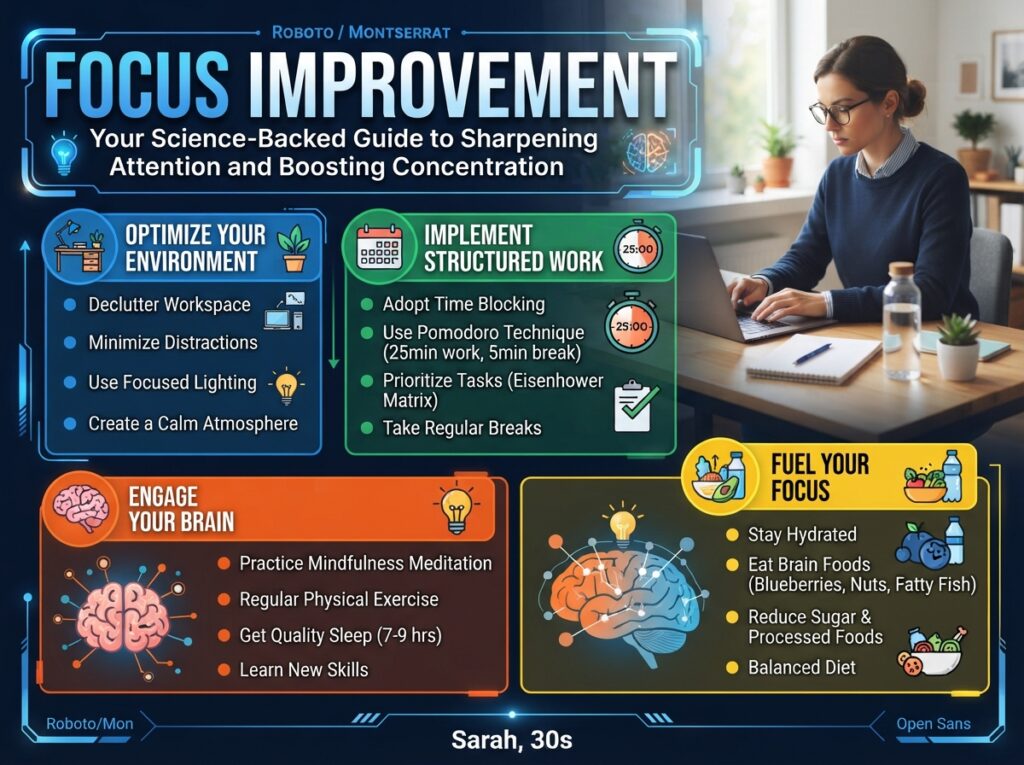
- Create a focused environment: declutter your desk, adjust lighting, and keep only essential tools within reach
4. The Power of Focus Techniques
The Pomodoro Technique: Set a 25-minute timer and work with full concentration, followed by a 5-minute break . This approach is particularly helpful for people who struggle to initiate tasks because committing to a fixed time period makes starting seem less daunting .
Time Blocking: Schedule specific blocks of time for certain tasks in your calendar. Treat these blocks like appointments you cannot miss . Consider reserving the first 60-90 minutes of your day for high-cognitive tasks before checking emails .
Batching: Group similar tasks together and complete them in a single, focused block. This minimizes the mental cost of switching between different types of tasks .
Deep Stacking: Combine the Pomodoro Technique with time stacking for complex projects. For example, use one 25-minute Pomodoro for research, a second for outlining, and a third for drafting—all within a single project block .
5. Take Strategic Breaks
Though it might seem counterintuitive, taking breaks actually improves focus and concentration . Research shows that short, regular breaks can improve focus and reduce decision fatigue .
Break strategies :
- Take a 10-minute break each hour to prevent mental fatigue
- Try Yoga Nidra (non-sleep deep rest), a practice Google CEO Sundar Pichai is said to be a fan of—it creates a deeply relaxed state of consciousness that may remove waste from the brain and boost attention
- Get aerobic exercise: even a brief 10-minute walk increases blood flow to the prefrontal cortex, providing a quick concentration boost
- Use short 5-15 minute breathers between higher-value tasks
6. Train Your Brain Through Attention Practice
Just as you can build physical muscle, you can train your brain to focus better through deliberate practice .
Mindfulness and meditation: Practice a daily five-minute meditation, such as silently counting your breaths in repeated sets of 10. When your mind wanders, return to the pattern .
Read in silence: Start with 10 minutes of silent reading or until your attention drifts. Take a break and return. Eventually, try to extend the time .
Engage in focused activities: Learn a new skill that requires attention, like painting, cooking, or playing an instrument. These activities encourage you to pay attention while providing measurable progress and encouragement .
Avoiding Common Focus Traps
Multitasking is a myth: The brain can process only one string of information at a time. Multitasking actually erodes memory skills and worsens performance on tests of working memory . Heavy media multitaskers perform worse on cognitive tests even without external distractions .
Visual environment matters: Researchers at the Technical University of Valencia found that people performed better on attention tasks when in rooms decorated with cooler colors (greens and blues) compared to warmer ones . White walls may be especially distracting—studies have found that children in classrooms with white walls found it harder to maintain concentration