Table of Contents
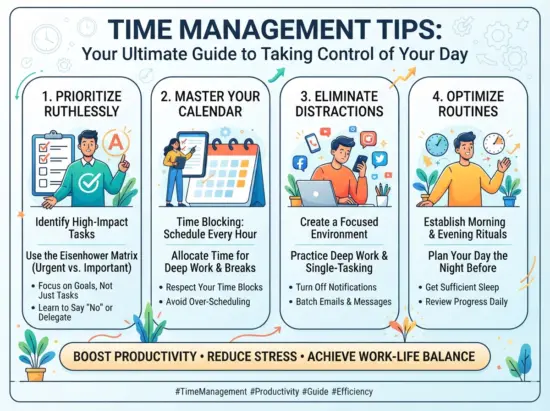
Welcome to HabitHack.fun, your trusted source for mastering productivity and habit formation. Time management is one of the most essential skills you can develop—not just for getting more done, but for reducing stress, improving focus, and creating space for what truly matters . This comprehensive guide explores science-backed time management tips, from understanding your current habits to implementing powerful techniques like the Eisenhower Matrix and Pomodoro method.
What Is Time Management and Why Does It Matter?
Time management is the process of intentionally planning how you spend your time on specific tasks to increase efficiency and effectiveness . When you manage your time well, you experience benefits like decreased stress, improved focus, enhanced confidence, and better work-life balance .
Time management is also a top employability skill, making it valuable beyond your current situation . Whether you’re a student juggling assignments, a professional managing projects, or someone balancing work and personal life, these skills can make the difference between constantly feeling behind and achieving your goals .
Step 1: Reflect on Your Current Approach
Before you can improve your time management, it’s helpful to understand your current habits. Ask yourself :
- Do I generally plan my time?
- Do I like to have things done on time?
- Can I juggle competing tasks effectively?
- Do I use tools to plan my time?
Being honest about your strengths and weaknesses helps you identify which strategies will be most helpful . Some people find they’re natural planners while others struggle with prioritization—both are okay, and both can be improved.
Step 2: Prioritize Tasks Effectively
Not all tasks are created equal. Learning to distinguish between what’s urgent and what’s important is essential for effective time management .
The Eisenhower Matrix
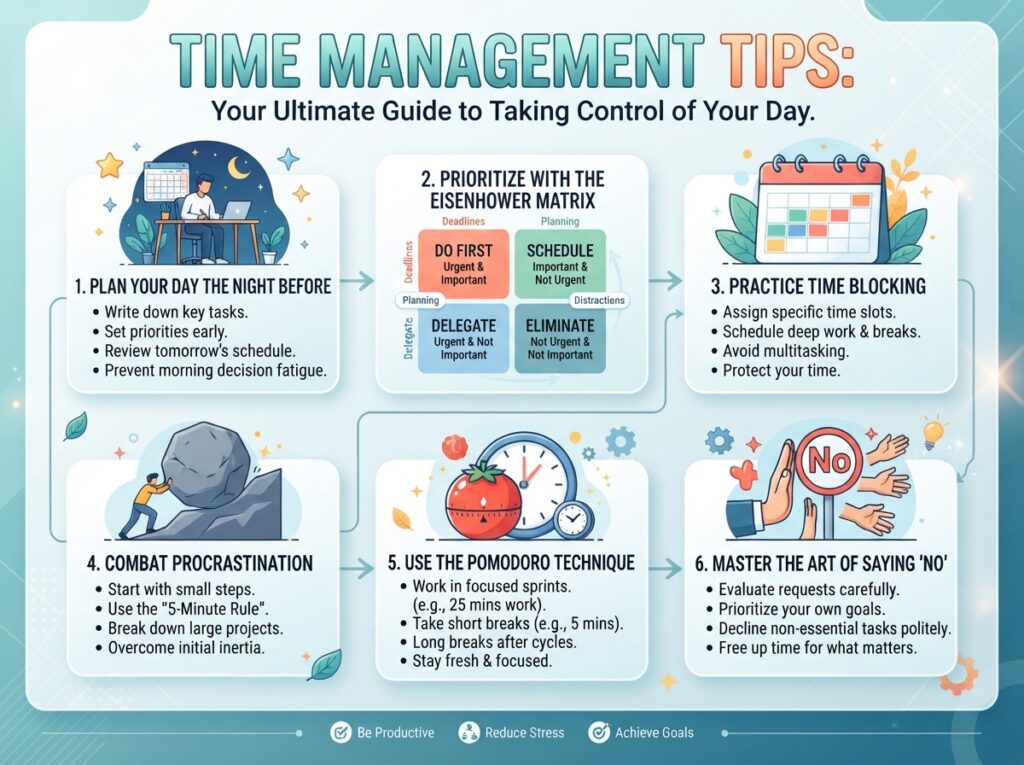
The Eisenhower Matrix divides tasks into four categories based on urgency and importance :
| Quadrant | Description | Action |
|---|---|---|
| Urgent & Important | Critical tasks with serious consequences | Do immediately |
| Important, Not Urgent | Long-term goals and meaningful work | Schedule time |
| Urgent, Not Important | Interruptions that feel pressing | Delegate if possible |
| Not Urgent & Not Important | Time-wasters and distractions | Eliminate |
This tool helps you focus on what really matters rather than being trapped in a loop of reacting to constant emergencies . As President Dwight Eisenhower once noted, “The urgent are not important, and the important are never urgent” .
The ABCDE Method
Another effective prioritization technique is the ABCDE method :
- A – Must do: Critical tasks with serious consequences if left undone
- B – Should do: Important but not urgent—can wait but shouldn’t be ignored
- C – Nice to do: Pleasant but no real consequences—can be postponed or dropped
- D – Delegate: Tasks someone else can do
- E – Eliminate: Time-wasters and distractions
Using this method helps you make your days more intentional and productive .
Step 3: Break Tasks Down
One of the most common reasons people procrastinate is that tasks feel too big and overwhelming . Instead of putting “write essay” or “revise for exam” on your to-do list, break these down into smaller, achievable tasks .
SMART Goals
Using SMART goals ensures your tasks are well-defined and achievable :
- Specific: Know exactly what you need to do—e.g., “find five relevant journal articles”
- Measurable: Can measure success—e.g., “I’ll find five articles”
- Achievable: Realistic given your time and resources
- Relevant: Aligned with your priorities
- Time-bound: Has a clear timeline
For example, instead of “do better on exams,” a SMART goal would be “revise for each exam for two focused hours every day, with a break on Sundays” .
Step 4: Use Proven Time Management Techniques
The Pomodoro Technique
The Pomodoro Technique uses focused work intervals followed by short breaks to maintain concentration and avoid burnout :
- Decide on a task
- Set a 25-minute timer
- Work until the timer is up (remove distractions)
- Take a 5-minute break
- After 4 Pomodoros, take a longer 15-30 minute break
This method is particularly helpful for those who struggle with procrastination or multitasking . Being timed may help you stay more focused and accomplish more in less time .
Time Blocking
Time blocking involves allocating specific blocks of time for different tasks, acting as a “do not disturb” sign for distractions . This method helps you:
- Balance responsibilities
- Ensure each task gets the attention it deserves
- Avoid multitasking
- Create a visual schedule that’s easier to follow
Use your calendar to set out your schedule, blocking time for work you need to do as well as meetings you need to attend .
The 60/40 Method
The 60/40 method suggests planning only 60% of your workday with scheduled tasks and leaving the remaining 40% open . This builds in buffer time for unexpected meetings, interruptions, or urgent requests, helping you stay calm and responsive without falling behind .
The 1-3-5 Rule
A simple framework for daily planning: focus on 1 big task, 3 medium tasks, and 5 small tasks each day. This ensures you’re making progress on important work while also handling smaller responsibilities.
Step 5: Master Your To-Do Lists
To-do lists are essential, but they can also be demotivating if done poorly .
Simplify Your Tasks
Instead of putting vague items like “revise for exam” on your list, write specific, achievable actions like “create a mindmap of Chapter 1 concepts” .
Keep Lists Short and Realistic
A long list often means you get less done—if your list looks impossible to finish, you lose motivation and start procrastinating . Keep daily lists short, ideally with a maximum of 5-7 items .
Avoid the “Rolling” To-Do List
Constantly adding new items to your list means you’ll never reach the end, which can be demotivating . Instead, keep a master list for future tasks and a separate daily list for what you’ll actually accomplish today .
Step 6: Understand Your Biological Prime Time
Everyone has periods of peak energy and focus—your “biological prime time” . Some people are “morning doves” who do their best work early in the day, while others are “night owls” who peak in the evening .
To maximize your productivity:
- Schedule your most important and challenging tasks during your peak energy times
- Use your less productive times for routine work, breaks, or rest
- Experiment to discover when you naturally feel most focused and energetic
Surgeons and other professionals have found that identifying their chronotype and working with it can increase productivity by up to 500% .
Step 7: Minimize Distractions and Interruptions
Distractions can cost you 20-40% of your productivity and take up to 23 minutes to recover from after each interruption .
Reduce Digital Distractions
- Turn off email notifications and check emails only every few hours
- Put your phone on silent or out of sight while working
- Close unnecessary browser tabs and apps
- Use “do not disturb” settings on your devices
Create a Focused Environment
- Find a quiet space where you’re less likely to be distracted
- Use noise-cancelling headphones if needed
- Set physical reminders to stay on track—like putting your running shoes on top of your laptop if you want to exercise
Communicate Your Schedule
- Let colleagues and family know when you need focused time
- Use calendar statuses like “Focusing” to signal you’re unavailable
- Learn to say “no” to requests that don’t align with your priorities
Step 8: Avoid Common Time Management Traps
Multitasking Is a Myth
Despite what many believe, multitasking doesn’t exist—we’re just rapidly switching attention between tasks . This costs us time, reduces the quality of our work, and prevents the depth of engagement needed for meaningful progress .
Don’t Let Perfectionism Hold You Back
Perfectionism can prevent you from even starting a task. Instead of aiming for “perfect,” define what’s “good enough” for the time you have . The 80/20 rule (Pareto Principle) suggests that 80% of your results come from 20% of your efforts—focus on that impactful 20% .
Avoid the “Fake Progress” Trap
Fake progress happens when you do activities that feel connected to your goal but don’t actually provide real value . Learn to distinguish between being busy and being productive.
Step 9: Maintain Balance and Well-Being
Effective time management isn’t about working all the time—it’s about creating space for what matters.
Take Purposeful Breaks
- Schedule regular short breaks between focused work sessions
- Use your breaks to recharge, not to start new tasks
- Take at least one day off per week to rest and recover
Pursue Fun with Intention
- Make time for enjoyable, rejuvenating activities like hobbies and social connections
- Organize your obligations around commitments to fun, not the other way around
Stay Energized
- Eat well, sleep enough, and exercise regularly
- Stay hydrated throughout the day—keep water at your desk
Step 10: Build Routine and Consistency
It takes about 30 days to create a habit, but good habits make your life easier . With consistent routines in place, you don’t have to make as many difficult decisions, reducing the chance of making unproductive ones .
Key routines to develop:
- A regular study or work schedule
- A weekly planning session (try Sunday evenings)
- A daily ritual of selecting your top 3 tasks for the next day