Table of Contents
Welcome to HabitHack.fun, your ultimate resource for mastering productivity and habit formation. In today’s world of constant notifications, overflowing inboxes, and endless meetings, being productive isn’t about working more hours—it’s about working smarter. This comprehensive guide explores the most effective, science-backed productivity hacks, from mindset shifts and daily habits to powerful techniques and digital tools.
Why Productivity Hacks Matter
True productivity isn’t about squeezing more tasks into your day. Its real benefit lies in freeing up time and mental energy for what matters most to you—whether that’s passion projects, hobbies, or time with family and friends.
Productivity hacks aren’t quick-fix cheat codes. They are strategies that help you better control factors like personal focus, environment, and organization to prioritize tasks and avoid procrastination and burnout. Ultimately, the goal is to make intentional choices about how you work and protect your time so you can stay efficient and, most importantly, “sane in a high-demand digital world”.
The Science of Focus: Hacking Your Brain
Understanding how your brain works is the first step to hacking your productivity. Here are some neuroscience-backed insights to help you get started.
Understand Your Biological Prime Time
Your brain has natural peaks and troughs of energy and focus throughout the day. Instead of fighting this rhythm, you can align your most mentally demanding tasks with your natural “peak” times, which, for many, occur around 10am and again at 2-3pm.
To find your personal “biological prime time,” track your energy levels for a few days. This is known as energy journaling. By mapping these patterns, you can reserve your “peak” periods for high-impact work and save routine administrative tasks for your natural energy dips. As one University of Exeter staff member put it, using mornings for deep work and afternoons for meetings is a simple way to align tasks with energy levels.
The Real Cost of Multitasking
Despite what some may believe, multitasking doesn’t exist. When we think we’re multitasking, we’re just rapidly switching our attention between tasks. This creates a cognitive load that makes it take longer to complete your to-do list than if you tackled each job one by one.
This constant context switching has a high price: it can cost you 20-40% of your productivity and leaves you feeling more stressed and in a worse mood. This is why learning to single-task is one of the most important productivity hacks you can adopt.
What is “Attention Residue”?
When you’re interrupted, your brain remains mentally tethered to the previous task. This phenomenon, known as “attention residue,” sabotages your ability to perform high-level, meaningful work. It takes, on average, a staggering 23-25 minutes to fully regain your focus after a single interruption. This is why protecting your focus time is non-negotiable for deep work.
Powerful Productivity Techniques
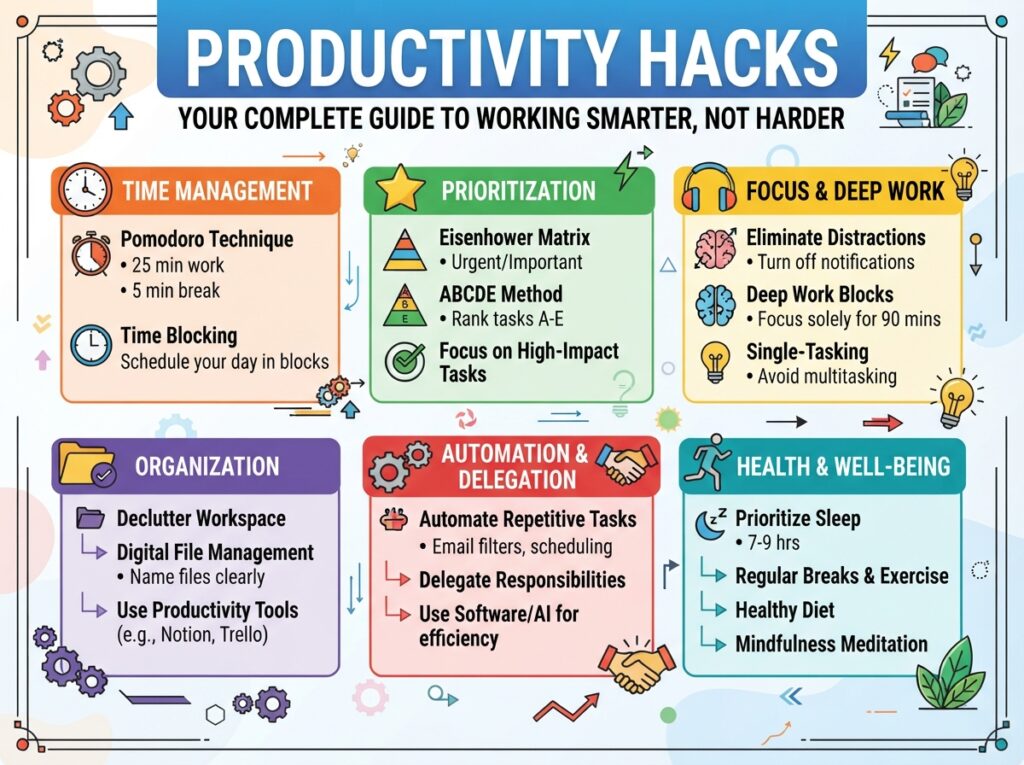
Here are some of the most popular and effective productivity techniques, along with advice on how to avoid common pitfalls.
1. The Two-Minute Rule
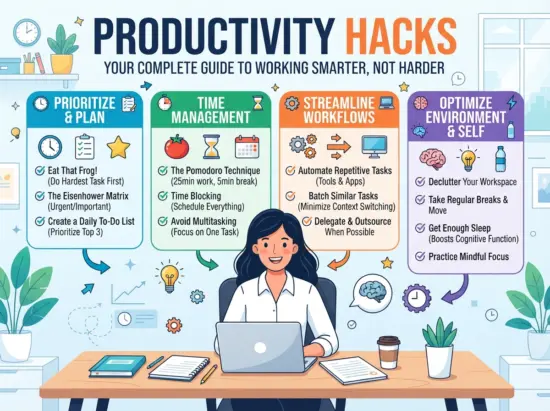
The Two-Minute Rule is simple and effective: If a task can be done in two minutes or less, do it immediately. This stops tiny tasks from building up and stealing focus from bigger priorities. By getting these small wins quickly, you build momentum and reduce the mental clutter of having a long list of unfinished items.
2. Time Blocking and The 1-3-5 Rule
Time blocking is a method where you divide your day into chunks of time, each dedicated to a specific task or project.
A great framework to use with time blocking is the 1-3-5 Rule:
- 1 Big Item: A primary project requiring significant focus.
- 3 Medium Items: Important tasks that move the needle but are less complex.
- 5 Small Items: Brief administrative “quick wins”.
This approach ensures your most important work gets done instead of being buried by minor tasks.
3. Eat the Frog
This approach says to start your day with your most challenging, and often most dreaded, task first. Big, complicated projects can weigh on you or seem daunting, leading to procrastination. Knocking out this responsibility first clears your mind and gives you a huge sense of accomplishment for the rest of the day. Remember, the hardest part is often just starting.
4. The “One More” Approach
If you’re feeling overwhelmed by your to-do list, try the “one more” approach. The idea is to break your tasks up into small pieces and continuously challenge yourself to do just “one more” mini-task before stopping.
For example, if you have a mountain of emails to get through, just urge yourself to tackle “one more” at a time. Every time you complete one, you get a small boost of confidence and momentum, making it easier to do another. This is a great way to use momentum to break through procrastination.
5. The Eisenhower Matrix
The Eisenhower Matrix helps you prioritize tasks by urgency and importance. It splits your tasks into four quadrants:
- Do: Urgent and important tasks you should do immediately.
- Schedule: Important but not urgent tasks you should schedule for later.
- Delegate: Urgent but not important tasks you can delegate to others.
- Delete: Neither urgent nor important tasks you can eliminate.
This method helps you avoid the “mere urgency effect,” our tendency to focus on urgent tasks over important ones.
Digital Tools to Hack Your Workflow
Technology can be a major productivity booster when used correctly. Here are some tools and hacks to consider:
Project Management and Automation
Tools like Trello and Asana help you visualize projects and manage tasks with boards, timelines, and deadlines. Zapier can connect your apps to automate recurring tasks. For example, you can automatically create a task in Asana when a meeting pops up on your Google calendar.
AI as a Daily Support Tool
You can use AI to remove everyday productivity blockers like emails, meeting notes, and repetitive tasks. Some effective AI habits include:
- Start your day with an AI-powered plan: Share your task list with AI and ask it to group tasks by urgency and suggest what to do first.
- Use AI to summarize: Use AI to summarize long emails, documents, and meeting notes into concise bullet points, highlighting action items and deadlines.
- Turn meeting notes into action items: After a meeting, paste your raw notes into an AI tool and ask it to extract decisions, tasks, deadlines, and follow-ups.
- Draft routine emails: Use AI to create a starting point for common emails like updates, reminders, and thank-you notes.
Focus Tools
Pomodoro Timers implement the Pomodoro Technique, a time management method that involves working in focused 25-minute intervals followed by short breaks. Apps like Freedom can temporarily block distracting websites and apps on your phone or computer. Even using your phone’s built-in “Do Not Disturb” mode can help protect your attention.
Avoiding Common Productivity Traps
Even well-intentioned hacks can backfire if not implemented correctly. Here are some common traps to avoid:
The Productivity Tool Paradox
Sometimes, digital tools meant to boost efficiency can end up making us less productive. Introducing new tools can “speed up the wrong tasks,” leading us to accomplish less over time. The key is to avoid focusing too much on the impact on individual tasks and instead pay attention to your “scoreboard”—are you producing more valuable output than before?
The “Always On” Culture Trap
The constant pressure of an always-on culture creates a state of fragmented attention. To combat this, set clear “busy” and “available” hours so there’s no expectation of always being online. Encourage asynchronous communication: collaborate and respond on your own schedules to cut down on unnecessary meetings and allow for deeper work.
The “Too Long” To-Do List
A long, unprioritized to-do list can be more demotivating than helpful. Instead of a list of 20 things you need to get done, aim for 3-5 big and small tasks per day. Keep a separate list for tasks that can wait so you’re only focusing on what’s most important.
The “Too Many Apps” Problem
Downloading too many productivity apps can paradoxically make you less productive. Instead of collecting apps, focus on mastering one tool at a time. Research apps thoroughly, and when you download a new one, schedule time to learn how to use it fully before you move on to the next