Table of Contents
Welcome to HabitHack.fun, your ultimate resource for mastering the art of productivity and habit formation. In today’s world of constant notifications, endless meetings, and information overload, being productive isn’t about working more hours—it’s about working smarter. This comprehensive guide compiles the most effective, science-backed productivity strategies, from understanding the psychology of productivity to implementing powerful techniques like the Two-Minute Rule, time blocking, and habit stacking.
Understanding Productivity: What It Really Means
Productivity means different things to different people, especially in knowledge work . While the traditional definition focuses on the ratio of output to input, modern productivity frameworks recognize that knowledge work is far more nuanced. A study by Kim et al. uncovered six main themes of productivity evaluation: work product (concrete output and achievements), time management (efficiency and punctuality), attention versus distraction, attitude toward work, long-term impact and benefit, and the ability to handle compound tasks like multitasking and task switching .
The SPACE Framework
The SPACE framework offers a more robust way to measure productivity, particularly for knowledge workers. It measures productivity across five dimensions:
- Satisfaction and well-being: Personal satisfaction with work, efficacy, and burnout
- Performance: Quality and impact of work done, not just output
- Activity: Number of tasks and operational activities performed
- Communication and Collaboration: How work is integrated among team members
- Efficiency and flow: Ability to complete tasks with minimal distractions
This holistic approach reminds us that true productivity isn’t just about checking boxes—it’s about creating sustainable systems that support your well-being while delivering meaningful results.
The Science of Habits and Productivity
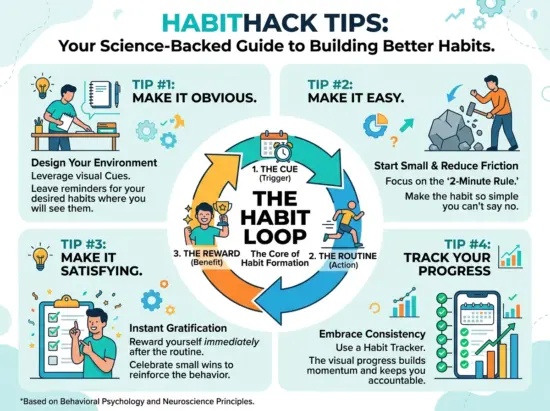
The Habit Loop
Habits account for about 40 percent of our behaviors on any given day, according to researchers at Duke University . Understanding the habit loop—cue, routine, reward—is essential for building productive habits:
- Cue (Trigger): A situation or event that prompts an action
- Routine (Behavior): The habitual action taken in response to the cue
- Reward (Benefit): A positive outcome that reinforces the behavior
Why Most Habits Don’t Stick
Motivation is unreliable. Energy comes and goes. What lasts? Systems. As James Clear famously wrote, “You do not rise to the level of your goals. You fall to the level of your systems” . This is the shift from habit hacking to systems thinking—from isolated behaviors to integrated workflows .
Identity-Based Habits
Instead of focusing on what you want to do, focus on who you want to become. When you ask yourself, “What story do I reinforce when I skip this habit? What story do I want instead?” you’re building identity-based habits that stick . Examples include: “I protect my calendar because I respect my future self” and “I close my day clean because tomorrow’s chaos starts with today’s neglect” .
Proven Productivity Tips
1. The Two-Minute Rule
The Two-Minute Rule, popularized by James Clear in Atomic Habits, is a powerful technique for overcoming procrastination . The rule works by scaling down your goals to a version that can be completed in two minutes or less .
How it works:
- Shrink the habit: Take your desired habit and scale it down to the smallest possible version. For example, “I want to run 5 kilometers” becomes “I’ll put on my running shoes and step outside”
- Focus on starting: The goal isn’t to complete the habit but simply to start it. Once you’re in motion, you’ll often naturally continue
- Trust the process: Even if you stop after two minutes, you’ve won because you’re reinforcing the habit of showing up
Dr. Suyash V. Shendye, Consultant Psychiatrist, explains: “Practices like the ‘two-minute rule’ break inertia—that heavy ‘mental drag’ before starting—by lowering the activation energy. When you act for just two minutes, the brain shifts from hesitation to motion. Neurologically, it’s not just dopamine at play; glutamate and norepinephrine circuits also kick in, strengthening focus and cue-response pathways” .
2. Time Blocking
Timeboxing—deliberate scheduling of when each task gets attention—can significantly reduce interruptions and boost clarity . Rather than letting tasks ramble or interrupt one another, you create a structure in which each block has purpose .
How to implement:
- Block the first 60–90 minutes for high-cognitive tasks
- Reserve afternoons for meetings or collaboration
- Include buffer time for unexpected issues
Trivago’s CEO, Johannes Thomas, describes how he reserves early blocks for deep work: “I just focus on a problem, think it through, and really go into deep thinking” .
3. Habit Stacking
Habit stacking adds new behaviors to an established workplace routine. Follow these steps :
- Identify a current routine: Look for things you regularly do, like turning on your computer
- Specify a new behavior: Choose a simple habit that flows naturally after the first
- Create a habit-stacking statement: Use the formula “After [existing work habit], I will [new work habit]”
- Start small: Add short, easy-to-perform habits first, then chain them for longer routines
4. Batch Similar Tasks
Combine task batching and time blocking for a sustainable routine . Instead of checking messages sporadically, set aside time to handle all communications at once. Repeat this step to knock out approvals or admin work in a single session .
5. Know Your Biological Prime Time
Everyone has windows of peak focus. Chris Bailey refers to this as your “Biological Prime Time”—the daily period when your energy, clarity, and productivity are highest . Research from Cornell University found that many knowledge workers hold clear preferences for when they feel most effective, though their actual schedules often don’t reflect those preferences . Axios CEO Jim VandeHei starts his day between 4:30 and 5 a.m. to capture hours of uninterrupted thinking and writing .
6. Take Purposeful Breaks
Research shows that short, regular breaks improve focus and reduce decision fatigue . A Slack study found that when employees took daily breaks, their ability to manage stress increased by 230 percent, and their ability to focus on work increased by 92 percent .
7. Design Your Environment
Your surroundings can have a bigger impact on productivity than you think. Even small changes like adjusting lighting, reducing digital notifications, or keeping only what you need on your desk can make a big difference . Visual cues like writing out your to-do list and putting it on your screen can trigger your morning productivity routine .
Tracking Progress and Building Systems
Track Systems, Not Just Streaks
Instead of simply checking off habits one by one, ask yourself :
- How often did my full morning system run?
- What percentage of days did I protect my deep work block?
- When the system failed, where exactly did it break?
This turns habit tracking from guilt into strategic insight .
Build Keystone Micro-Systems
Create micro-systems—short routines that unlock a cascade of behavior. For example, a “Focus Launcher” might include a 5-minute morning review, turning on noise-canceling headphones, and updating Slack status to “Deep Work” . An “End-of-Day Clean-Up” might include clearing calendar clutter, writing a one-line reflection, and setting tomorrow’s three priorities