Table of Contents
Welcome to HabitHack.fun, your ultimate resource for mastering productivity and cognitive performance. In a world where distractions are constant and notifications never stop, the ability to perform deep work has become one of the most valuable and increasingly rare skills in the modern workplace. This comprehensive guide explores the neuroscience behind deep work, proven techniques to achieve it, and practical strategies to build a sustainable practice that will transform your productivity.
What Is Deep Work?
Deep work is a cognitive state in which you give your full, undivided attention to a demanding task, pushing your cognitive abilities to their limit. In this state, you produce high-quality work efficiently while making significant progress on complex problems.
The concept was coined by Cal Newport, a professor of computer science at Georgetown University, in his bestselling book Deep Work: Rules for Focused Success in a Distracted World. Newport argues that deep work is “professional activities performed in a state of distraction-free concentration that push your cognitive capabilities to their limit. These efforts create new value, improve your skill, and are hard to replicate”.
Deep Work vs. Shallow Work
Understanding the distinction between deep and shallow work is essential:
| Deep Work | Shallow Work |
|---|---|
| Requires full concentration | Requires minimal mental effort |
| Pushes cognitive limits | Easy and routine |
| Creates new value | Rarely makes significant impact |
| Hard to replicate | Easily performed by others |
| Examples: Writing, coding, research, strategizing | Examples: Emails, scheduling, social media, filing |
The Neuroscience of Deep Work
When you’re in a deep work state, your brain operates at peak efficiency through a process called neural synchronisation—different parts of your brain work together in coordination, boosting both cognitive efficiency and creativity.
A key player in this process is dopamine, often called the “feel-good” neurotransmitter. When you enter a flow state, dopamine is released, making you feel satisfied and rewarded for staying on task—your brain’s natural way of encouraging you to continue.
The opposite of deep work is continuous partial attention, where you’re primarily focusing on one thing but constantly checking Slack, email, and other interruptions. This state creates mental exhaustion, reduces output quality, and can lead to burnout. When your attention fragments this way, you trigger “attention residue”—your brain remains mentally tethered to previous interruptions, sabotaging your ability to perform high-level, meaningful work.
The Four Deep Work Philosophies
Newport outlines four distinct scheduling philosophies for incorporating deep work into your routine. Choose the one that best fits your work style:
1. Monastic Philosophy
The most intensive approach: cut out all shallow work and focus solely on deep work for consecutive days. You isolate completely from distractions for hours or days. Best for: Professionals requiring constant focus, like data scientists or authors working on urgent deadlines.
2. Bimodal Philosophy
Split your schedule between deep and shallow work—reserving specific days, weeks, or months for deep work and the rest for shallow activities. Best for: Those needing long uninterrupted periods, such as authors or researchers.
3. Rhythmic Philosophy
Turn deep work into a consistent, sustainable habit by scheduling the same time every day. This creates a structured routine that builds momentum. Best for: Professionals with limited availability, like professors or those with fixed schedules.
4. Journalistic Philosophy
Fit deep work into your schedule whenever you have the time or motivation—switching from shallow to deep work “on a dime”. Best for: Professionals whose jobs require quickly switching gears, such as those in public relations.
Deep Work Techniques to Sharpen Your Focus
1. Time Blocking
Schedule dedicated blocks of time for deep work in your calendar—just like important meetings. Color-code these blocks and treat them as non-negotiable appointments. A good rule of thumb is to aim for 60-90 minute deep work sessions, as attention typically wanes beyond this window.
2. Combine with Time Stacking
Time stacking involves grouping similar tasks together and completing them in a single focused block. This minimizes the mental cost of switching between different task types. For example:
- Group all your email replies, scheduling, and communication tasks into one block
- Combine research, writing, and editing into separate but related blocks
3. Deep Stacking (Advanced Method)
Deep stacking combines the Pomodoro Technique with time stacking for complex projects:
- Identify a large, complex project with several related tasks
- Group these related tasks into a single “stack”
- Use the Pomodoro Technique within that stack—e.g., one 25-minute pomodoro for research, a second for outlining, and a third for drafting
4. The 1-3-5 Rule
Prioritize your deep work by limiting your daily focus. Aim for:
- 1 Big Item: A primary project requiring significant focus
- 3 Medium Items: Important tasks that move the needle but are less complex
- 5 Small Items: Brief administrative “quick wins”
This ensures your most important work gets done instead of being buried by minor tasks.
5. The Eisenhower Matrix
Prioritize tasks by urgency and importance to identify what truly deserves deep work:
- Quadrant 1 (Urgent & Important): Do immediately—these are suited for deep work
- Quadrant 2 (Important, Not Urgent): Schedule
- Quadrant 3 (Urgent, Not Important): Delegate
- Quadrant 4 (Not Urgent & Not Important): Eliminate
Building Your Deep Work Environment
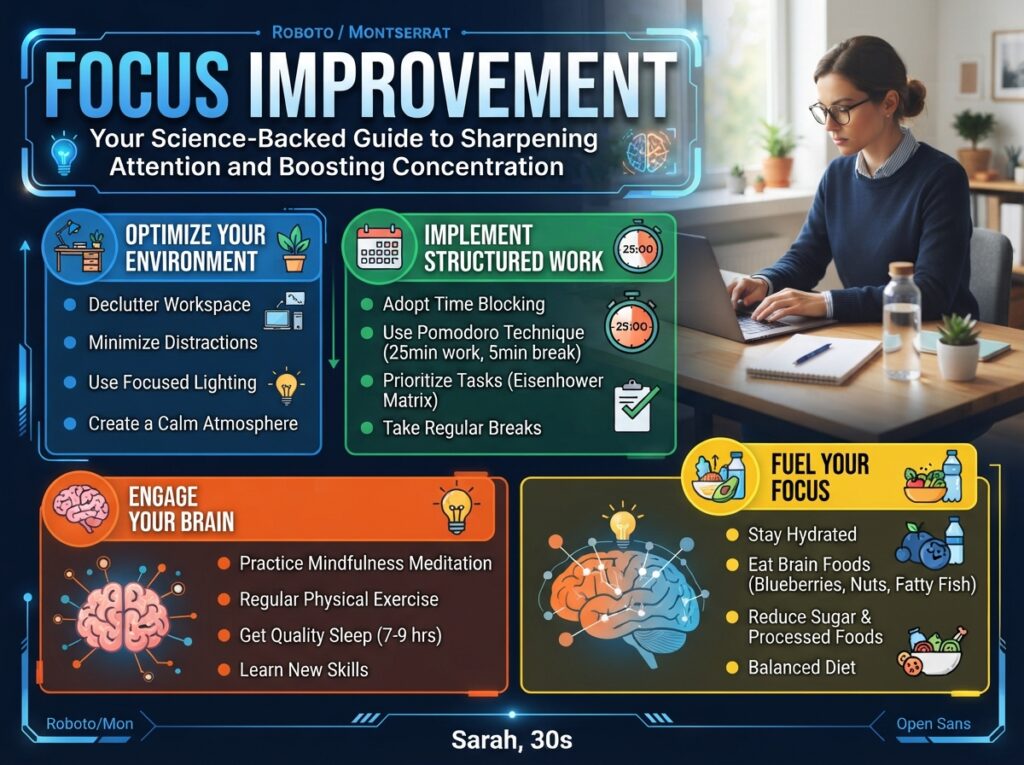
Your environment significantly impacts your ability to focus. Here’s how to create a distraction-free space:
Tame Your Workspace
- Declutter your desk: Clear away anything not needed for the current task
- Adjust lighting: Use bright, natural or warm white light to improve alertness
- Optimize temperature: Ensure proper airflow for cognitive function
- Use a start signal: Create a simple ritual (like putting on noise-canceling headphones) to trigger your brain’s focus mode
Remove Digital Distractions
- Silence your phone and put it out of sight
- Turn on “Do Not Disturb” for all devices
- Close unnecessary tabs and apps
- Use website blockers for distracting sites
- Set specific times to handle inevitable disruptions (like right after lunch)
Schedule Strategically
- Protect your biological prime time—your natural energy and focus peaks
- For most people, this occurs around 10am and again at 2-3pm
- Use energy journaling to identify your patterns: track your energy levels for a few days to find when you’re naturally sharpest
Habits That Make Deep Work Easier
1. Embrace Boredom
Newport argues that if you reach for your phone every moment of downtime, you’re training your brain to need constant stimulation. The more comfortable you become with boredom, the better you’ll sustain focus when it counts. Break habits like picking up your phone in a five-minute line or scrolling TikTok while waiting for a meeting.
2. Track Your Progress
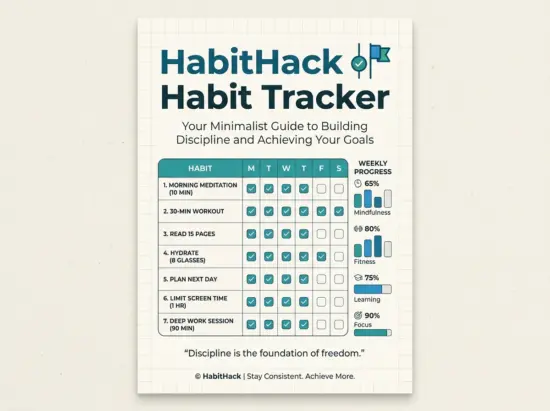
Like any other habit, deep work should get easier with practice. Measure your deep-to-shallow work ratio:
- Calculate what percentage of your work week should be dedicated to deep work
- Track your actual time spent in deep work
- Identify the gap and work to close it
3. Train Your Brain
Concentration is a muscle that weakens without practice. Train your brain to avoid distractions by:
- Reading in silence for 10 minutes and gradually extending the time
- Engaging in focused activities like painting, cooking, or playing an instrument
- Committing to long sprints with clear, measurable goals
4. Communicate Boundaries
Talk to your team about your deep work blocks:
- Set clear “busy” and “available” hours
- Use collaborative tools that allow asynchronous communication
- Hold “docket-clearing” meetings where team issues are logged and reviewed together rather than interrupting focus