Table of Contents
Welcome to HabitHack.fun, your ultimate destination for mastering the art and science of habit formation. If you’ve ever wondered how to build better habits that actually stick, you’re not alone. The problem isn’t a lack of willpower—it’s that we’re often working against how our brains are naturally wired. This comprehensive guide will show you how to work with your brain using science-backed strategies to build better habits that transform your life.
Understanding How to Build Better Habits
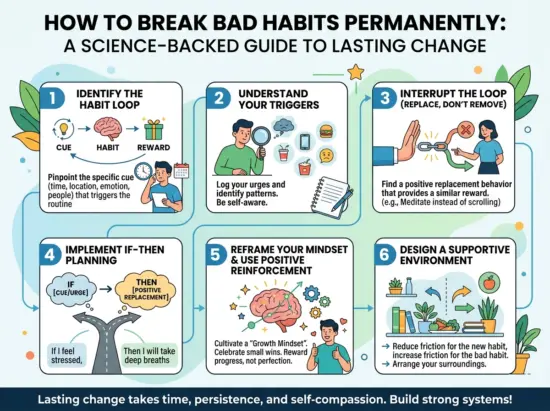
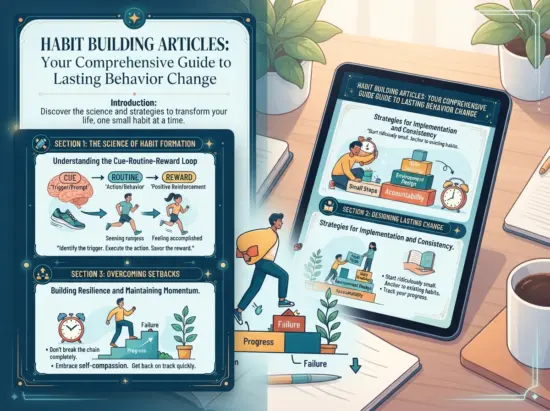
Before diving into strategies, it’s essential to understand what habits are and how they work. A habit is a behavior that becomes automatic through repetition, requiring little to no conscious thought. Habits are formed through a four-step neurological feedback loop called the habit loop: cue, craving, response, and reward . The cue triggers a craving, which motivates a response that provides a reward, reinforcing the entire loop .
Recent neuroscience research from Kyoto University has revealed that habit formation is more complex than previously understood. Two distinct neural circuits manage different aspects of habits: one circuit determines whether a behavior becomes a habit at all, while another controls how intensely the habit is executed—helping explain why habits differ from person to person . The research team discovered they could artificially manipulate these pathways to promote habit formation or alter execution levels, suggesting that how to build better habits may eventually be influenced by understanding these brain mechanisms .
How Long Does It Take to Build Better Habits?
One of the most common questions about how to build better habits is: “How long will it take?” The answer varies significantly. A 2024 systematic review and meta-analysis of health-related habit formation studies found that habits can start forming within about two months, with a median time of 59-66 days and mean times ranging from 106-154 days—with substantial individual variability from 4 to 335 days .
The same meta-analysis identified several key determinants of successful habit formation: frequency and consistency of repetition, timing (morning practices generally exhibit greater strength), individual choice, affective judgments, behavioral regulation, and preparatory habits . The research also showed significant improvements in habit strength across various health behaviors including physical activity, healthy diet, flossing, and vitamin consumption .
The Four Laws of Behavior Change

The most comprehensive framework for how to build better habits comes from James Clear’s Atomic Habits, which presents the Four Laws of Behavior Change . These laws provide practical rules for creating good habits and breaking bad ones.
Law 1: Make It Obvious
The first step in how to build better habits is making the cue for your desired behavior obvious. This involves designing your environment to make good habits visible and easy to start . For example, if you want to drink more water, place a full bottle on your desk. If you want to exercise in the morning, lay out your workout clothes the night before.
Implementation tools for this law include:
- Habits Scorecard: Write down your current habits to become aware of them
- Implementation intentions: Use the formula “I will [BEHAVIOR] at [TIME] in [LOCATION]”
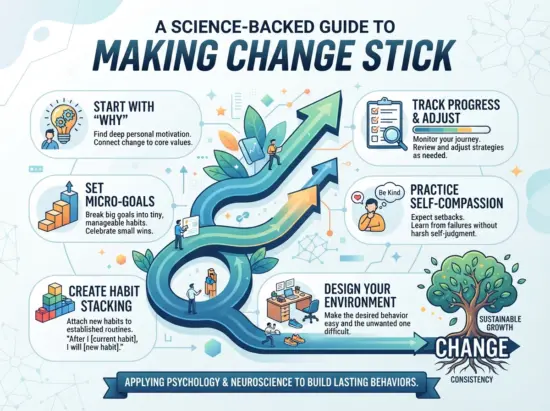
- Habit stacking: “After [CURRENT HABIT], I will [NEW HABIT]”
- Environment design: Make the cues of good habits obvious and visible
Law 2: Make It Attractive
The second law of how to build better habits is making the behavior attractive. We’re more likely to repeat behaviors we find appealing .
Practical applications:
- Temptation bundling: Pair an action you want to do with an action you need to do
- Join a culture where your desired behavior is the normal
- Create a motivation ritual: Do something you enjoy immediately before a difficult habit
According to Charles Duhigg’s The Power of Habit, understanding the root cause of a behavior can help shift it. If you always feel like eating a cookie in the afternoon, you might discover you’re craving social interaction rather than sugar—allowing you to replace the behavior instead of just trying to stop it .
Law 3: Make It Easy

The third law for how to build better habits focuses on reducing friction. The easier a behavior is to perform, the more likely you’ll do it .
Key strategies:
- Reduce friction: Decrease the number of steps between you and your good habits
- Prime the environment: Prepare your environment to make future actions easier
- Use the Two-Minute Rule: Downscale your habits until they can be done in two minutes or less
- Automate your habits: Invest in technology and one-time purchases that lock in future behavior
The “Two-Minute Rule” is particularly powerful for how to build better habits. For example, “read before bed” becomes “read one page,” and “do thirty minutes of yoga” becomes “take out my yoga mat” . The point is to make the habit so easy you can’t say no, building the habit of showing up before expanding on it.
Law 4: Make It Satisfying
The final law for how to build better habits is making the behavior satisfying. We’re more likely to repeat behaviors that provide immediate rewards .
Practical applications:
- Use reinforcement: Give yourself an immediate reward when you complete your habit
- Use a habit tracker: Keep track of your habit streak and “don’t break the chain”
- Never miss twice: When you forget to do a habit, make sure you get back on track immediately
Habit Stacking: The Secret Weapon for Better Habits
One of the most effective strategies for how to build better habits is habit stacking—linking a new habit to an existing one . The formula is simple: “After [CURRENT HABIT], I will [NEW HABIT]” .
The American Heart Association recommends this approach for building healthier behaviors, providing numerous examples :
| When You… | Try This… |
|---|---|
| Wash up in the morning | Smile at yourself in the mirror and add positive self-talk |
| Turn on the morning news | Do 10 toe touches as you listen |
| Get in the car | Take several slow, deep breaths before starting the car |
| Sit down to eat or use a computer | Do a set or two of seated exercises |
| Turn on the TV in the evening | March in place for five minutes before sitting down |
| Go to bed | Put your phone away at least 30 minutes before sleep |
Habit stacking works because it taps into existing neural pathways. Since approximately 40% of our daily actions are driven by automatic behavior, you can use these established routines as reliable cues for new behaviors .
Focus on Identity, Not Just Outcomes
One of the most powerful principles for how to build better habits is shifting focus from goals to identity. According to James Clear, “The key to building lasting habits is focusing on creating a new identity first” . Your current behaviors reflect the type of person you believe yourself to be. To change your behavior, you need to start believing new things about yourself .
The three layers of behavior change demonstrate this:
- Outcomes: Changing your results (e.g., losing weight)
- Process: Changing your habits and systems
- Identity: Changing your beliefs and self-image
The most effective way to change your habits is to focus not on what you want to achieve, but on who you wish to become . Every action you take is a vote for the type of person you wish to become. “The goal is not to read a book, the goal is to become a reader. The goal is not to run a marathon, the goal is to become a runner” .
Breaking Bad Habits
Understanding how to build better habits also involves knowing how to break bad ones. The inverse of the Four Laws applies:
- Make it invisible: Remove the cues of your bad habits from your environment
- Make it unattractive: Highlight the benefits of avoiding your bad habits
- Make it difficult: Increase the number of steps between you and your bad habits
- Make it unsatisfying: Get an accountability partner or create a habit contract
Charles Duhigg’s research shows that you can’t eliminate a specific behavior, but you can replace it. By understanding the cue and reward, you can experiment with ways to change the behavior . For example, if you realize you’re craving social interaction during your afternoon slump rather than the cookie you’ve been eating, you can replace the cookie with a walk to a colleague’s desk .
Practical Applications of Better Habits
Applying these principles to real life is how to build better habits that actually stick. The American Heart Association provides food-specific habit stacking examples :
| When You… | Try This… |
|---|---|
| Check your email or texts | Watch a short video on how to prepare a healthy food |
| Heat water for coffee or tea | Wash and prepare a vegetable or fruit for snacking later |
| Get impatient while waiting in line | Use your phone to look up a healthier recipe |
| Microwave a meal | Prepare a pitcher of water with fruit slices |
| Unload the dishwasher | Mentally plan half your plate as vegetables for your next meal |
| Open a food package | Read the Nutrition Facts label |