Table of Contents
Welcome to HabitHack.fun, your ultimate destination for mastering the art and science of habit formation. Understanding the science of habit formation is the key to unlocking lasting behavior change. When you grasp how habits work in the brain, you can work with your biology rather than against it. This comprehensive guide explores the neuroscience, psychology, and practical applications of habit formation science.
What Is the Science of Habit Formation?
The science of habit formation describes how behaviors transition from deliberate, effortful actions to automatic routines performed with little conscious thought . This process is fundamental to understanding human behavior—research suggests that over 40% of our daily actions are habitual, making habit formation one of the most powerful forces shaping our lives.
At its core, habit formation involves a shift in decision-making strategy. When a behavior is first learned, it is controlled by a goal-directed strategy where actions are selected based on expected outcomes and current needs. As the behavior is repeated in a consistent context, it transitions to a habitual strategy where actions are triggered automatically by environmental cues, independent of the value of the outcome .
The Neuroscience of Habit Formation
Neuroplasticity: The Brain’s Ability to Change
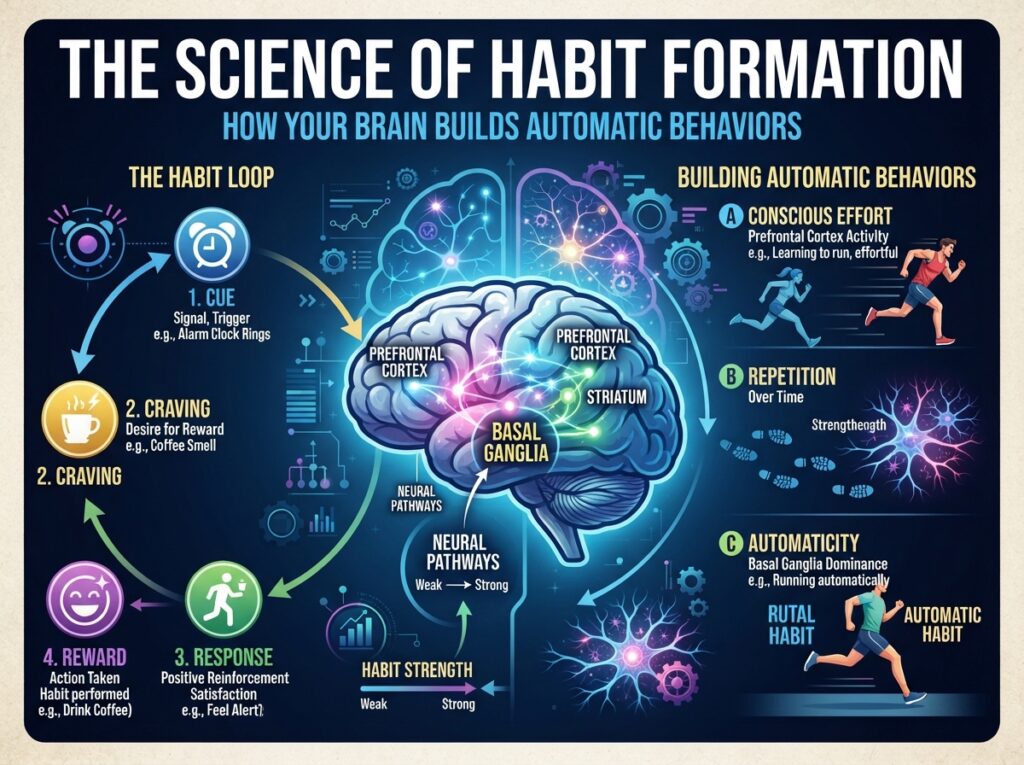
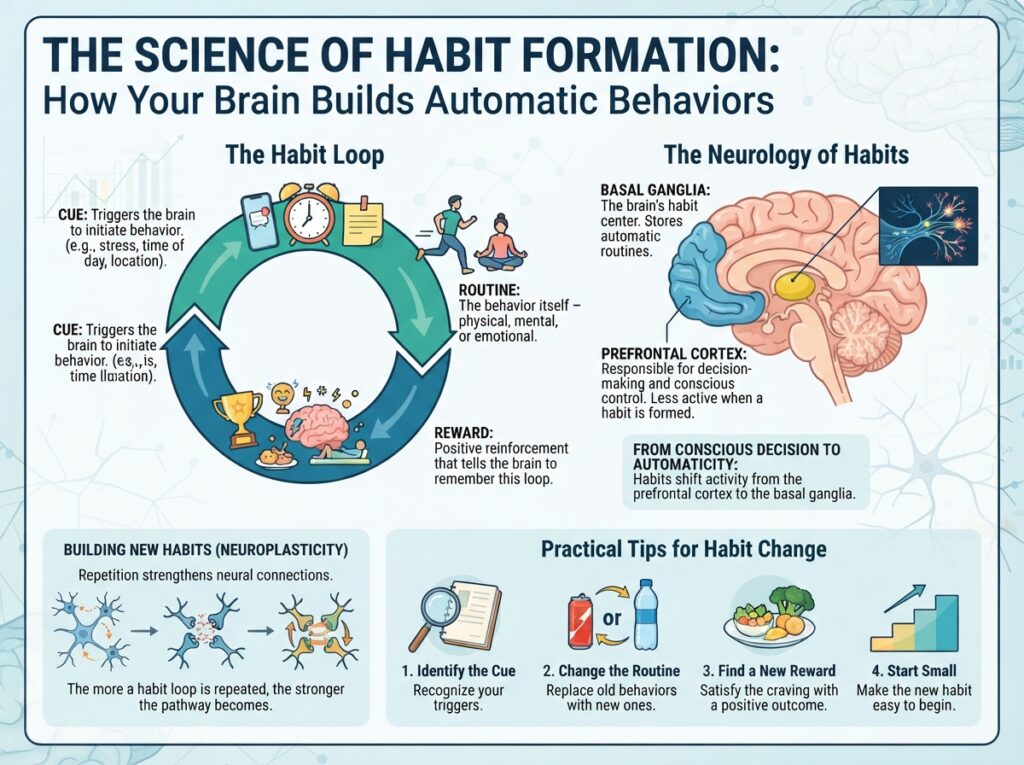
The science of habit formation is rooted in neuroplasticity—the brain’s remarkable ability to change and adapt in response to new experiences. Every time we perform an action or behavior, we establish or reinforce connections between different areas of our brains, known as neural pathways . When we repeat a particular action, we strengthen the neural pathway—this is how habits are formed.
This process is described in neuroscience as Hebbian learning, summarized by the phrase “neurons that fire together, wire together” . The sustained practice of a new behavior challenges the brain to change, and persevering with repeated practice makes the behavior easier over time, to the point where it becomes second nature .
The Brain Regions Involved in Habit Formation
The science of habit formation involves multiple brain regions working together in complex ways. The basal ganglia—a group of structures deep within the brain—play a central role in habit learning .
Key brain structures in habit formation:
- Dorsolateral striatum (DLS): Associated with habitual, stimulus-triggered actions. When habits form, neural activity shifts here .
- Dorsomedial striatum (DMS): Associated with goal-directed behavior and flexible decision-making .
- Prefrontal cortex: Involved in decision-making and strategy selection; becomes less active as habits become automatic .
- Infralimbic cortex (IL): Plays a crucial role in the development of habitual behavior; lesions here impede habit formation .
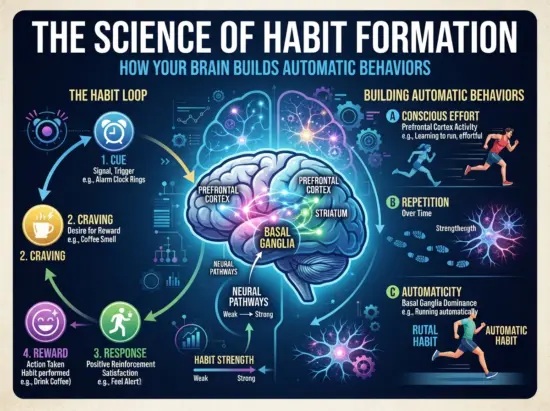
As habits become more automatic, neural activity transfers from the prefrontal cortex—where information processing and decision-making happens—to the basal ganglia, which turns the behavior into an automatic routine requiring little cognitive effort . This is known as stabilization.
The Transition from Goal-Directed to Habitual Behavior
Recent research has revealed that the transition from goal-directed to habitual behavior is more complex than previously understood. Scientists at Kyoto University developed a new training method to study this transition directly in mice and discovered that two distinct neural circuits manage completely different aspects of habits :
- The first circuit (from the anterior cingulate cortex to the retrosplenial cortex) determines whether a behavior becomes a habit at all, with its connections weakening during the transition.
- The second circuit (from the lateral orbitofrontal cortex to the central striatum) controls how intensely the habit is executed, helping explain individual differences in habit strength .
By artificially manipulating these pathways, researchers were able to selectively promote habit formation or alter execution levels, proving the distinct roles of these two brain circuits. This finding helps explain why habits differ from person to person and suggests that the habit formation process is much more complex than the traditional view that repetition simply replicates an action into a habit in its original form .
How Habits Form: The Key Mechanisms
Cue-Behavior Repetition
The science of habit formation emphasizes that repetition in the presence of consistent cues is essential for habit development. A habit can be understood as a cognitive representation of a cue-behavior association, acquired through repetition of the behavior in the presence of the cue .
A recent micro-randomized trial examining physical activity habits found that cue-behavior repetition had a positive effect on habit strength, confirming that consistent repetition is a key driver of habit formation . Once established, a habit promotes the likelihood of repeated execution of the behavior by automatically instigating the associated behavior when the cue occurs .
The Role of Consistent Cues
Research has shown that contextual and internal cues play a critical role in habit formation. A study examining the effects of different cue types on physical activity habits found that habit mediated the effects of past behavior on physical activity more strongly when people reported :
- Undertaking physical activity at the same time of day
- Doing the same activity
- Being in the same mood
The same study found that consistent place, people, and part of routine did not moderate the effects of habit to the same degree, suggesting that some cues may be more relevant than others for habit formation . This provides formative evidence that consistent contextual and internal cues are a cornerstone of habitual development.
Individual Differences in Habit Formation
The science of habit formation reveals significant individual variation in how habits develop. A study examining the impact of morningness-eveningness (chronotype) on habit-formation effectiveness found that planning interventions may be more effective when tailored to individual differences :
- For a relatively complex behavior like exercise, planning at a time that matches an individual’s diurnal preference facilitated behavioral engagement.
- For a simpler behavior like taking calcium supplements, optimal results occurred when the behavior was planned for the morning.
This suggests that habit-formation strategies may depend on both diurnal preference and behavioral complexity, challenging the “one-size-fits-all” approach to habit formation.
The Role of Automaticity in Habits
Action Chunking
One dominant feature of neural activity in the basal ganglia during habit formation is a pattern related to “chunking”—the process of linking actions together into a behavioral unit . Studies of rats running mazes have shown that as animals acquire habitual behavior, neurons in the dorsolateral striatum exhibit activity that accentuates the boundaries of behavioral runs—bursting at initiation and completion .
This chunking pattern forms quite early in learning, well before behavior becomes insensitive to devaluation, suggesting that the brain is built to favor flexible decision-making processes while the habit system undergoes changes for later selection or dominance of the future habit .
Decline of Deliberative Behavior
As habits form, the deliberative, trial-and-error behaviors seen during early learning decline. In maze-running studies, animals displayed “vicarious trial-and-error”—temporary halting with head turns toward possible maze arms before making a selection—often during early learning, then this declined to near-zero levels as the behavior became well-learned .
The strength of the DLS chunking pattern correlates inversely with deliberation on a trial-by-trial basis: the stronger this pattern, the less likely animals are to exhibit deliberation during their run . This correlation occurs during early learning phases as well, when animals are still goal-directed, suggesting that the sensorimotor striatum carries a potentially active influence over behavior very early in the learning process, bestowing automaticity the stronger its activity is as behavior begins .
How Long Does Habit Formation Take?
A common question in the science of habit formation is how long it takes. Research shows significant variability:
- A widely cited study found it took participants anywhere from 18 to 254 days to form a new habit, with an average of about 66 days .
- This means it may be helpful to expect habit formation based on daily repetition to take around 10 weeks .
- However, the trajectory of habit formation is highly idiosyncratic—person-specific growth functions indicate that habit strength trajectories vary considerably from person to person .
The science of habit formation also reveals that habit formation typically follows a non-linear pattern, often characterized by asymptotic growth where initial rapid progress gradually slows and plateaus .
The Science Behind Habit Promotions Strategies
Research has identified effective strategies for promoting habit formation, grounded in the science of habit formation :
- Implementation intentions: Formulating specific plans (“If situation X occurs, then I will do Y”) helps individuals identify the context and cues to be associated with the target behavior.
- Prompts and cues: External memory aids like reminders increase the likelihood of remembering to perform the behavior during opportunities for action.
- Commitment: The strength of the decision towards performing an intended behavior represents a prerequisite for the effectiveness of implementation intentions.
Tentative findings suggest that commitment and prompts and cues are effective habit-promotion strategies when delivered together .
Applications of Habit Formation Science
The science of habit formation has significant implications for understanding and treating conditions involving overly fixed behaviors :
- Addiction: Understanding the neural mechanisms of habit formation helps explain compulsive drug-seeking behavior .
- Obsessive-compulsive disorder: The persistence of repetitive behaviors may reflect dysfunctions within the brain’s habit network .
- Behavioral interventions: Insights from habit science can be applied to promote beneficial habits like physical activity, healthy eating, and medication adherence