Table of Contents
Welcome to HabitHack.fun, your ultimate destination for mastering the art and science of habit formation. If you’ve ever struggled to make a new routine stick or felt frustrated by a lack of progress, you’re not alone. The problem isn’t a lack of willpower—it’s that we’re often working against how our brains are naturally wired. This guide compiles the most effective, science-backed strategies for habit building, offering you a complete toolkit to transform your intentions into lasting actions.
Understanding the Science of Habit Formation
Before diving into strategies, it’s essential to understand how habits form in the brain. A habit is a behavior that becomes automatic through repetition, requiring little to no conscious effort . This automaticity is what makes habits so powerful—they free up mental energy for more complex tasks.
The Habit Loop
The foundational framework for understanding habit formation is the habit loop, consisting of four steps: cue, craving, response, and reward. The cue triggers a craving, which motivates a response that provides a reward, reinforcing the entire loop. Understanding this cycle is the key to both building good habits and breaking bad ones .
Neuroplasticity: Your Brain Can Change
Your brain possesses a remarkable ability called neuroplasticity—its capacity to change and adapt in response to new experiences. When you repeatedly engage in a thought or action, you strengthen the neural connections supporting those behaviors. Over time, this makes the action more automatic and efficient, requiring less conscious thought and effort .
How Long Does Habit Formation Really Take?
You’ve likely heard the popular claim that it takes 21 days to form a habit. This is a myth. Modern research tells a very different story.
A 2024 systematic review and meta-analysis of 20 studies involving 2,601 participants examined the time required to form health-related habits . The findings revealed:
- Average time: 55 to 66 days for habits to become automatic
- Mean times: One study found it took 106 days for morning stretching and 154 days for evening stretching to become habitual
- Individual variability: Habit formation ranged from as few as 4 days to as many as 335 days
- Complexity matters: Simpler behaviors like daily flossing were more likely to succeed than more complex ones like maintaining a healthy diet
The most important takeaway? Habits need at least two to five months to become automatic for most people . Understanding this real timeline can help you stay motivated when progress feels slow and prevent the frustration that leads to giving up.
Key Determinants of Habit Formation
The same systematic review identified several factors that significantly influence whether a habit will form successfully :
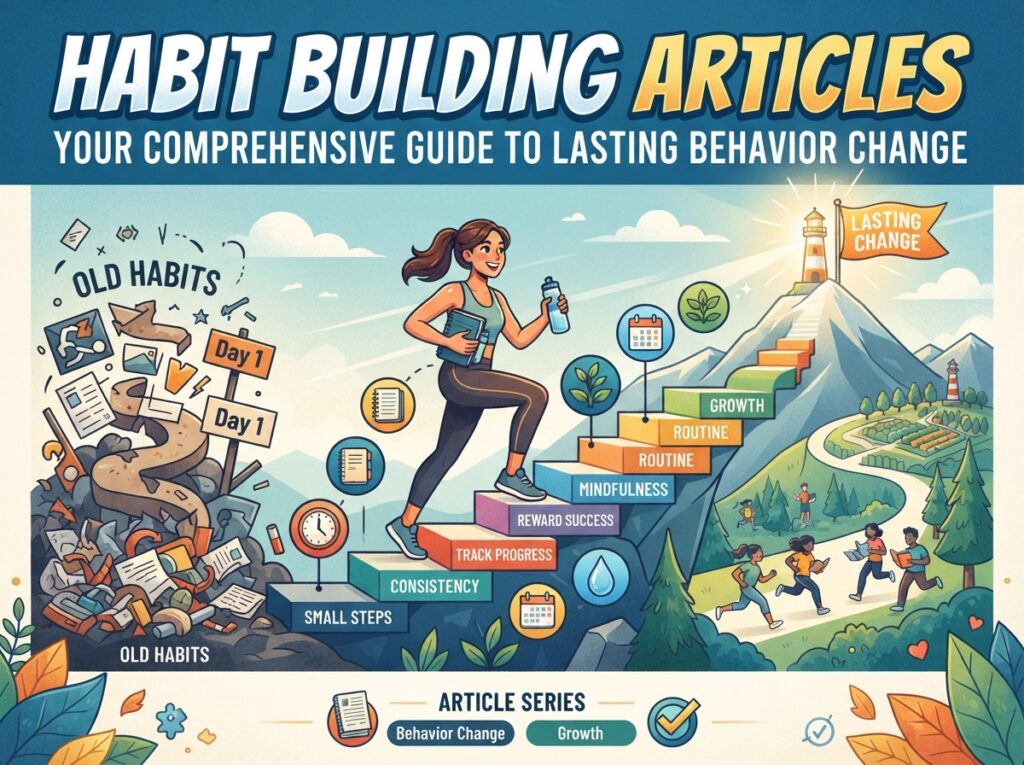
- Frequency and consistency: More frequent repetition in a stable context accelerates habit formation
- Timing: Morning habits tend to form more reliably than evening ones—likely due to higher motivation and fewer distractions early in the day
- Self-selected habits: People are more likely to stick with habits they choose themselves, suggesting that having a clear, structured plan before starting is essential
- Affective judgments: Positive feelings about the behavior enhance habit formation
- Preparatory habits: Structured planning before starting helps develop better routines
Proven Strategies for Building Habits That Stick
1. Start Small—The Two-Minute Rule
One of the biggest mistakes people make when trying to build a new habit is aiming too high, too fast. The research is clear: creating change and achieving goals is much more manageable when approached incrementally.
The “Two-Minute Rule,” popularized by James Clear in his bestselling book Atomic Habits, states that when you start a new habit, it should take less than two minutes to do . For example:
- “Read before bed” becomes “Read one page.”
- “Do thirty minutes of yoga” becomes “Take out my yoga mat.”
- “Exercise” becomes “Put on my workout clothes.”
The point is to make the habit so easy you can’t say no. This builds the habit of showing up, which is the most crucial part of the process. Once that’s established, you can expand on it .
2. Habit Stacking
Habit stacking is one of the most effective and practical strategies for building new habits. It involves linking a new habit you want to build to an existing one that is already deeply ingrained in your routine . The formula is simple: After [CURRENT HABIT], I will [NEW HABIT].
This technique works because it taps into the brain’s existing neural pathways. Since approximately 40% of our daily actions are driven by automatic behavior, you can use these established routines as reliable cues for new behaviors .
Practical Habit Stacking Examples:
| Existing Habit (Cue) | New Habit to Stack |
|---|---|
| After I pour my morning coffee | I will write down one thing I’m grateful for |
| After I brush my teeth at night | I will floss |
| After I get in the car and put on my seat belt | I will take several slow, deep breaths |
| After I sit down to eat or use a computer | I will do seated exercises |
| Before I go to bed | I will put my phone away at least 30 minutes prior |
3. Design Your Environment
Your environment has a significant impact on your emotions and actions. Elements within our surroundings act as “cues” that have a tremendous influence on our behavior .
- For good habits: Make the cues obvious. If you want to drink more water, place a full bottle on your desk. If you want to exercise in the morning, lay out your workout clothes the night before.
- For bad habits: Make the cues invisible. If you want to eat healthier, move unhealthy snacks to the back of the cupboard. If you want to stop scrolling on your phone, put it in another room while you work.
Research has shown that when recycling bins were placed near each person’s desk rather than having one central bin, office paper recycling shot up. Conversely, people took the lift less often when the doors were programmed to open and close more slowly . These examples demonstrate how environmental design can subtly but powerfully shape behavior.
4. Track Your Progress
Tracking your progress provides accountability and motivation . Use a calendar, habit-tracking app, or journal to mark each successful day. The visual evidence of your consistency becomes its own reward and releases a small amount of dopamine that makes you want to keep going . Seeing your improvement makes it easier to continue .
5. Focus on Consistency, Not Perfection
The “never miss twice” rule is a powerful mindset shift . When you miss a day, simply start again the next day. As long as you don’t let one missed day become two, you’re still on track. The key is to maintain the pattern, not achieve perfection.
Doing something daily—even if it’s imperfect or just for two minutes—is more effective than doing it perfectly once a week . Skip perfection and focus on simply showing up.
6. Make It Enjoyable
If a habit feels like a chore, it won’t last. The trick is to make it effortless and enjoyable . Find ways to make habits fun—listen to music while working out, choose nutritious foods you actually like, or turn the habit into a game. Habits should feel good in the moment, not just “worth it later