Table of Contents
Welcome to HabitHack.fun, your ultimate destination for mastering the art and science of habit formation. Habit formation is the process through which behaviors become automatic—actions we perform with little to no conscious thought. It’s estimated that over 40% of our daily actions are habitual, making habit formation one of the most powerful forces shaping our lives . Understanding the science behind this process is the key to creating lasting, positive change.
In this comprehensive guide, we’ll explore the psychology of habit formation, debunk common myths, provide evidence-based strategies, and share practical techniques you can use to build habits that truly stick.
What Is Habit Formation?
In psychology, a behavior has become habitual when it is triggered automatically by specific cues in the environment, bypassing conscious decision-making . As psychologist William James observed over a century ago, when it comes to habits, “action goes on of itself” .
The more a behavior becomes ingrained as a habit, the more it is controlled by brain networks involved in involuntary action rather than those related to conscious goals and decisions. The decision-making process you once had to go through has been bypassed—making the behavior efficient and effortless .
The Habit Loop
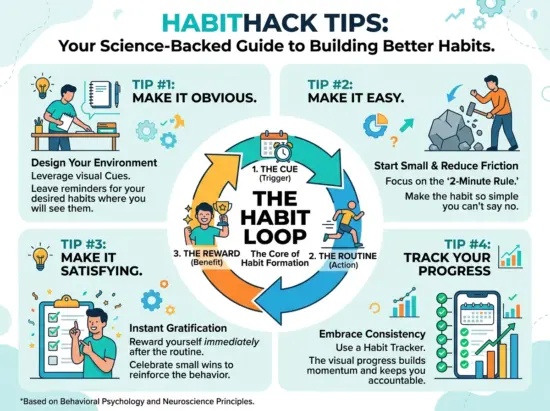
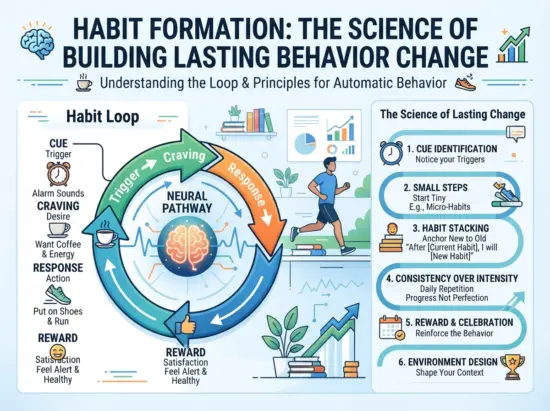
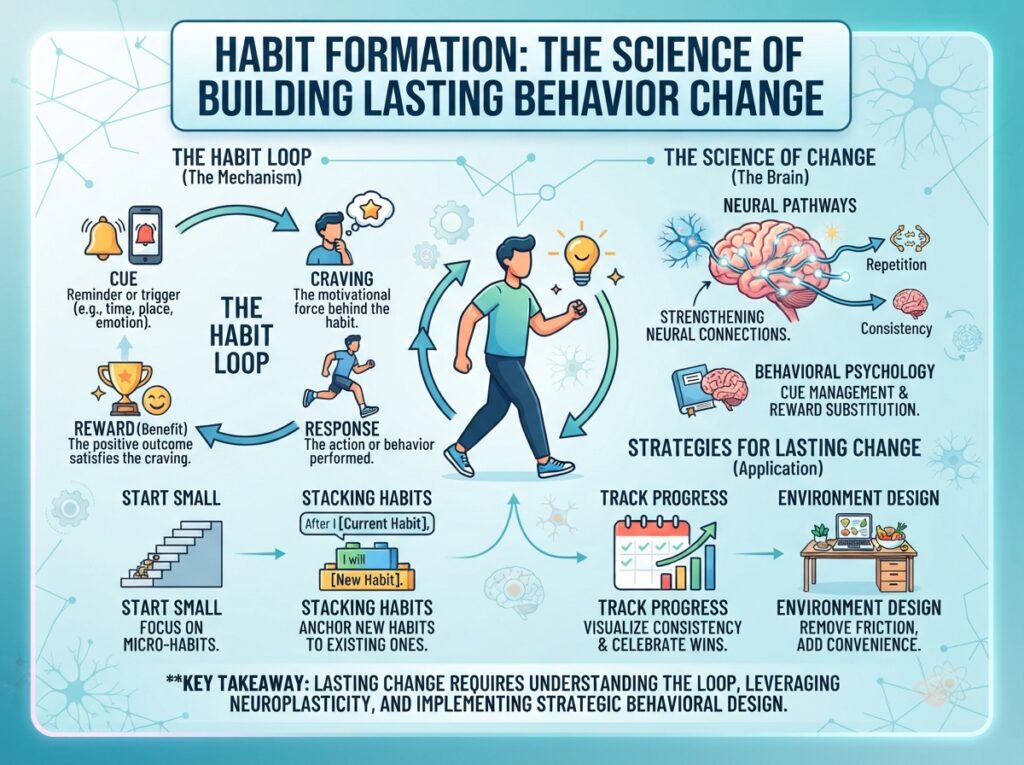
The foundational framework for understanding habit formation is the habit loop, consisting of four steps: cue, craving, response, and reward .
- Cue: The trigger that initiates the behavior—a time of day, location, emotional state, or preceding action.
- Craving: The motivational force behind the habit. It’s the desire for the reward that makes you want to take action.
- Response: The actual habit or behavior you perform.
- Reward: The positive feeling or outcome that reinforces the loop, teaching your brain to repeat the behavior.
Together, these four steps form a neurological feedback loop that ultimately creates automatic habits. This cycle is the foundation of all habit formation .
How Long Does Habit Formation Really Take?
You’ve likely heard the popular claim that it takes 21 days to form a habit. This is a myth. The idea can be traced back to 1960s plastic surgeon Maxwell Maltz, who observed it took about three weeks for his patients to adjust to physical changes . However, modern research tells a very different story.
A 2024 systematic review and meta-analysis examined 20 studies with 2,601 participants, evaluating the time required to form health-related habits . The findings revealed:
- Average time: 55 to 66 days for habits to become automatic
- Mean times: Some studies found it took 106 days for morning stretching and 154 days for evening stretching to become habitual
- Individual variability: Habit formation ranged from as few as 4 days to as many as 335 days
- Simple behaviors vs. complex ones: Drinking water or taking daily vitamins tends to form faster than complex behaviors like marathon training
The most important takeaway? Habits need at least two to five months to become automatic for most people . Understanding this real timeline can help you stay motivated when progress feels slow and prevent the frustration that leads to giving up.
Key Determinants of Habit Formation
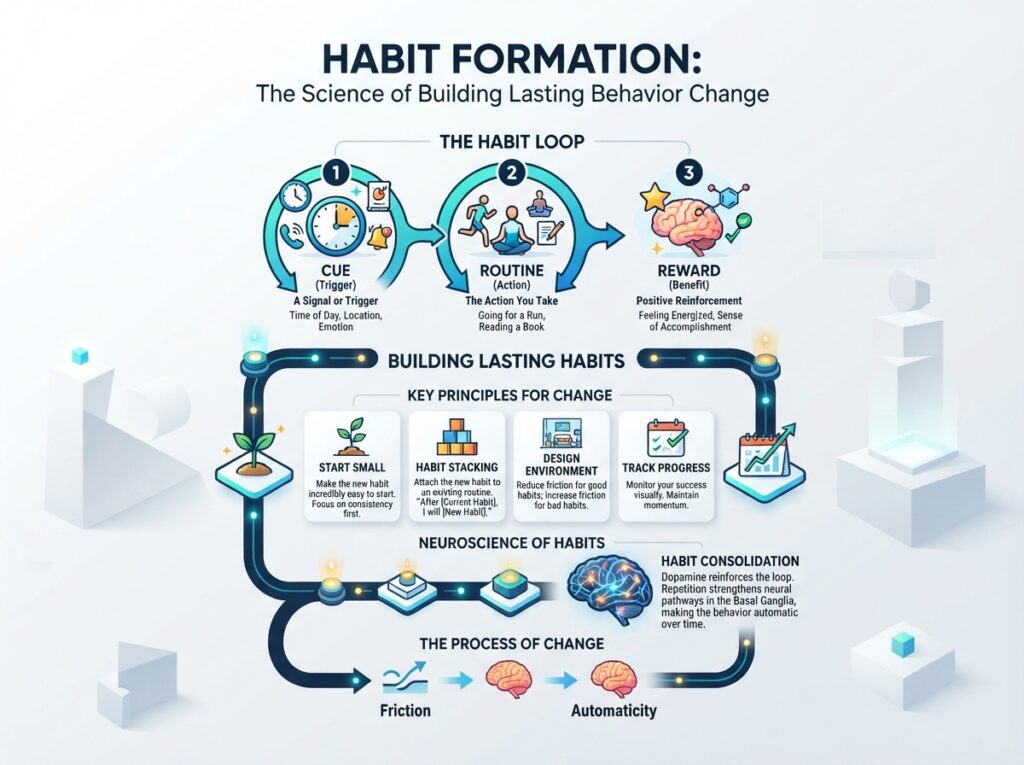
The same systematic review identified several factors that significantly influence whether a habit will form successfully :
- Frequency, timing, and type of habit: More frequent repetition in a stable context accelerates habit formation
- Morning practices: Habits performed in the morning tend to form more reliably than those attempted at night—likely due to higher motivation and fewer distractions early in the day
- Self-selected habits: People are more likely to stick with habits they choose themselves
- Individual choice and affective judgments: Positive feelings about the behavior enhance habit formation
- Behavioral regulation and preparatory habits: Structured planning before starting helps develop better routines
Evidence-Based Strategies for Successful Habit Formation
1. Start Small and Build Gradually
One of the most important strategies for building sustainable habits is starting with an easy goal and gradually increasing . This builds momentum and confidence. For example, if you want to exercise more, start with 10 jumping jacks or a 10-minute walk three days a week .
2. Use Habit Stacking
Habit stacking involves linking a new habit to an existing one . This creates a natural cue for the new behavior. Examples include:
- Flossing immediately before brushing your teeth
- Drinking water after every meal
- Doing a few stretches after pouring your morning coffee
3. Design Your Environment
Environmental cues play a crucial role in habit formation . Make good habits easy and bad habits difficult:
- Place a water bottle on your desk to encourage hydration
- Leave your workout clothes out the night before
- Remove junk food from the pantry
- Put your phone in another room to reduce screen time
4. Track Your Progress
Monitoring your habits provides accountability and motivation . Use a calendar, habit-tracking app, or journal to mark each successful day. Seeing your improvement makes it easier to continue .
5. Build in Rewards
Positive reinforcement helps habits stick . Celebrate small wins—make a special coffee after a morning walk or watch an episode of your favorite show after a week of consistent workouts. These positive emotions help solidify the habit .
6. Be Consistent
Consistency is more important than intensity. Repeating a behavior in the same context—such as walking right after lunch each day—increases the chances it will become automatic . Missing a day won’t reset the clock, so don’t be discouraged. Just get back on track .
7. Make It Easy
The first steps should be ones you can realistically achieve . This is where the “Two-Minute Rule” applies: make the behavior so easy you can’t say no. For example, “read one page” rather than “read for 30 minutes.”
8. Use Implementation Intentions
Make a specific plan: “If [situation occurs], then I will [behavior]” . For example, “If I feel stressed, I will take three deep breaths instead of eating a snack.” This prepares your brain to respond automatically when the cue arises.
9. Focus on Identity
According to James Clear, author of Atomic Habits, the key to lasting behavior change is focusing on creating a new identity first . Don’t just think about what you want to achieve—think about who you want to become. “Every action you take is a vote for the type of person you wish to become” .
10. Be Patient and Practice Self-Compassion
Habit formation takes time, and setbacks are normal. Research shows that habits don’t form overnight—they require at least two to five months of consistent effort . Be patient with yourself and don’t let one missed day become a reason to give up .
Breaking Bad Habits
The science of habit formation also provides a framework for breaking unwanted habits :
- Identify the cue: What triggers the behavior? The sight of your phone? A specific time of day?
- Remove the cue: Leave your phone downstairs if checking it in bed is the problem.
- Alter the context: Habits are often embedded in broader routines. Changing your routine—even moving house or changing jobs—can disrupt the associations that trigger bad habits .
- Substitute the behavior: Instead of leaving a “hole,” replace the unwanted habit with a healthier one that serves a similar function