Table of Contents
Welcome to HabitHack.fun. If you’ve ever felt like there’s never enough time for everything—or that your personal life is constantly being squeezed by work demands—you are not alone. In fact, a recent global study found that for the first time, work-life balance is more important to employees than pay . Achieving balance isn’t about splitting your day perfectly in half; it’s about creating a sustainable rhythm that allows you to thrive both professionally and personally.
What is Work-Life Balance, Really?
Work-life balance is often misunderstood as a perfectly even split of your time and energy between work and personal life. In reality, it’s a dynamic state of equilibrium where you feel you have control over your time and are present and engaged in the various roles you play . It’s the ability to manage the demands of your career alongside your needs, relationships, and responsibilities at home.
This balance looks different for everyone, and it can shift from week to week. The goal isn’t a rigid 50/50 split, but a consistent feeling that you are not constantly sacrificing one aspect of your life for another . When you have good work-life balance, you are less stressed, more productive, and generally more fulfilled in all areas of your life.
Why is Work-Life Balance So Hard to Achieve?
Several modern factors make maintaining balance a challenge:
- The Blurring of Work and Home: With the rise of remote and hybrid work, the physical and mental separation between “work” and “home” has disappeared for many. It’s easier than ever to answer a work email after dinner or finish a project on a Sunday, which makes it hard to truly switch off .
- The “Always On” Culture: Technology like smartphones and the internet can erase the line between your time and your employer’s time if you don’t set clear boundaries .
- The Pressure to be “Busy”: Many people feel pressured to appear constantly productive, leading them to glorify busyness and overwork . Taking on too much can lead to burnout and resentment .
- Personal Expectations: For those with high standards, it can be difficult to set boundaries or say “no,” fearing it might impact their career progress .
Practical Steps to Improve Your Work-Life Balance

You don’t need a life overhaul to start finding better balance. Often, small, intentional changes can make a significant difference.
1. Set Boundaries That People Can Understand
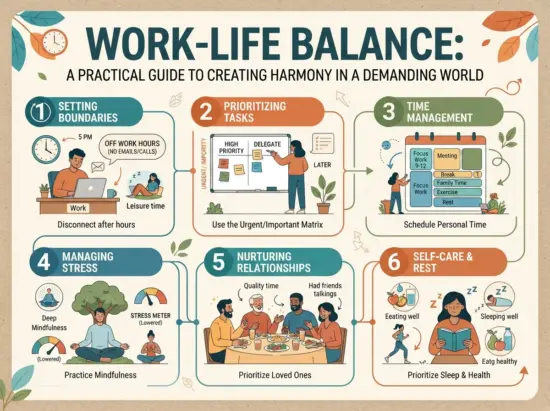
Boundaries are essential for protecting your time and energy. They don’t have to be rigid; “soft” boundaries that leave room for flexibility can be very effective . For example:
- Communicate Your Work Style: Let your colleagues and clients know when you are typically available and when you are not. Adding your work hours to your email signature is a simple, non-confrontational reminder .
- Define “Enough”: Reflect on what success means to you, and be honest about what is “enough” in terms of money, status, or accomplishment. An open-ended definition of success can lead to pursuits without end .
- Learn to Say No: Taking on too much will wear you out. Focus on what’s important and let go of things that don’t matter. If you’re unsure if you have the capacity, it’s okay to discuss it with a trusted friend or colleague before committing .
2. Bookend Your Work Day
Creating rituals to start and end your day helps your brain shift between work mode and rest-of-life mode.
- Morning Routine: Start your day with intention rather than immediately reacting to emails.
- End-of-Day Ritual (The Fake Commute): If you work from home, create a “fake commute” to bookend your day. A 10-15 minute walk around the block can create a mental separation between “work” and “home” .
- Shutdown Routine: Five minutes before you finish work, close the loop by writing down what you’ve completed and your top three priorities for tomorrow. Close all your tabs and shut your laptop with a sense of finality . This helps prevent the workday from bleeding into your evening.
3. Be Intentional with Your Time
If you don’t plan for personal time, it’s likely to get absorbed by work.
- Schedule Personal Time: Schedule time for what matters to you—whether it’s exercise, a hobby, or time with loved ones—like you would a non-negotiable meeting. This “strategic recovery time” should be treated as essential, not optional .
- Prioritize Your Health: Your well-being is a non-negotiable. Simple acts of self-care like eating well, getting enough sleep, exercising, and taking micro-breaks during the day protect your energy and enable you to perform at your best .
- Batch Similar Tasks: Instead of multitasking, group similar tasks together and tackle them in focused blocks of time. This reduces decision fatigue and can help you get more done in less time, freeing up space in your day .
4. Embrace the “Good Enough” Approach
Letting go of perfectionism is a key step toward better work-life balance.
- Automate, Delegate, Delete: At the beginning of each week, review your recurring tasks and ask yourself if you can automate it, delegate it, or even delete it .
- Stop Glorifying “Busy”: Instead of measuring your day by how much you got done, track how often you felt engaged and energized .
5. Use Your Resources
You don’t have to do it all alone.
- Seek Support and Delegate: You can let your children, spouse, coworkers, and other people in your life help you get things done . If you can afford to, consider outsourcing tasks like lawn care or meal delivery to reduce stress .
- Ask for Flexibility: Many companies have programs to help balance work and home life, including flexible schedules, time off, and the ability to work from home. Check to see if your company has any of these options, and if not, consider talking to your boss about them .
- Talk to Your Manager: If you feel your workload is unsustainable, communicate that to your leaders. They can help you prioritize your time, and if there really is too much to do, discuss hiring extra help or streamlining certain tasks .
- Talk to Your Partner: If you have a partner, your career is not pursued in isolation, but in parallel with theirs. Meeting once a week to discuss the week ahead can remove a lot of stress by preplanning shared responsibilities with less conflict .
Navigating Work-Life Balance as a Remote Worker
Working from home offers incredible flexibility, but it also presents unique challenges when it comes to separating work and personal life. To thrive as a remote worker:
- Create Physical Boundaries: Set up a dedicated workspace where you can close the door at the end of the day .
- Establish Work Hours: Clearly define your start and stop times and stick to them. Shut down your computer and mute notifications after hours .
- Take Real Breaks: Step away from your workspace for lunch and take short breaks throughout the day to rest your mind. Even a few minutes of stepping outside or looking out a window can be effective .