Table of Contents
Welcome to HabitHack.fun, your ultimate destination for mastering the art and science of habit formation. If you’ve ever wondered why you automatically reach for your phone when bored or grab a snack when stressed, the answer lies in a powerful neurological process called the habit loop. Understanding this loop is the key to unlocking lasting change in your life. This comprehensive guide will explain how the habit loop works, what happens in your brain, and how you can use this knowledge to build better habits and break bad ones.
What Is the Habit Loop?
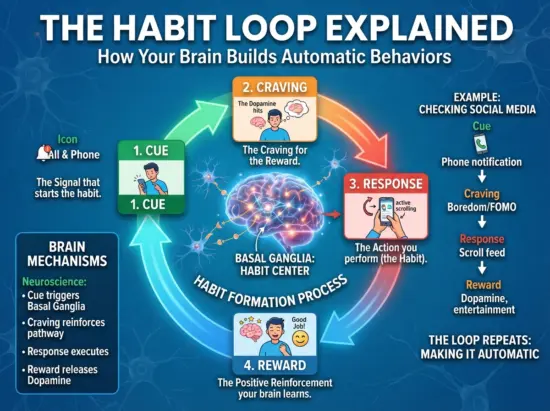
The habit loop is a three-part neurological process that your brain uses to automate repeated actions. It consists of three key components:
- Cue (Trigger): A signal that initiates the habit
- Routine (Behavior): The action you take in response to the cue
- Reward: The positive reinforcement that makes the habit stick
This concept was popularized by Charles Duhigg in his bestselling book, The Power of Habit. Duhigg defines a habit as “a behavior that starts as a choice, and then becomes a nearly unconscious pattern”. Every habit—no matter how simple or complex—follows this same structure.
Why Your Brain Creates Habit Loops
Habits are your brain’s way of conserving energy. Research from Duke University found that more than forty percent of the actions people perform each day aren’t actual decisions, but habits. When you wake up, do you think about which shoe to tie first? Do you deliberate over which route to drive to work? Probably not. These actions have become automatic, freeing your brain to focus on more complex tasks.
The Three Components of the Habit Loop in Detail
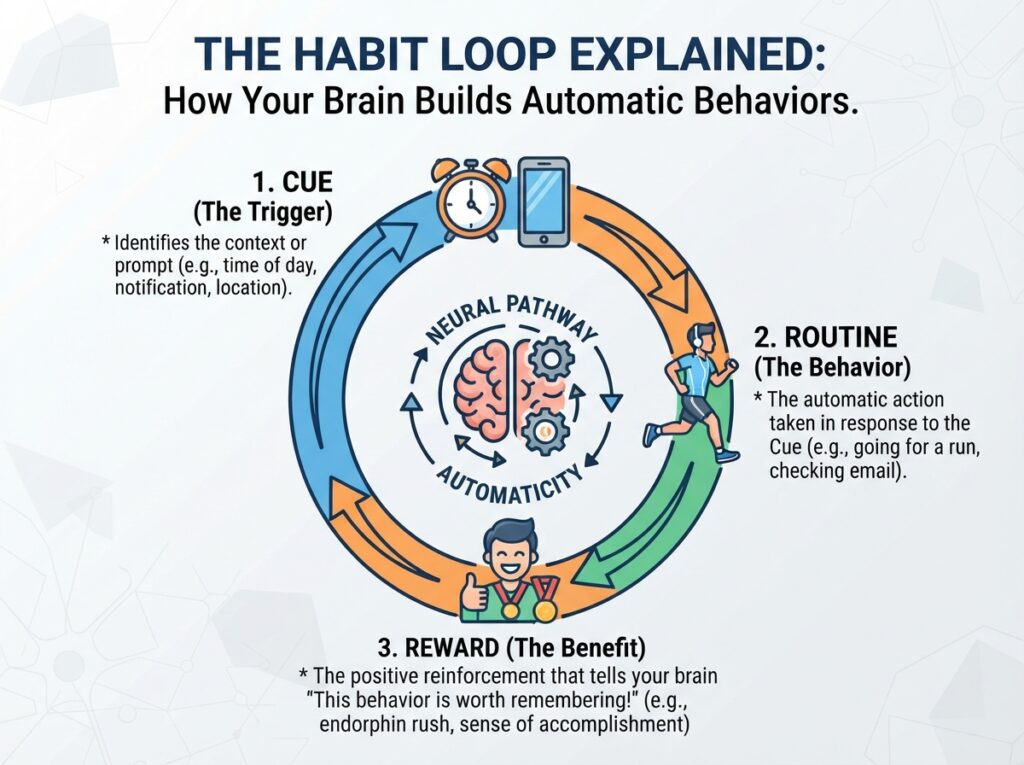
1. The Cue (Trigger)
A cue is any stimulus that tells your brain to initiate a behavior. It’s the starting gun that sets the entire habit loop in motion. Cues can be either external or internal:
Types of cues include:
- Location: Walking past a coffee shop, seeing your phone on the desk
- Time: 3pm every day, first thing in the morning, before bed
- Emotional state: Feeling stressed, bored, anxious, or lonely
- Other people: The company of certain friends or colleagues
- Preceding action: An action that automatically triggers the next behavior
Your brain is constantly scanning for these cues. Once it recognizes a familiar pattern, it initiates the associated routine—often before you’re consciously aware you’ve decided to act. This automaticity is what makes habits so powerful and, sometimes, so difficult to change.
2. The Routine (Behavior)
The routine is the behavior itself—what you actually do in response to the cue. It’s the most visible part of the habit loop, and where intentional change occurs. Routines can take many forms:
- Physical: Reaching for your phone, eating a snack, lighting a cigarette, brushing your teeth
- Mental: Worrying, ruminating, daydreaming, procrastinating
- Emotional: Feeling anxious in certain situations, seeking reassurance, people-pleasing
- Social: Withdrawing from others, checking social media
3. The Reward
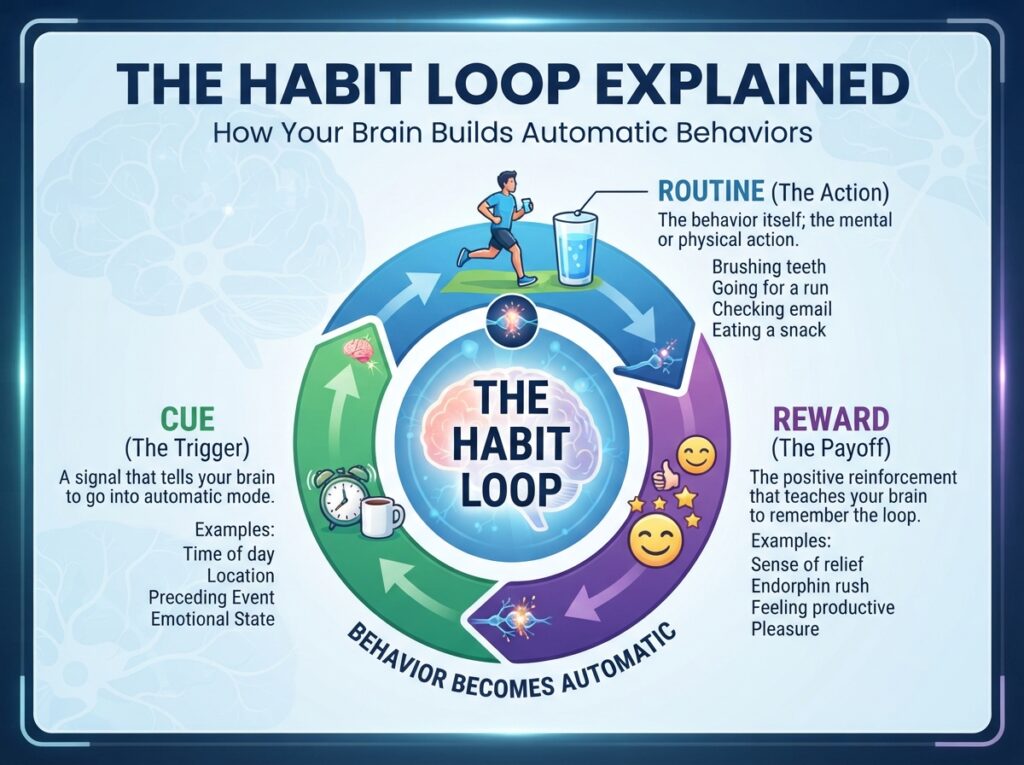
The reward is what your brain gets from the behavior—the payoff that reinforces the loop. It signals to your brain that the action was worth performing and worth remembering. Rewards can be:
- Physical: Sugar, caffeine, endorphins
- Sensory: A pleasing taste, a comfortable feeling
- Emotional: Stress relief, sense of control, distraction from discomfort
- Neurochemical: Dopamine release, temporary pleasure
- Social: Connection, approval, belonging
- Cognitive: Certainty, resolution of ambiguity, feeling productive
Here’s what most people miss: the perceived reward is what matters, not the actual long-term outcome. Your brain learns based on what it expects to get in the moment, not what you consciously want in the long run. This is why you can fully intend to eat healthy but still grab a donut when you walk past the bakery—your brain has learned that the donut delivers an immediate reward.
What’s Actually Happening in Your Brain?
The Basal Ganglia: Your Brain’s Autopilot System
When we first learn something new, it requires active focus and attention from the prefrontal cortex—the “thinking brain”. But as we repeat the task, the basal ganglia—a cluster of structures deep in the forebrain—takes over. This shift from conscious effort to subconscious behavior is what makes habits so powerful.
Recent research has isolated the dorsolateral striatum (DLS) as the specific structure where habit sequences are stored. Once a habit is consolidated here, it runs independently of conscious decision-making. You can be thinking about something completely different while your hands automatically reach for your phone.
The Neurochemistry of Habit Formation
Dopamine, the brain’s reward chemical, creates a positive association between the behavior and what you’re experiencing. As you repeat a routine, more and more neurons fire to reinforce it until it becomes a memory. The neural circuits become so efficient that over time, the behavior requires less and less effort—to the point where you feel you don’t even need to think about it.
Dr. Heidi Allison Bender, a neuropsychologist at NewYork-Presbyterian, explains: “When you create habits, the neurons in your brain fire in the same pattern or sequence, etching it into your mind”.
Why Willpower Alone Doesn’t Work
Willpower is a prefrontal cortex function—conscious, effortful decision-making. But habits live in the basal ganglia, which operates below conscious awareness. This is the critical mismatch: you’re trying to use a “slow, deliberate” brain system to override a “fast, automatic” one. It’s like trying to manually override your heartbeat.
This is why you can be 100% committed to change in the morning and still find yourself doing the same behavior by afternoon. The habit loop activates faster than your prefrontal cortex can intervene.
How to Change Your Habits
Understanding the habit loop gives you the power to change your behavior. There is a “Golden Rule of Habit Change”: to change a habit, you must insert a new routine into the habit loop while keeping the old cue and reward. You can never truly extinguish a bad habit, but you can replace it with a healthier one.
Step 1: Map Your Habit
Start by identifying the specific components of your habit loop. Most people stay vague—”I eat when I’m stressed”—which isn’t specific enough. Instead, ask yourself:
- Trigger: What exactly happened right before? (Notification sound? A thought? A time of day?)
- Behavior: What did you do, step by step? (Reached for phone, opened app, scrolled for 20 minutes?)
- Reward: What did you get? (Distraction? Relief? Novelty?)
Step 2: Notice the Actual Reward
Instead of trying to stop the behavior, investigate what you’re actually getting from it. The next time the trigger appears, pause and ask: “What am I getting from this, right now?”
People who pay close attention often discover:
- Worrying doesn’t solve problems; it creates more tension
- Stress-eating doesn’t relieve stress; it adds guilt and physical discomfort
- Scrolling doesn’t satisfy curiosity; it leaves you more restless
When your brain learns the behavior isn’t delivering the reward it predicted, the loop weakens naturally.
Step 3: Replace the Routine
Find a healthier alternative that delivers the same reward. If you crave a distraction, try a short walk or listening to music. If you need a break, try deep breathing instead of scrolling. The key is to keep the same cue and reward while changing only the routine.
The Role of Mindfulness
Mindfulness is one of the most powerful tools for breaking bad habits. Being mindful of your triggers and behaviors helps disrupt the automatic habit loop, giving you more control over your actions. Dr. Jud Brewer, a psychiatrist and neuroscientist at Brown University, has shown that awareness itself—without any effort to change—predicts behavior change. Why? Because awareness interrupts the autopilot