Table of Contents
Welcome to HabitHack.fun, your ultimate resource for mastering productivity and habit formation. Feeling busy but not productive is a common trap; it often signals that our days are shaped by reaction rather than intention. A structured daily productivity routine is the most effective way to reclaim your focus, reduce stress, and ensure your energy is directed toward what truly matters. This guide provides a science-backed framework for building a routine that works with your biology, not against it.
The Philosophy Behind a Productive Day
A daily productivity routine is a set of intentional habits and time management practices that structure your day from start to finish. The goal is not to pack more in, but to create a system that makes your most important work easier to accomplish. This is rooted in principles like respecting your cognitive limits and automating decision-making.
The persistent pressure of an “always-on” culture creates a state of fragmented attention, where constant digital responsiveness triggers “attention residue.” This cognitive phenomenon means your brain remains mentally tethered to a previous interruption, sabotaging your ability to perform high-level, meaningful work . A solid routine proactively combats this by creating clear boundaries and dedicated focus periods.
The Core Components of a Daily Routine

A well-structured routine aligns with your natural energy patterns and utilizes proven techniques to optimize your workflow. Here are the key pillars:
1. Morning: Start with Intentionality
Your morning sets the tone for the entire day. The goal is to be proactive, not reactive.
- Establish a Power Hour: Identify your “peak” performance window—often the first few hours after waking—and protect it fiercely . Your most important, cognitively demanding tasks should go here.
- Plan Your Day, Don’t Just React: Take a few minutes each morning to define your top priorities. A simple yet powerful habit is to decide on a “Top 3” for the day . This combats decision fatigue and provides a laser-like focus on what matters most .
- Prep Your Environment: Small actions like preparing something for “future you,” such as making coffee or clearing your desk, can create a smoother start and reduce friction .
2. The “1-3-5 Rule” for Task Management
If your to-do list is a never-ending scroll, the 1-3-5 rule provides a simple, effective framework. It is built on the principle of realistic output and ensures your most important work doesn’t get buried by minor tasks .
The framework for your workday is:
- 1 Big Item: A primary project requiring significant focus.
- 3 Medium Items: Important tasks that move the needle but are less complex.
- 5 Small Items: Brief administrative “quick wins.”
This approach is scalable and helps you pivot during unexpected changes without feeling guilty about an unfinished list .
3. Use Time Blocking for Deep Focus
A to-do list tells you what to do, but time blocking tells you when. This technique assigns every task a specific slot on your calendar . Instead of a floating list, you decide in advance when you will do each thing and how long it will take .
- Why It Works: It leverages Parkinson’s Law, combats decision fatigue by eliminating hundreds of micro-decisions, and helps you overcome the planning fallacy of underestimating task duration .
- How to Implement:
- Brain Dump: Write down every task on your plate .
- Categorize: Group tasks into deep work, shallow work, meetings, and personal items.
- Schedule: Place your “Top 3” tasks in your “power hours” and assign similar tasks to specific blocks. Keep deep work blocks between 60 and 120 minutes and add buffer time between blocks .
4. Manage Energy, Not Just Time
Your focus and cognitive ability fluctuate throughout the day in a predictable pattern. By scheduling tasks around these rhythms, you can significantly improve output.
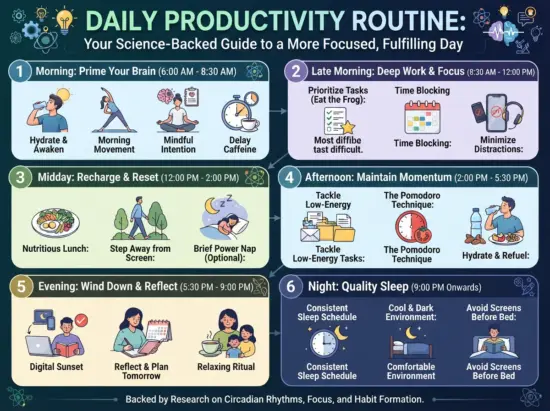
- Know Your Peaks and Troughs: Research suggests a typical cycle is Peak-Trough-Recovery . The morning “Peak” is ideal for high-value work. The early afternoon “Trough” is a natural low-energy time, perfect for administrative tasks. The late afternoon “Recovery” can be a great window for creative work .
- Take Strategic Breaks: To counter the afternoon slump, take short breaks that are Moving, Outside, Social, Fully Detached, and Short . Even a quick 20-minute walk can improve memory and decision-making, as it increases blood flow and oxygen to the brain . Schedule these as non-negotiable blocks in your calendar.
5. End with a Daily Review
Creating closure at the end of your day sets you up for a more focused morning and protects your personal time.
- The 5-Minute Wind-Down: Spend the last few minutes of your workday reviewing what you accomplished, outlining priorities for the next day, and clearing your workspace . This creates a sense of progress and allows you to disconnect more easily.
Tiny Habits for Big Gains
In addition to the core structure, these small habits can help you reclaim 10+ hours per week :
- Batch Similar Tasks: Do all your email, phone calls, or administrative work in a single block to minimize the hidden time drain of context-switching .
- The Two-Minute Rule: If a task takes less than two minutes to complete, do it immediately. This prevents small tasks from piling up .
- Set “Do Not Disturb” Blocks: Use your devices’ DND feature during your power hours to block out digital distractions .
- Create Email Templates: Identify common responses you send and create templates to save time .
- Prepare for Tomorrow Tonight: Lay out your clothes, pack your bag, or prepare your lunch in the evening to ease decision fatigue in the morning