Table of Contents
Welcome to HabitHack.fun, your ultimate resource for mastering productivity and habit formation. The concept of “work smarter, not harder” is more than just a popular saying—it is a fundamental shift in how we approach our work. In a world where burnout is rampant and 77% or more of the modern American workforce experiences workplace stress, working smarter is no longer optional; it is essential for survival and success . This guide explores what this principle truly means, why the “hustle culture” fails, and provides actionable strategies to transform your work life.
What Does “Work Smarter, Not Harder” Really Mean?
At its core, working smarter means finding more efficient and effective ways to complete tasks, enabling you to achieve better results with less wasted effort . It’s about leveraging strategy, systems, and intelligent tactics to maximize output while minimizing unnecessary exertion. This phrase is a contrast to the traditional “hustle culture,” which equates visible activity with productivity .
Working smart means prioritizing the results of your work and not getting so obsessed with demonstrating your work ethic that you end up wasting time . The key insight is that hard work and success are correlated, but it is a mistake to think that simply working harder will lead to better outcomes. The direction of your effort—your strategy—is what determines how far you will go .
The Problem with Hustle Culture: Why Working Harder Fails
The Trap of Pseudo-Productivity
The modern workplace is plagued by “pseudo-productivity,” a concept explored by Cal Newport. This is the idea that we use visible activity as a proxy for useful effort . Because knowledge work is difficult to measure in the same way as factory output, we fall back on being visibly busy—responding to emails, attending Zoom meetings, and staying “always on”—to prove our value . This creates a relentless pressure that is counterproductive and unsustainable.
The Cognitive Cost of Constant Interruption
The persistent pressure of an always-on culture creates a state of fragmented attention. Constant digital responsiveness triggers “attention residue,” where your brain remains mentally tethered to a previous interruption, sabotaging your ability to perform high-level, meaningful work . Multitasking, often seen as a valuable skill, is a disaster for the brain. When you switch your attention, it triggers an expensive cognitive context switch that drains your mental energy .
Core Principles for Working Smarter
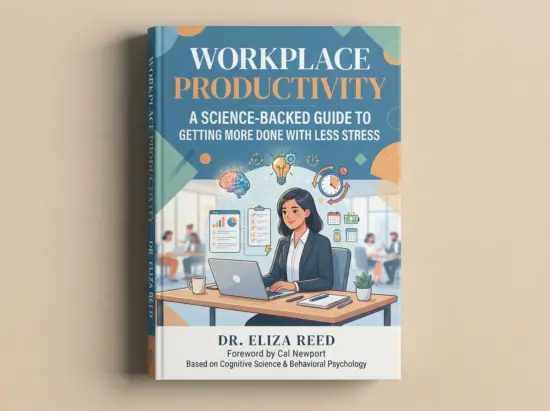
Cal Newport’s book, Slow Productivity, outlines three key principles that form the foundation for working smarter .
Principle #1: Do Fewer Things.
Strive to reduce your obligations to the point where you can easily imagine accomplishing them with time to spare. Work on at most one major project per day, with the goal of reducing the administrative overhead that accumulates when you juggle too many tasks .
Principle #2: Work at a Natural Pace.
Don’t rush your most important work. Allow it instead to unfold along a sustainable timeline, with variations in intensity. This means accepting that work is not always linear and embracing the idea of “seasonality,” where you vary your intensity throughout the year to avoid burnout .
Principle #3: Obsess Over Quality.
Focus on the quality of what you produce, even if this means missing opportunities in the short term. Once you commit to doing something very well, busyness becomes intolerable. However, it’s important to balance this with realistic deadlines to avoid falling into an obsession with perfectionism .
Practical Strategies to Optimize Your Workday
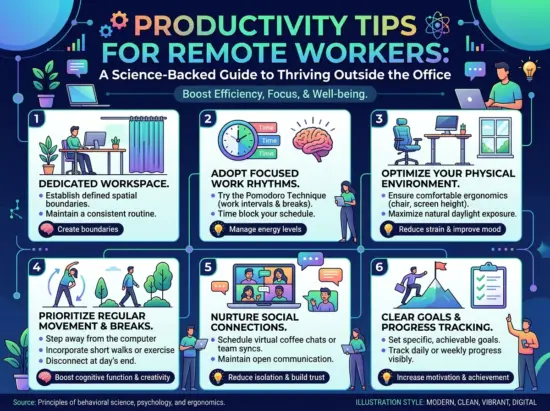
Manage Your Energy, Not Just Your Time
Align your most demanding tasks with your natural biological rhythms. Most people follow a predictable Peak-Trough-Recovery pattern .
- Morning “Peak”: This is your “power hour” and the best time for your most important, cognitively demanding work.
- Early Afternoon “Trough”: A natural low-energy time. Save this for routine administrative tasks, meetings, or responding to emails .
- Late Afternoon “Recovery”: Your energy often picks up again, making it a good time for creative brainstorming or planning.
To identify your personal patterns, try “energy journaling”: track your performance rating on a scale of 1 to 10 every two hours for a few days to identify your natural peaks and troughs .
Build Systems, Not Just Goals
A system is a repeatable process that reduces decision fatigue and streamlines your efforts. Instead of reinventing the wheel daily, you create a framework that works for you .
- Task Batching: Group similar tasks together, such as responding to all emails in one time block, rather than switching between different types of work .
- Automation: Leverage technology to automate low-stakes decisions and routine tasks. This could mean using software like Asana or Notion to automate workflows .
- Simplify Decisions: Reduce decision fatigue by automating low-stakes decisions. Steve Jobs famously wore the same outfit every day to eliminate one trivial choice .
Use the “1-3-5 Rule”
A practical heuristic for structuring your daily to-do list is the 1-3-5 Rule, which is built on the principle of realistic output . It suggests you can effectively accomplish nine tasks per day:
- 1 Big Item: A primary project requiring significant focus.
- 3 Medium Items: Important tasks that move the needle but are less complex.
- 5 Small Items: Brief administrative “quick wins.”
This approach ensures your most important work gets done instead of being buried by minor tasks