Table of Contents
Welcome to HabitHack.fun, your trusted resource for mastering the art of productivity and building lasting habits. In a world where the average person gets distracted every 11 minutes and takes 23 minutes to regain focus, productivity isn’t about working harder—it’s about building the right habits . This comprehensive guide explores the most effective, science-backed productivity habits that can transform how you work and live.
What Are Productivity Habits and Why Do They Matter?
Productivity habits are repetitive activities, behaviors, and strategies that improve your ability to get meaningful work done efficiently . They’re not about squeezing more hours into your day—they’re about creating a smarter, more focused way of working that reduces stress and drives real progress . When you build these habits, work feels less like a scramble and more like a flow .
The Science Behind Productivity Habits
Research from Duke University shows that habits account for more than 40% of our daily behaviors. This means that by changing your habits, you’re transforming nearly half of your life. Charles Duhigg, Pulitzer Prize-winning author of The Power of Habit and Smarter Faster Better, emphasizes that the most productive people have “contemplative routines”—habits that push them to think more deeply about their priorities and choices .
A Slack study found that when employees took daily breaks, their ability to manage stress increased by 230%, and their ability to focus on work increased by 92% . This shows that productivity habits aren’t just about output—they’re about sustainable well-being.
Core Productivity Habits to Adopt
1. Start Your Day With a Plan
The first 10 minutes of your day can set the tone for everything that follows. Instead of jumping straight into emails, use this time to map out your priorities . Ryan McGrath, CEO of Asset Living, recommends a five-minute journaling habit that includes :
- What you’re grateful for (shifts mindset toward positivity)
- What will make today great (sets clear intentions)
- A daily affirmation (reinforces confidence and focus)
At the end of the day, revisit the journal to reflect on what went well and where you could improve .
2. Use the Stretch Goal + SMART Goal Strategy
According to Charles Duhigg, the most effective to-do list strategy pairs a “stretch goal” with SMART goals . The stretch goal—your most important objective—goes at the top of your list so you’re constantly reminded of your priority. Then break it down using SMART goals :
- Specific: What exactly do you want to accomplish?
- Measurable: How will you know if you’ve succeeded?
- Achievable: Is this realistic?
- Relevant: Does this align with your broader goals?
- Time-bound: What’s your deadline?
This process takes only about 45 seconds but gives you a clear plan, making it much easier to start .
3. Apply the Two-Minute Rule
If a task can be done in two minutes or less, do it immediately . This could be replying to a short email, filing a document, or scheduling a quick call. Instead of letting small tasks pile up and clutter your mind, clear them out quickly. This practice creates momentum and keeps your task list leaner .
4. Protect Your Mornings for Deep Work
Your mornings are often when your energy and focus are at their peak. Instead of wasting this time on reactive tasks like checking emails, protect this window for deep, meaningful work . Aligning your highest-value work with your natural energy peaks ensures you’re making real progress rather than reacting to others’ priorities.
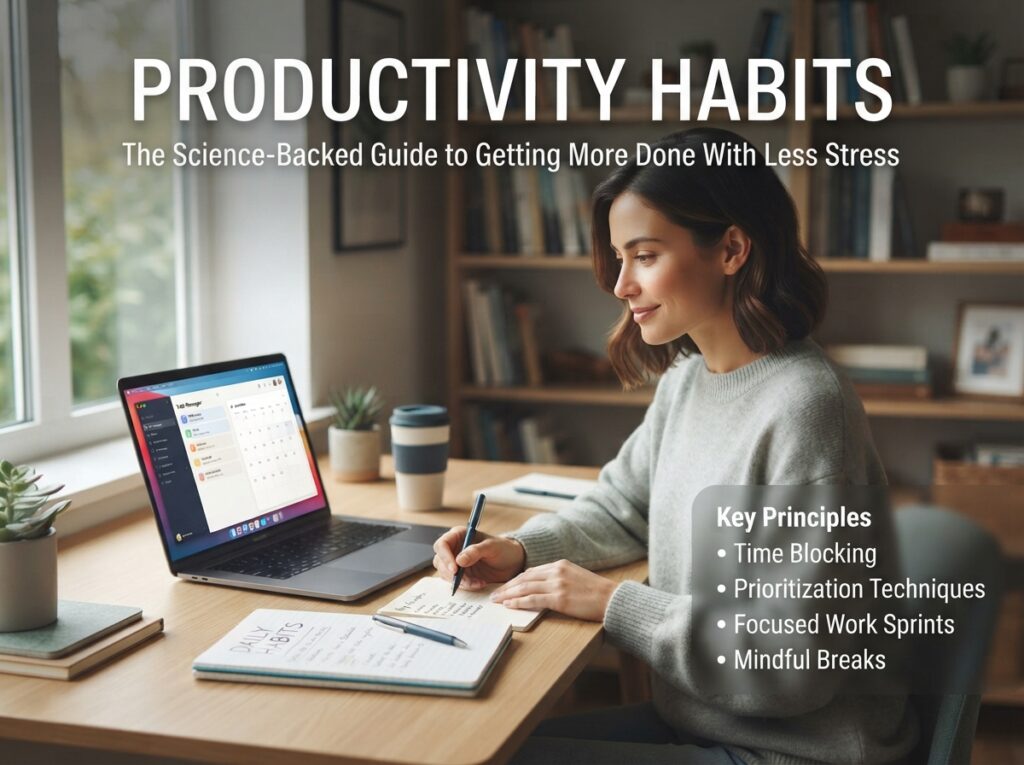
5. Practice Time Blocking
Time blocking means assigning specific tasks to fixed blocks of time in your calendar . Instead of a long, open-ended to-do list, you decide when each task will be done. For example :
- 9:00–11:00 a.m.: Project research
- 11:00–12:00 p.m.: Client follow-ups
- 1:00–3:00 p.m.: Creative work
This approach creates accountability, reduces multitasking, and ensures you have protected space for deep work .
6. Batch Similar Tasks
Mental energy is depleted by constantly switching between different types of work. Task batching solves this by grouping similar activities together . Instead of checking emails throughout the day, dedicate one 30-minute slot to respond to all emails. Handle all your calls or administrative work in a single block .
7. Use Habit Stacking
Habit stacking is a powerful strategy that adds new behaviors to an established routine . The formula is simple :
- Identify a current routine (e.g., turning on your computer)
- Specify a new behavior (e.g., reviewing your top three priorities)
- Create a habit-stacking statement: “After I turn on my computer, I will review my top three priorities”
Start small, then chain stacks together for longer routines .
8. Track Your Progress Visually
Seeing your progress is a powerful motivator. Each crossed-off task or tally mark becomes a cue to keep going . Use a simple checklist, progress board, habit tracker, or even a physical calendar to mark successful days .
9. Take Purposeful Breaks
Research shows that short, regular breaks improve focus and reduce decision fatigue . The key is to make breaks intentional—choose activities that clear your head and re-energize you, rather than mindlessly scrolling on your phone . Consider a quick walk, stretching, or a brief chat with a teammate .
10. Limit Notifications and Distractions
Every ping, buzz, or popup pulls your attention away and forces your brain to refocus, and it can take up to 23 minutes to regain full concentration after an interruption . Silence non-urgent alerts and set specific times to check messages . Put your phone out of reach during focus time .
11. Create a Done List
Sometimes acknowledging your triumphs can help you through your challenges . Write down every meeting attended, task completed, and small win achieved. Recognizing what you’ve already accomplished can get you in a more productive mindset for what’s next .
How to Build These Productivity Habits
Start Small and Be Consistent
You can’t build all these habits at once. Start with one or two and practice them consistently. It takes time—research shows habit formation can range from 18 to 254 days . Focus on progress, not perfection.
Use Visual Cues and Reminders
Until new habits become second nature, put cues or reminders in plain sight. Physical or digital prompts act as behavior nudges, guiding you toward productive routines . Write out your to-do list and put it on your screen to trigger your morning productivity routine .
Build Accountability
Accountability partners can help turn good intentions into great work habits . Schedule check-ins, share progress, and use digital tools like Slack for asynchronous updates .
Plan to Fail
Many people slip up when trying new things. It’s not about expecting failure but learning and recovering from mistakes . When mistakes happen, be kind to yourself—self-compassion generates the courage to try again .
Celebrate Milestones
A work habit milestone means a new routine is sticking . Celebrate wins, no matter how small. Recognize 14 days of sticking to work-life boundaries or completing four “inbox-clearing” sessions .