Table of Contents
Welcome to HabitHack.fun, your trusted resource for mastering productivity and habit formation. Setting goals is easy—achieving them is where most people struggle. Research shows that only 9% of people actually achieve their New Year’s resolutions, with 43% giving up before the end of January . The difference between success and failure often comes down to the strategies you use. This comprehensive guide explores science-backed goal setting strategies, from the renowned SMART framework to advanced techniques like habit stacking and if-then planning.
Why Goal Setting Works: The Science Behind It
Goal setting is one of the most researched topics in psychology, with over 35 years of empirical studies demonstrating its effectiveness . The foundational research by Locke and Latham shows that specific, challenging goals lead to higher performance than vague or “do your best” goals . In fact, four independent meta-analyses found that people assigned specific, difficult goals performed 8% to 16% better than those simply told to “do your best” .
Why Goals Matter
Goals do more than give you something to aim for—they fundamentally change how you approach work:
- Direction and purpose: Goals identify where to focus your efforts
- Enhanced motivation: Clear goals increase persistence and effort
- Better performance: Research consistently links goal setting to improved outcomes
- Increased accountability: Goals provide a framework for measuring progress
The SMART Framework: The Gold Standard for Goal Setting
The SMART framework is the most widely recognized and effective goal-setting strategy . This approach ensures your goals are clearly defined and achievable. Here’s how it works.
S – Specific
Make your goal hyper-focused and detailed. Instead of “I want to be healthier,” try “I will eat two more servings of vegetables every day” . A specific goal answers: What exactly do you want to accomplish? Who is involved? Where will it happen? When will it be completed?
Example: “I will exercise 30 minutes, five days a week so I can have the strength and stamina to travel to a new country” .
M – Measurable
If you can’t measure it, you can’t know if you’ve achieved it. Decide what data will help you track progress . Instead of “I’m going to lose weight,” try “I’m going to lose 15 pounds by my birthday in three months” .
A – Achievable
Be honest with yourself about what you can realistically accomplish with your current lifestyle and resources . The goal should be challenging but within reach. As one expert explains, if you used to walk five miles without fatigue and now can only do one mile, your goal should reflect your current capability .
R – Relevant
Your goal should align with your priorities and broader objectives . Ask yourself: Is this goal important to your life right now? Does it have a purpose you care about? As the University of Kansas explains, this is the time to ensure your energy is directed toward an end that matters to you .

T – Time-bound
Set a clear deadline or timeframe . When do you need to accomplish this? What are the milestones along the way? A study of college students found that those who developed monthly goals improved their study habits more than those with four-day goals, suggesting that finding the right time horizon matters .
Beyond SMART: Advanced Goal Setting Strategies
The WOOP Framework
WOOP—which stands for Wish, Outcome, Obstacle, Plan—helps you visualize your goal, identify obstacles, and plan to overcome them . This approach is particularly useful for challenging goals where anticipation of setbacks is critical.
How it works:
- Wish: Define your goal clearly
- Outcome: Imagine what achieving it will feel like
- Obstacle: Identify what might get in your way
- Plan: Create a specific plan to overcome obstacles
The Two-Phase Goal Process
Goal setting is not a one-step activity but a multiphasic process that requires deliberate thought at every stage .
Phase 1: Goal Commitment
This phase involves refining vague ideas into specific, challenging goals. Key tasks include:
- Exploring personal values to connect goals to what truly matters
- Assessing resources and barriers
- Using mental contrasting to deepen commitment
Phase 2: Goal Implementation
This phase transforms goals into reality through structure and systematic action. Essential elements include:
- Creating if-then plans for anticipated obstacles
- Tracking progress and adjusting as needed
- Building systems that support goal achievement
If-Then Planning
This powerful strategy prepares you for challenges before they arise . The formula is simple: “If [situation X occurs], then I will [do Y].”
Examples:
- “If I feel the urge to check my phone during work, then I’ll set a timer and work for 25 minutes first.”
- “If a friend tries to talk to me during work time, then I’ll say, ‘Let’s talk at break’ and keep focusing.”
By creating automatic responses to obstacles, you maintain focus and momentum even when challenges arise .
Turning Goals into Habits: The Essential Connection
Make the Habit the Goal
As one expert explains, “The difference between the winner (who achieves their goal) and the loser (who never achieves their goal) is their habits” . Instead of focusing solely on outcomes, focus on becoming the type of person who achieves those outcomes. “If you make the habit itself the goal, the results will naturally follow” .
Habit Stacking
This technique links a new habit to an existing one, making it easier to stick with your goals . The formula is simple: After [CURRENT HABIT], I will [NEW HABIT] .
Examples:
- “After I pour my morning coffee, I will write down my top three priorities for the day”
- “After I brush my teeth at night, I will review my progress on today’s goals”
Lower the Activation Energy
Make it easy to start working toward your goal. If your guitar is stored in the attic, you’ll rarely play it—but if it’s on a stand next to your desk, picking it up becomes effortless . Identify and remove barriers to action.
Actionable Strategies for Goal Achievement
Break Big Goals into Smaller Parts
One of the most effective strategies is breaking large goals into smaller, manageable action steps . Research shows that completing smaller tasks provides a motivating sense of accomplishment and makes the work less intimidating .
The Three-Level Framework :
- Goals: Long-term achievements (things you want to accomplish over time)
- Objectives: Smaller accomplishments that help achieve larger goals (milestones)
- Tasks: Specific activities you can do to meet objectives
Reward Yourself Along the Way
Incentives can be a fun way to encourage yourself. Structure your work with little rewards along the way—they give you something to look forward to and help you get started in the first place .
Examples:
- After completing a week of consistent effort, treat yourself to a massage
- After reaching a milestone, buy something related to your goal
- Share accomplishments with friends and family for positive feedback
Anticipate Challenges
For each goal, try to anticipate possible challenges you might encounter . This proactive approach helps you stay ahead of obstacles rather than being derailed by them. Generate a list of resources that can help you overcome these challenges.
Track Your Progress
Use a journal, calendar, or app to keep track of your progress . Seeing your streak of success helps establish the habit as part of your daily routine . Visual reminders—like a photo related to your goal—can also help maintain motivation .
Be Flexible When You Need To
One of the biggest reasons people fail at goals is rigidity . When you can’t live up to your own high expectations, you give up. Instead, accept that you’re not perfect and keep going. Recommit to your goal and get back on track .
Tell People About Your Goals
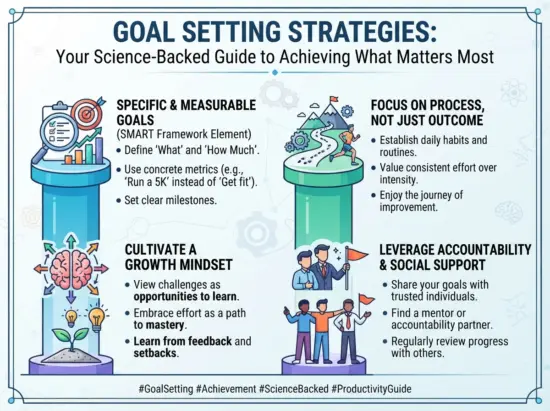
Letting other people know about your goal can be motivating . If you want more accountability, find someone working toward a similar goal or ask someone to check in on your progress.