Table of Contents
Welcome to HabitHack.fun, your trusted resource for mastering productivity and building lasting habits. In a world where the average employee spends only about 60% of their workday on productive tasks, efficiency isn’t just a nice-to-have—it’s essential for reducing stress, reclaiming your time, and achieving meaningful results without burning out . This comprehensive guide explores proven efficiency tips, from understanding the difference between productivity and efficiency to implementing powerful techniques that help you work smarter, not harder.
Productivity vs. Efficiency: Understanding the Difference
Before diving into specific tips, it’s important to understand the distinction between productivity and efficiency.
- Productivity refers to the amount of work you can complete in a specific amount of time .
- Efficiency, on the other hand, focuses on achieving the same amount of work with fewer resources—less time, less effort, less energy .
As career coach Caroline Castrillon explains, it’s useful to ask yourself: do you want to get more done, or do you want to get the same work done with less time and effort? Efficiency is about optimizing your workflow so you can achieve your goals while preserving your energy for what matters most.
Core Efficiency Strategies
1. Track Your Time to Understand Where It Goes
You cannot improve what you don’t measure. Start by tracking your time for a minimum of two weeks—one week to account for awareness bias, and a second week for a more accurate representation of your habits .
Three primary methods for time tracking :
- Time estimates: Looking back at your week and estimating how you spent your time (least accurate)
- Time logs: Filling out a daily sheet in 15- or 30-minute increments (more accurate)
- Automated apps: Tools like RescueTime or Rize that track computer usage automatically (most accurate for digital work)
The most important step is reviewing how you actually spend your time and reflecting on whether that aligns with your priorities .
2. Master Prioritization
Working efficiently starts with working on the right things. The Eisenhower Matrix is a time-tested framework for distinguishing between what’s urgent and what’s important .
| Quadrant | Description | Action |
|---|---|---|
| Do | Important and Urgent | Complete immediately |
| Schedule | Important, Not Urgent | Plan dedicated time |
| Delegate | Urgent, Not Important | Assign to others if possible |
| Delete | Not Urgent, Not Important | Eliminate |
The goal is to spend as much time as possible in Quadrant 2—the important but not urgent tasks like planning, skill development, and relationship building. These are the activities that create compounding returns and reduce future emergencies .
3. Apply the 80/20 Principle (Pareto Principle)
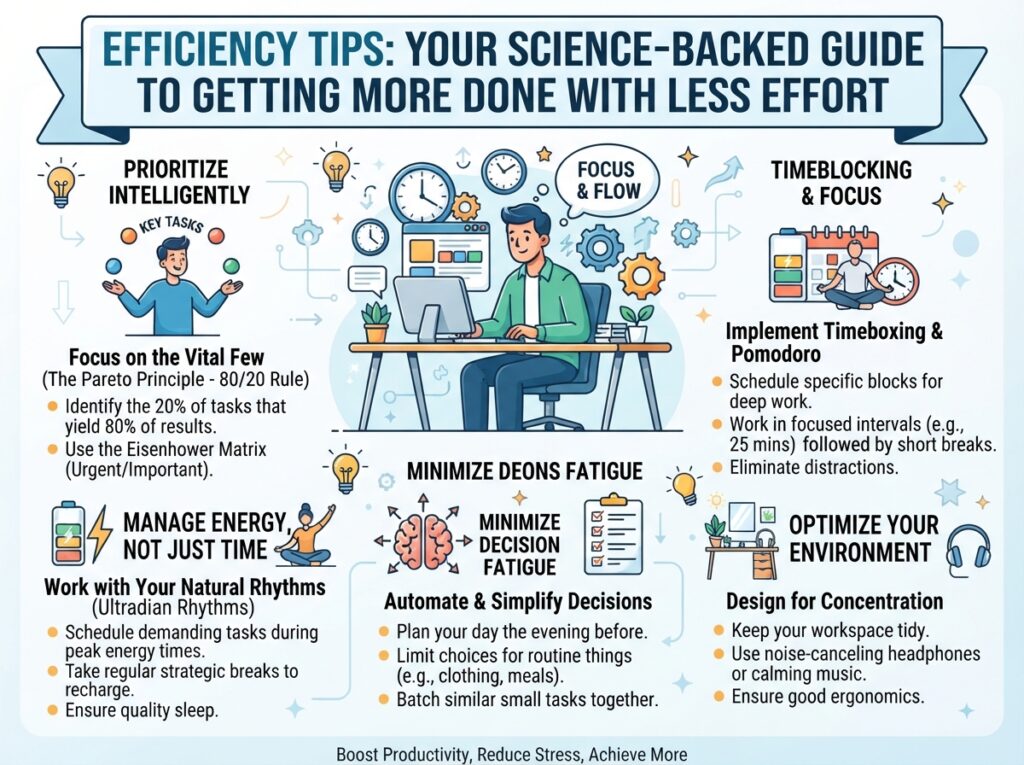
Roughly 80% of your results come from 20% of your efforts. Working smarter requires you to identify that vital 20% .
Ask yourself:
- Which clients generate the most revenue?
- Which tasks lead to the most career advancement?
- Which activities bring the most satisfaction?
Double down on these high-impact activities and systematically reduce or eliminate the rest .
4. Use Time Blocking
Stop using your to-do list as a guide and start using your calendar as a blueprint. Time blocking involves scheduling specific blocks of time for specific tasks .
Why it works :
- Transforms intentions into commitments
- Protects you from context switching
- Provides a realistic view of your capacity
- Leverages natural cognitive patterns—research shows our brains operate most efficiently in 90- to 120-minute concentration periods
How to implement: Schedule not just meetings, but also blocks for strategic planning, creative work, email processing, and even breaks .
5. Stop Multitasking
What we call “multitasking” is actually rapid task-switching, which carries a significant cognitive cost .
Research shows that context switching can reduce productivity by up to 40% . When you switch between tasks, you pay a “mental tax” each time—fragmenting focus, draining mental stamina, and increasing the risk of errors .
The solution: Batch similar tasks together and tackle them in a single, focused session. Dedicate one block to processing all emails, another for phone calls, and another for creative work .
6. Apply the Two-Minute Rule
If a task can be done in two minutes or less, do it immediately . This could be replying to a short email, filing a document, or scheduling a quick call.
Why it works: It cuts down on mental clutter and builds momentum. The energy created from a small win can lead you to tackle larger tasks .
7. Use the “One More” Approach
When overwhelmed by a large task, break it into small pieces and challenge yourself to do just “one more” before stopping .
How it works :
- Instead of committing to “finish all emails,” commit to answering just one more
- In the gym, instead of focusing on “17 minutes left,” ask “can I do one more minute?”
- For cleaning, start with one task and then ask “can I do one more?”
Every time you complete a small piece, you get a boost of confidence, making it easier to continue .
8. Eat the Frog
Start your day with your most challenging, often most dreaded task . Big, complicated projects can weigh on you and lead to procrastination. Knocking out this responsibility first clears your mind and gives you a sense of accomplishment for the rest of the day .
9. Limit Distractions Proactively
If you know you’re easily distracted, block access to tempting sites before they pull you in .
Tools to consider:
- Stayfocusd: Blocks distracting sites during set hours
- Freedom: Temporarily blocks distracting apps and websites
- Forest: Gamifies focus—leave the app and your tree dies
Also use “Do Not Disturb” features on your phone and turn off non-essential notifications .
10. Take Strategic Breaks
Working too long without breaks leads to burnout and reduced productivity .
Break strategies:
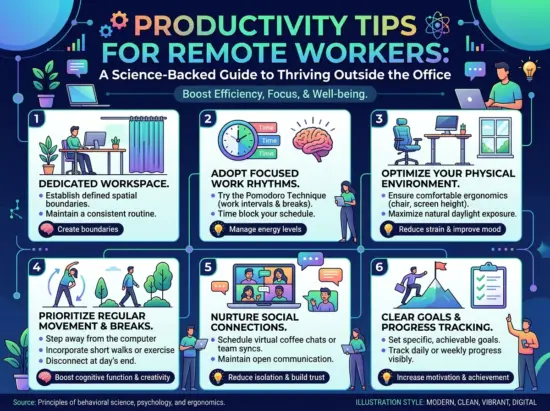
- The Pomodoro Technique: Work for 25 minutes, take a 5-minute break. After four cycles, take a longer break
- Green micro-breaks: Looking at nature (even a green roof) during breaks can improve performance
- Move your body: Walking promotes creativity and physical health. One break per day should involve getting out of your chair and moving
11. Reward Yourself for Completing Tasks
When you finish a task, reward yourself. Buy a coffee, read a bit of news, or message a friend. Rewards reinforce the behavior and help sustain motivation .
12. Automate Repetitive Tasks
Identify tasks you do repeatedly—data entry, scheduling, email sorting—and automate them .
Examples:
- Use email filters to automatically sort messages
- Automate task creation in project management tools
- Use AI meeting assistants to transcribe and summarize calls
One expert describes this as “digital friction”—the wasted time navigating bloated tech stacks, switching platforms, and performing repetitive clerical work. Automating these tasks frees up time for strategic thinking .
13. Organize Your Workspace
Both physical and digital clutter reduce your ability to focus .
Tips:
- Keep your desk free of unnecessary items
- Close unused browser tabs and applications
- Create a quiet, distraction-free work environment
- Consider ergonomic furniture and personal touches like plants or photos for motivation
14. Review Your Calendar First Thing
Look over your calendar and to-do list first thing every morning. This less-than-one-minute habit prevents surprises and helps you start the day with intention .
15. Conduct a Digital Audit
Audit your tech stack to identify unnecessary, redundant, or unused apps that create digital friction .
Apply the “Five Rs” method :
- Retain: Keep the tool as-is
- Remove: Eliminate the tool
- Reduce: Limit usage
- Replace: Find a better alternative
- Rearchitect: Modify to better suit your needs
Even small efficiency improvements—a series of 1% gains—can add up to significant reclaimed time and energy