Table of Contents
Welcome to HabitHack.fun, your trusted resource for mastering personal growth and habit formation. Confidence isn’t a trait you’re born with—it’s a skill you build. It’s the quiet inner knowing that you can handle life’s challenges, learn from your mistakes, and achieve your goals. Research shows that 85% of people struggle with self-doubt, but the good news is that confidence can be developed through intentional practices . This comprehensive guide explores the science of confidence, proven strategies for building it, and the daily habits that will help you become your most confident self.
What Is Confidence and Why Does It Matter?
Confidence is generally understood as a belief in your ability to succeed. It’s a feeling of trust in your abilities, qualities, and judgment. However, it’s important to distinguish between confidence and competence—you can be competent without being confident, and vice versa.
The Psychology of Confidence
Confidence has a significant impact on your life. It influences your ability to make decisions, take risks, and build relationships. It empowers you to take on challenges, persist in the face of setbacks, and pursue your goals with determination. Psychologists have identified several key elements of confidence:
- Self-Efficacy: The belief in your ability to succeed in specific situations
- Self-Esteem: The overall sense of your own worth
- Self-Confidence: The trust in your own abilities, qualities, and judgment
The Neuroscience of Confidence
Confidence is not just a feeling—it’s a neurological state. When you have a positive experience, your brain releases dopamine, which reinforces the behavior and makes you more likely to repeat it. Over time, this builds a confidence loop: success creates confidence, which creates more success. This is called the confidence-competence loop. On the flip side, fear and self-doubt activate the amygdala, the brain’s fear center, which can inhibit your ability to think clearly and perform well.
Core Confidence-Building Strategies
1. Build Self-Awareness
Confidence starts with knowing yourself—your strengths, values, and triggers. Take time to reflect on what you’re good at, what you care about, and what situations drain your confidence. This self-awareness is the foundation upon which you can build your confidence. Consider keeping a journal to track your thoughts and behaviors.
2. Set Small, Achievable Goals
The most effective way to build confidence is to start small. Break a larger goal into tiny, manageable steps. For example, if you want to become a confident public speaker, start by speaking up in a small group. Each time you achieve a small goal, you reinforce the belief that you are capable, which strengthens your confidence for the next challenge.
3. Focus on Process, Not Perfection
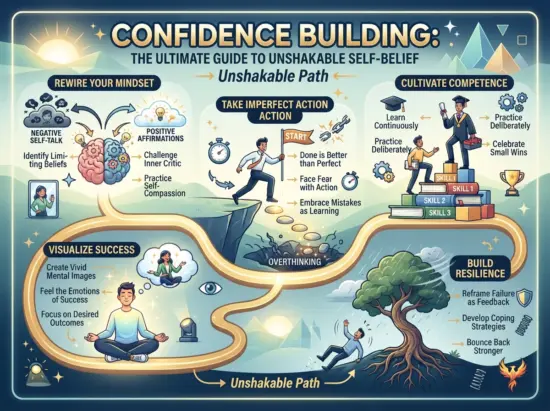
Perfectionism is the enemy of confidence. When you focus on perfection, you set yourself up for failure. Instead, shift your focus to progress. Ask yourself, “What can I learn from this?” This shifts your mindset from a fixed, outcome-oriented one to a growth-oriented one, where mistakes are seen as learning opportunities rather than signs of failure.
4. Practice Positive Self-Talk

The words you say to yourself matter. Negative self-talk—like “I’m not good enough” or “I’ll never succeed”—reinforces self-doubt. To counteract this, practice positive affirmations. Statements like “I am capable,” “I am learning,” and “I am resilient” can help rewire your brain for greater confidence. This is backed by research on neuroplasticity: your brain can form new neural pathways based on the thoughts you practice most often.
5. Visualize Success
Visualization is a powerful tool used by athletes and high performers. Spend a few minutes each day vividly imagining yourself succeeding. For example, if you have a presentation, visualize yourself walking into the room confidently and delivering it with ease. This mental rehearsal primes your brain for success, making it more likely to happen.
6. Step Out of Your Comfort Zone
Confidence grows when you push past your comfort zone. Choose one small thing each day that scares you. It could be speaking up in a meeting, introducing yourself to a stranger, or trying a new hobby. Each time you do something that feels uncomfortable, you prove to yourself that you are capable of more than you think.
7. Embrace Failure and Learn from It
Failure is not the opposite of success—it’s part of it. Every failure is an opportunity to learn. When you inevitably make a mistake, ask yourself: “What can I learn from this?” and “What will I do differently next time?” This approach reframes failure as a stepping stone to growth.
8. Practice Self-Compassion
Be kind to yourself, especially when you fall short. Treat yourself with the same compassion you’d offer a good friend. Instead of beating yourself up, acknowledge your effort and commit to trying again.
9. Focus on Body Language
Your body language can influence your mindset. Research shows that standing in a “power pose” for just two minutes can increase testosterone and decrease cortisol, making you feel more confident. Practice good posture, smile, and make eye contact. These non-verbal cues can not only signal confidence to others but also make you feel more confident internally.
10. Dress for Success
What you wear can impact your confidence. Dressing well—in clothes that make you feel good and appropriate for the situation—can boost your self-esteem.
11. Maintain a “Confidence Portfolio”
Keep a record of your accomplishments. This can be a file on your computer or a physical folder. When you’re feeling low, review your “portfolio” to remind yourself of your past successes. This is a powerful way to interrupt the cycle of self-doubt.
12. Surround Yourself with Supportive People
Your environment matters. Surround yourself with positive people who believe in you and encourage you to grow. They will provide honest feedback and help you see your blind spots. On the other hand, toxic, critical people can tear you down. You have permission to limit your time with them.
13. Learn to Accept Compliments
When someone pays you a compliment, resist the urge to dismiss it. Simply say “thank you” and internalize the positive feedback. This practice teaches you to receive validation, which reinforces your self-belief.
14. Keep Promises to Yourself
Self-trust is a core component of confidence. If you tell yourself you’re going to do something, do it. Small acts of self-discipline—like sticking to a morning routine—build trust in yourself and your abilities.
15. Seek Feedback and Act on It
Constructive feedback is a gift. By seeking it out and acting on it, you show yourself that you are committed to growth, which builds a more resilient confidence.
Overcoming Common Confidence Barriers
The “Imposter Syndrome” Trap
Imposter syndrome is the feeling that you’re a fraud and don’t deserve your success. To overcome it, write down your accomplishments. Remind yourself that you’ve earned your success. Talking about your feelings with a trusted friend or mentor can also help.
The “Fear of Failure” Trap
The fear of failure can be paralyzing. To overcome it, reframe failure as a learning opportunity. Ask yourself: “What’s the worst that could happen?” and “What will I learn from this?” Remember that most successful people have failed many times.
The “Comparison” Trap
Comparing yourself to others is a surefire way to kill your confidence. Instead, compare yourself to your past self. Focus on your progress and celebrate how far you’ve come.
The “All-or-Nothing” Trap
Perfectionism is a confidence killer. Instead of aiming for perfection, aim for “good enough.” Accept that you’re a work in progress.
Daily Habits for Sustaining Confidence
- Morning Intention Setting: Start the day by visualizing a confident version of yourself.
- Gratitude Journaling: Write down three things you’re grateful for each day to build a positive, empowered mindset.
- Act “As If”: When you’re not feeling confident, act as if you are. Over time, this behavior becomes internalized.
- Daily Affirmations: Start the day with a simple affirmation, like “I am capable,” “I am strong,” or “I am learning.”