Table of Contents
Welcome to HabitHack.fun, your ultimate destination for mastering the art and science of habit formation. If you’ve ever struggled to make a new routine stick or break an old one, you’re not alone. The problem isn’t a lack of willpower—it’s that we’re often working against how our brains are naturally wired. This guide provides the “habit hacks” you need to work with your brain, using science-backed strategies to build lasting, positive changes. We’ll explore the psychology of habits, the power of the habit loop, and give you practical, actionable hacks you can start using today.
Understanding the Brain’s Habit System
Before you can hack your habits, you need to understand how they work. Research shows that our habits are driven by two distinct but interacting brain systems. One system is responsible for automatic responses to familiar cues—like automatically reaching for your phone when you feel bored. The other facilitates goal-directed control, which is your ability to consciously override that impulse and focus on your work, for example. The challenge is that habits form when the automatic system wins out over the conscious one, leading to those daily slip-ups and behaviors we struggle to control.
Neuroplasticity: Your Brain Can Change
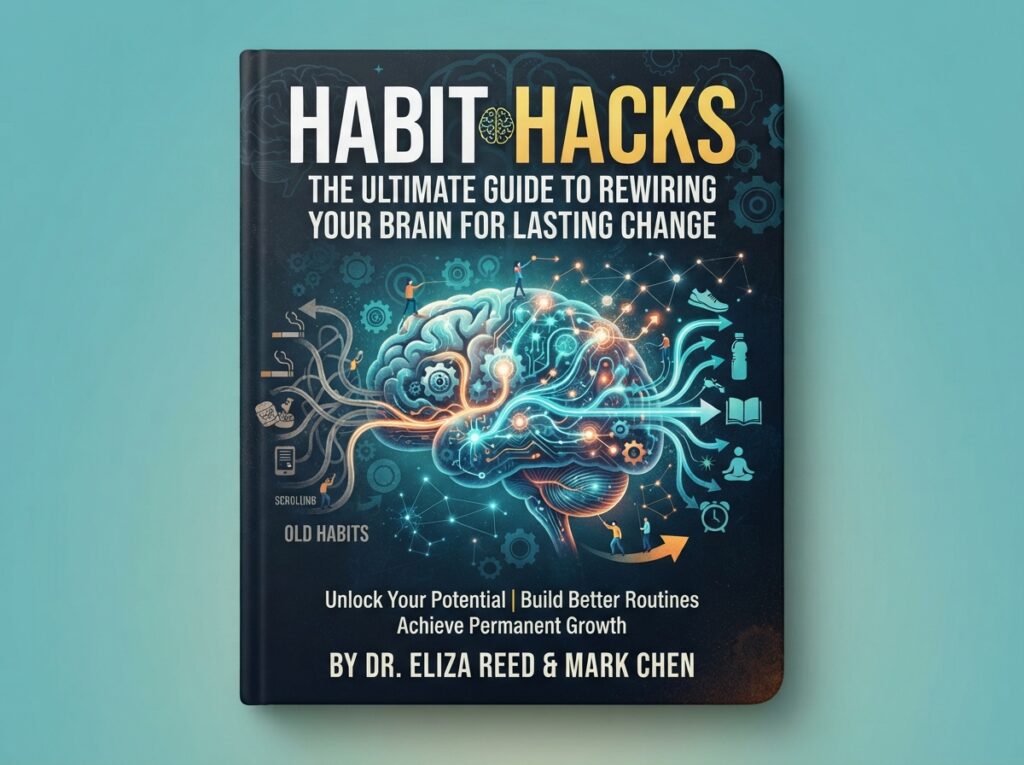
The good news is that your brain is not fixed. It possesses a remarkable ability called neuroplasticity, which is its capacity to change and adapt in response to new experiences. When you repeatedly engage in a thought or action, you strengthen the neural connections supporting those behaviors. Over time, this makes the action more automatic and efficient, requiring less conscious thought and effort. This ability to rewire your brain is the foundation for acquiring new skills, forming memories, and, most importantly, establishing new habits.
The Habit Loop: The Foundation of All Habits
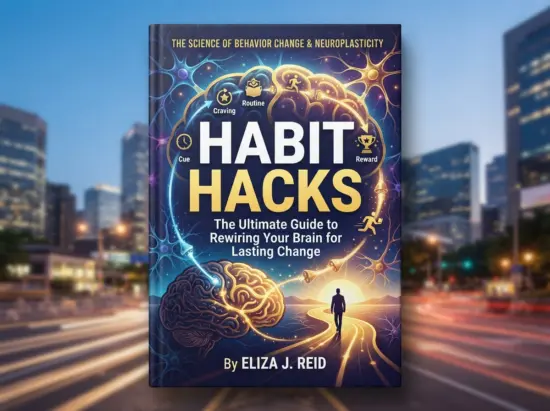
The most powerful framework for understanding and changing habits is the “habit loop,” a concept popularized by Charles Duhigg in his book, The Power of Habit. The habit loop consists of three key elements:
- Cue (Trigger): The signal that initiates the habit. This can be a specific time of day, a location, an emotional state, the presence of other people, or an immediately preceding action.
- Routine (Behavior): The actual habit or action you perform in response to the cue.
- Reward: The positive feeling or outcome you get from performing the routine, which reinforces the habit loop. Your brain releases dopamine, the “feel-good” chemical, creating a positive association and a craving to repeat the behavior.
To effectively hack a habit, you need to understand this loop. To build a new habit, you insert a new routine into the loop. To break a bad one, you must disrupt a component of it.
Hack 1: Master the Art of Habit Stacking
One of the most effective and practical “habit hacks” you can use is habit stacking. This simple but powerful technique involves linking a new habit you want to build to an existing one that is already deeply ingrained in your routine. The formula is simple: After [CURRENT HABIT], I will [NEW HABIT].
This technique is effective because it uses an established behavior as a reliable cue for the new one. Since approximately 40% of our daily actions are driven by automatic behavior, you can use these existing neural pathways to “hack” the system and make adopting new habits feel almost effortless. By tying your new desired habit to something you already do every day, you make it far easier for your brain to adopt, as it doesn’t have to think about a new cue. It turns the invisible into the visible, making your progress tangible.
Practical Habit Stacking Examples

Here are some habit stacking ideas you can implement immediately, grouped by area of life.
For Physical Health & Fitness
| Existing Habit (Cue) | New Healthy Habit (Routine) |
|---|---|
| After I pour my morning coffee | I will do 10 toe touches or jumping jacks. |
| After I put on my seat belt | I will take several slow, deep breaths. |
| Before I sit down to watch TV | I will do a set of squats or lunges. |
| While I’m watching Netflix | I will do a round of squats or crunches during the credits. |
| When I’m reading a book | I will do a set of calf raises for 30 seconds. |
| After I finish the dishes | I will take a 10-minute walk with my partner. |
For Healthy Eating & Nutrition
| Existing Habit (Cue) | New Healthy Habit (Routine) |
|---|---|
| While heating water for coffee | I will wash and prepare a vegetable or fruit for snacking. |
| When I get impatient in line | I will use my phone to look up a healthier recipe. |
| While unloading the dishwasher | I will mentally plan my next meal to include more vegetables. |
| After I sit down to eat | I will do a set of seated exercises. |
For Mental Well-being & Mindfulness
| Existing Habit (Cue) | New Healthy Habit (Routine) |
|---|---|
| After I pour my morning coffee | I will write down one thing I’m grateful for. |
| After I put the kids to bed | I will spend five minutes meditating. |
| Before I go to bed | I will put my phone away at least 30 minutes prior. |
| As I brush my teeth | I will practice the 5-4-3-2-1 grounding technique. |
Hack 2: Start with Tiny Habits
One of the biggest mistakes people make when trying to build a new habit is aiming too high, too fast. The research is clear: creating change and achieving goals is much more manageable when approached incrementally.
The “Two-Minute Rule”
James Clear, in his book Atomic Habits, popularized the “Two-Minute Rule.” It states that when you start a new habit, it should take less than two minutes to do. For example:
- “Read before bed” becomes “Read one page.”
- “Do thirty minutes of yoga” becomes “Take out my yoga mat.”
- “Exercise” becomes “Put on my workout clothes.”
- “Study” becomes “Open my notes.”
The point is to make the habit so easy you can’t say no. This builds the habit of showing up, which is the most crucial part of the process. Once that’s established, you can expand on it. This approach is supported by neuroscience: the brain strengthens through consistent, intentional practice, and starting with tiny behaviors lowers the barrier to getting started.
Hack 3: Use “If-Then” Plans
Another powerful science-backed hack is creating “if-then” plans, also known as implementation intentions. This strategy is about making a specific plan that connects a situation with a behavior.
The format is simple: If [situation X occurs], then I will [do Y].
For example, “If I feel the urge to check social media while working, then I will put my phone in the other room.” Or, “If I feel stressed, then I will take three deep breaths instead of eating a snack.” This technique works by preparing your brain to automatically trigger a specific behavior when a certain cue arises, bypassing the need for conscious decision-making.
Hack 4: Design Your Environment
Your environment has a significant impact on your emotions and actions. Elements within our surroundings act as “cues” that have a tremendous influence on our behavior. To make a habit easier, you can engineer your environment to support your goals.
- For Good Habits: Make the cues obvious. If you want to drink more water, place a full bottle on your desk. If you want to exercise in the morning, lay out your workout clothes the night before. This is a way to let your present self help your future self.
- For Bad Habits: Make the cues invisible. If you want to eat healthier, move unhealthy snacks to the back of the cupboard or out of the house entirely. If you want to stop scrolling on your phone, put it in another room while you work or sleep.
Hack 5: Consistency Over Perfection
The “21-day myth” is a common misconception. Research shows that habit formation typically takes an average of 66 days, with a broad range of 18 to 254 days depending on the behavior and the individual. This means patience and consistency are key.
The “Never Miss Twice” Rule
When you miss a day, simply start again the next day. As long as you don’t let one missed day become two, you’re still on track. The key is to maintain the pattern, not achieve perfection. When stressed or tired, the brain tends to revert to established patterns, so don’t be discouraged by setbacks; they are a normal part of the process