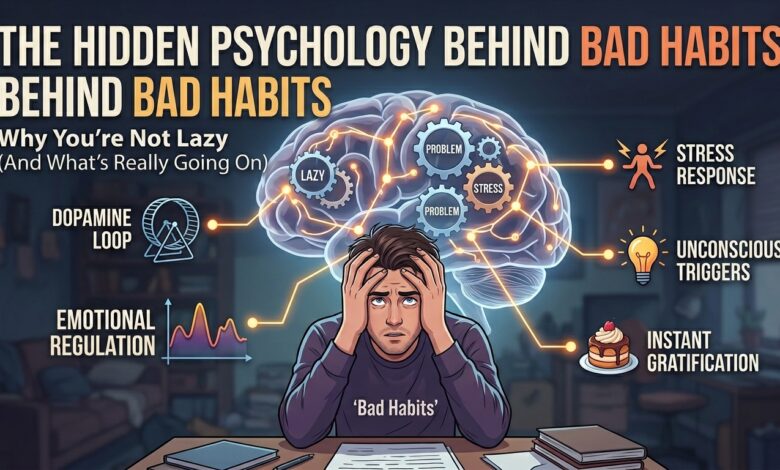
The Hidden Psychology Behind Bad Habits: Why You’re Not Lazy (And What’s Really Going On)
Introduction: The Shame That Doesn’t Help
You have probably done this. At the end of a long day, you tell yourself, “I will just watch one episode.” Three hours later, you have finished an entire season. The dishes are unwashed. The email remains unsent. And the voice in your head says the same thing it always says: “What is wrong with you? Why can’t you just stop?”
That voice calls you lazy. It calls you weak. It calls you undisciplined.
And that voice is completely wrong.
For decades, we have been told that bad habits are a simple failure of willpower. We believe that if we just wanted it badly enough, we would stop procrastinating, stop overeating, stop scrolling, stop smoking. But neuroscience and behavioral psychology have recently uncovered a much stranger, more uncomfortable truth.
Your bad habits are not a sign of moral failure. They are a sign that your brain is working exactly as it was designed to work—just in the wrong environment. In this article, we will explore the hidden psychology behind bad habits: the unconscious drivers, the biological traps, and the secret rewards that keep you stuck. More importantly, you will learn how to stop fighting yourself and start working with your brain.
Chapter 1: The Pleasure-Pain Mistake (Why Your Brain Lies to You)
Most people believe they repeat bad habits because those habits feel good. Smoking feels relaxing. Scrolling feels entertaining. Eating sugar feels pleasurable. This is only half true—and the other half explains everything.
The hidden psychology: You do not repeat bad habits because of the pleasure they give you. You repeat them because of the pain they relieve.
Here is the distinction. Imagine you have had a stressful day at work. Your boss criticized you. Your inbox is overflowing. Your chest feels tight. That tightness is a low-grade state of psychological pain. Now, you open Instagram. Within seconds, the tightness fades. Did Instagram give you pleasure? Not exactly. It removed the pain of stress. The relief is what feels good.
This is called the negative reinforcement loop. A behavior is reinforced because it removes something unpleasant. Over time, your brain learns: “Stress = bad. Phone = stress goes away. Therefore, phone is good.”
The problem is that the relief is temporary. Thirty minutes later, the stress returns—often worse because you wasted time. So you scroll again. The loop tightens.
The hidden driver: Most bad habits are not approach behaviors (seeking pleasure). They are avoidance behaviors (escaping discomfort). You are not running toward the donut. You are running away from the feeling of hunger, boredom, loneliness, or fatigue.
What this means for you: Stop asking, “Why do I want this bad habit?” Start asking, “What uncomfortable feeling am I trying to escape right now?” The answer—boredom, anxiety, exhaustion, rejection—is the real problem. The habit is just the escape route.
Chapter 2: The Cue-Routine-Reward Loop (Your Brain’s Autopilot)
In the 1990s, neuroscientists at MIT discovered something remarkable. They studied rats in a maze. At first, the rats sniffed and wandered randomly to find chocolate. But after a week, their brains changed. The part of the brain responsible for decision-making (the prefrontal cortex) went quiet. A different part—the basal ganglia—took over.
The rats were no longer deciding. They were running on autopilot.
This is the habit loop, and it runs your life more than you know. Every habit—good or bad—follows the same three-step pattern:
- Cue (Trigger): A signal that tells your brain to go into automatic mode. Examples: waking up (cue for coffee), feeling bored (cue for phone), finishing a meal (cue for dessert).
- Routine (Behavior): The action itself. The cigarette, the scroll, the snack.
- Reward (Result): The relief or pleasure that makes your brain remember the loop for next time.
The hidden psychology is that you almost never notice the cue. It operates below conscious awareness. You do not decide to check your phone. You just look down and it is already in your hand. That is the autopilot.
The trap: Once a loop is established, the cue triggers a craving before you even know what is happening. The craving is invisible. But it is powerful enough to override your conscious goals every single time.
The fix: Break the loop by interrupting the cue. For one week, do not try to stop the habit. Just notice the cue. Every time you reach for your phone, pause and ask: “What was the trigger? Was I bored? Anxious? Tired?” Write it down. You cannot change what you do not see.
Chapter 3: The Dopamine Prediction Error (Why “Just One” Is Never Just One)
Here is a terrifying fact from addiction research. When a person addicted to cocaine sees a white powder, their brain releases more dopamine than when they actually take the cocaine. The anticipation of the reward is stronger than the reward itself.
This is called the dopamine prediction error. Your brain constantly predicts how good something will feel. When the prediction is accurate, dopamine release is moderate. But when your brain predicts something even better than expected? It floods the system.
Bad habits exploit this mercilessly. You open Netflix thinking, “I will watch 20 minutes.” But the show ends on a cliffhanger. That cliffhanger is an unexpected reward. Your brain releases a burst of dopamine. Suddenly, 20 minutes becomes three hours. You are not weak. You are being chemically manipulated by a prediction error.
The hidden driver: Variable rewards keep you hooked. This is why slot machines are addictive (sometimes you win, sometimes you lose) and why social media infinite scroll works (the next post might be amazing, might be boring). Your brain cannot stop checking because it is constantly trying to correct its predictions.
What this means for you: Do not trust “just one.” For bad habits with variable rewards (social media, gaming, gambling, binge-watching), the first dose triggers the prediction error loop. One is never one. It is the first step of one hundred.
The fix: Make the first step impossible. Delete the apps. Use a website blocker. Log out of streaming services. Do not rely on willpower at the moment of craving. Rely on barriers built when you are calm.
Chapter 4: Identity Conflict (The Lazy Label Becomes a Prophecy)
This is the most painful hidden psychology of all. Every time you fail to break a bad habit, you tell yourself a story. “I am a procrastinator.” “I have no self-control.” “I am just an anxious person.”
That story becomes your identity. And once something is part of your identity, your brain will defend it like a soldier defending a fortress.
Psychologists call this identity-congruent behavior. You act in ways that prove your identity correct. If you believe you are lazy, your brain will sabotage your efforts to work because working would contradict who you are. The bad habit is not just a behavior. It is evidence that your self-story is true.
The vicious cycle: You fail → You label yourself “lazy” → That label lowers your confidence → You fail again → The label is confirmed. You are not lazy because you fail. You fail because you believe you are lazy.
The hidden driver: The need for internal consistency is stronger than the need for improvement. Your brain would rather be consistently “bad” than inconsistently “good” because consistency reduces uncertainty. And the brain hates uncertainty more than it hates failure.
The fix: Change the label before you change the behavior. Do not say, “I am trying to quit smoking.” Say, “I am not a smoker.” Do not say, “I want to stop procrastinating.” Say, “I am the kind of person who starts tasks immediately.” You will not believe it at first. That is fine. Say it anyway. Act as if it is true for 24 hours. Then do it again. The identity follows the action, not the other way around.
Chapter 5: The 2-Minute Rule (The Opposite of What You Think)
Most people believe that to break a bad habit, you must resist the urge completely. Use willpower. Say no. Fight.
This is exhausting. And it fails because resistance creates tension. Tension creates release-seeking. Release-seeking creates relapse.
The hidden psychology of breaking bad habits is not resistance. It is redirection. You cannot stop a thought by fighting it. The famous “don’t think about a pink elephant” experiment proves this. When you try not to think about something, you think about it more.
The counterintuitive solution: The 2-Minute Rule for breaking bad habits is the opposite of what you expect. Instead of trying to stop the bad habit entirely, give it a strict, boring, 2-minute container.
- Instead of saying “no more social media,” say “I can scroll for exactly 2 minutes, then I must close the app.”
- Instead of “no more junk food,” say “I can have three chips, then I must put the bag away.”
- Instead of “no more procrastination,” say “I can avoid work for 2 minutes, then I must write one sentence.”
What happens? Two things. First, the shame disappears because you are not failing. Second, the forbidden fruit effect disappears. The habit becomes less exciting when it is permitted but limited. Most of the time, after 2 minutes, you will stop naturally because the craving was not for the habit itself but for the forbiddenness.
Chapter 6: Environment Design Over Willpower (The Invisible Driver)
Here is a secret that successful people know and struggling people ignore. Willpower is not a skill you can strengthen like a muscle. It is a finite resource that depletes throughout the day. And when it is gone, your environment takes over.
Every bad habit in your life is being actively invited by your surroundings. The phone on your nightstand invites late-night scrolling. The cookies on the counter invite snacking. The game controller on the coffee table invites procrastination.
You are not fighting yourself. You are fighting the physics of your room. And physics always wins.
The hidden driver: The effort required to perform a behavior is the single strongest predictor of whether you will do it. This is called friction. High friction = less behavior. Low friction = more behavior. Bad habits have low friction (phone is already in your hand). Good habits have high friction (gym shoes are in the closet).
The fix: Invert the friction. Make bad habits hard. Make good habits easy.
| Bad Habit | Add Friction (Make It Hard) |
|---|---|
| Scrolling phone | Put phone in another room before bed. Buy a separate alarm clock. |
| Eating junk food | Keep junk food in the garage. Wrap it in aluminum foil. Put it in a box. Tape the box. |
| Watching TV | Remove batteries from remote. Store batteries in basement. |
| Procrastinating | Use app blocker with a 30-second delay. That delay is enough friction to stop autopilot. |
| Good Habit | Remove Friction (Make It Easy) |
|---|---|
| Exercise | Sleep in gym clothes. Put shoes by the bed. |
| Reading | Leave a book on your pillow. You will see it before sleep. |
| Drinking water | Keep a full glass on every desk and table. |
Do not try to be a hero. Change your room. Your room will change you.
Conclusion: You Are Not Broken
After reading these six chapters, you might feel relieved. Or you might feel exposed. The hidden psychology behind bad habits is uncomfortable because it removes the excuse of laziness. You cannot say “I am weak” anymore. You now know that you are fighting invisible cues, variable rewards, identity loops, and environmental physics.
But here is the good news: The same hidden psychology that creates bad habits can be used to destroy them. The habit loop works for exercise as easily as it works for scrolling. The dopamine prediction error can make you addicted to learning. The environment design that hides your phone can also display your guitar.
You are not broken. You are not lazy. You are a human being with a brain that was designed for a world of scarcity, now living in a world of abundance. Your bad habits are not character flaws. They are normal responses to an abnormal environment.
Start small. Pick one hidden driver from this article—the cue, the identity, the friction, the 2-minute rule. Apply it to one bad habit today. Do not try to fix everything. That is another hidden trap: the perfectionism that leads to paralysis.
Your only task right now: Look around your current environment. Find one object that invites a bad habit. Move it to a different room. That is not a small change. That is a victory over the hidden psychology that has been controlling you.