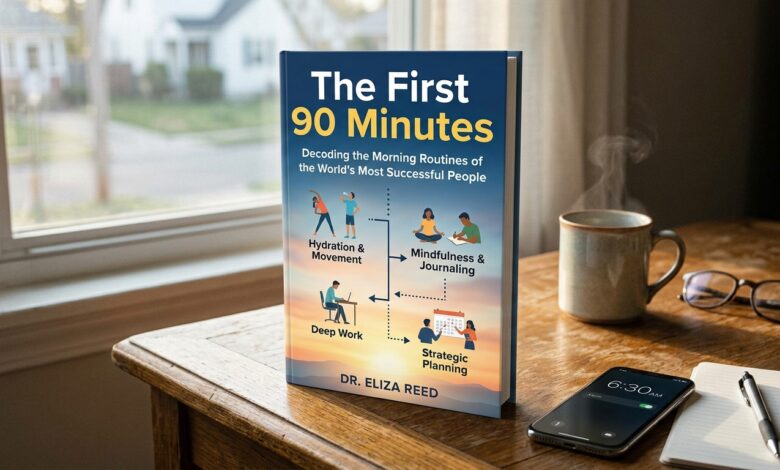
The First 90 Minutes: Decoding the Morning Routines of the World’s Most Successful People
Introduction: The Quiet Before the Chaos
What does a billionaire’s morning look like? If you imagine a frantic 4:00 AM scramble of cold plunges, green juice, and yelling at subordinates, think again.
The reality is far more surprising—and far more accessible.
Jeff Bezos, worth over $200 billion, spends his mornings “puttering” around the kitchen making pancakes . Apple CEO Tim Cook, one of the most disciplined executives on the planet, wakes up at 3:45 AM to answer 700 emails before the sun rises . Oprah Winfrey refuses to use an alarm clock because she finds them “alarming” .
There is no single formula for a perfect morning. But there is a pattern. The world’s most successful people—from tech founders to media moguls—treat their mornings as sacred territory. They protect the first hours of the day with fierce intentionality because they understand a simple truth: how you start your morning dictates the trajectory of everything that follows.
This guide takes you inside the actual morning routines of high achievers. Not the curated Instagram versions. The real ones. And more importantly, it distills the principles you can steal for your own life.
Part 1: The Early Riser vs. The Natural Waker (Two Philosophies)
Before we dive into specific routines, understand that successful people fall into two distinct camps regarding wake-up time. Neither is objectively better. The key is alignment with your own biology.
Camp One: The Pre-Dawn Warriors
This group believes that waking up before the rest of the world is a competitive advantage. Tim Cook famously wakes between 3:45 AM and 5:00 AM, explaining, “It turns out, it’s the part of the day that I can control the most. As the day starts to unfold, it becomes less predictable” .
Similarly, JPMorgan Chase CEO Jamie Dimon rises around 5:00 AM and spends the first 90 minutes to two hours reading physical newspapers and reports . Robin Sharma, author of “The Monk Who Sold His Ferrari,” advocates for the 5:00 AM wake-up to exercise, noting that early risers have lower cortisol levels and higher BDNF (brain-derived neurotrophic factor) for brainpower .
Camp Two: The Natural Wakers
Then there is Jeff Bezos. The Amazon founder does not believe in alarms. He wakes up naturally, gets eight hours of sleep, and spends his mornings in what he calls “puttering”—making coffee, reading the newspaper, eating breakfast with his kids . His fiancée Lauren Sánchez has confirmed that phones are strictly banned during this period .
Which camp is right? Both. The common denominator is not the hour on the clock. It is control over that time. Whether you wake at 4:00 AM or 7:00 AM, the principle is the same: claim the first hours for yourself before the world claims them for you.
Part 2: The Technology Triage (Email, Phones, and the Inbox Trap)
How successful people handle technology in the morning is perhaps the most revealing part of their routine. And interestingly, they are split on this too.
The “Email First” Approach
Tim Cook is the undisputed champion of morning email. He receives between 700 and 800 emails daily. His first hour after waking is dedicated to processing as many as possible. He reads emails from customers and employees to “stay grounded in terms of what the community is feeling” . He has recently incorporated Apple Intelligence to help summarize and manage this massive volume .
Similarly, Chili’s CEO Kevin Hochman wakes between 5:00 AM and 6:00 AM, checks emails, then heads out for a 3.25-mile run. He finds that his best business ideas emerge during this morning movement .
The “No Email” Approach
On the opposite end is Jeff Bezos, who refuses to check emails or take calls during his morning puttering time. His first meeting is scheduled at 10:00 AM, leaving the early hours entirely work-free .
Venture capitalist Carter Reum takes a middle path: he writes down his priorities before opening his inbox. As he told Business Insider, the moment he opens his email, he is no longer in control—he is immediately reacting to what everyone else wants .
The Verdict: Whether you check email or not, the key is intentionality. Cook uses email to ground himself. Bezos uses its absence to preserve peace. Both are deliberate choices, not reactive habits.
Part 3: Movement and the Cognitive Spark
Almost every successful person incorporates physical movement into their morning. This is not just about fitness. It is about brain optimization.
The Science: Dr. Praveen Gupta, Chairman of Marengo Asia International Institute of Neuro & Spine, explains that when individuals engage in activities like running or walking, the brain releases endorphins and improves blood circulation. This supports sharper cognitive function and reduces stress hormones such as cortisol . The early hours, being distraction-free, allow the brain to process complex thoughts more effectively—a phenomenon called “cognitive incubation” .
Real-World Examples:
- Kevin Hochman (Chili’s CEO): 3.25-mile run followed by a dog walk. He credits this routine for generating his strongest business ideas .
- Kevin O’Leary (“Shark Tank” star): Bikes 12 miles every morning for “longevity and mental acuity.” His warning: otherwise, “bad things happen” .
- Tim Cook: Spends 30 to 45 minutes on strength training at a private gym away from Apple Park to avoid distractions .
- Oprah Winfrey: Does 20 minutes on the elliptical and 30 minutes walking on the treadmill, progressively increasing the incline .
- Jeff Bezos: Works with a trainer named Wes Okerson (who has also trained Tom Cruise) on strength training and low-impact cardio. His honest admission: “Most days, going to the gym is not that hard for me, but some days it’s really hard and I do it anyway” .
Part 4: The Morning Drink Ritual
For many leaders, the morning beverage is not just about caffeine—it is a ritual that signals the start of the day .
- Stacey Kennedy (PMI US CEO): A non-negotiable double espresso from her Nespresso machine .
- Andrew Yang (entrepreneur and former presidential candidate): Iced matcha with oat milk .
- Jamie Dimon: A simple cup of coffee. He usually skips breakfast but drinks his coffee without fail .
- Jeff Bezos: Coffee during his puttering time, often accompanied by newspaper reading .
The specific drink does not matter. What matters is the pause. A deliberate moment of enjoyment before the rush begins. It is a small anchor of control in an otherwise unpredictable day.
Part 5: Fueling the Machine (Breakfast Choices)
Breakfast among the successful ranges from elaborate to almost absurdly minimalist.
The Protein Priority: A consistent trend among high achievers is protein-rich breakfasts for sustained energy . Whoop CEO Will Ahmed starts his workout days with six to eight eggs . Happiness expert Arthur C. Brooks eats Greek yogurt with protein powder, nuts, and berries after his 4:45 AM gym session .
Tim Cook’s Functional Fuel: Cook’s breakfast is as no-frills as the rest of his morning—cashew cereal with unsweetened almond milk, scrambled egg whites, and turkey bacon. He sometimes skips even that and just grabs coffee and cereal on busier days .
Jeff Bezos’s Pancake Spectacular: In true contrast, Bezos once prepared blueberry-chocolate chip pancakes from scratch for Seattle Seahawks player Russell Wilson and singer Ciara. On other mornings, he has been known to order Mediterranean octopus with poached eggs .
Part 6: Mindfulness, Meditation, and the Inner Game
Beyond the physical and logistical, many successful people build in time for spiritual or mental grounding.
Oprah Winfrey spends time practicing “a series of spiritual exercises” each morning, including meditations, readings, and daily affirmations. She works out after checking in with herself .
Arthur C. Brooks attends Catholic Mass every morning at 6:30 AM, even finding a church while traveling. He describes this meditative focus as helping him regulate his mood and sharpen his creativity .
Will Ahmed has practiced meditation for over 11 years, spending 10 to 20 minutes each morning with his eyes closed, breathing deeply and letting his thoughts settle .
Robin Sharma recommends reading for one hour daily to rewire thinking, spark creativity, and build vocabulary—noting that Warren Buffett reads 500 pages daily .
Part 7: The Non-Negotiable Sleep Foundation
Here is the counterintuitive truth about these early risers: most of them prioritize sleep aggressively.
Jeff Bezos is adamant about eight hours of sleep. He views sleep deprivation as a “false economy”—a short-term gain that costs far more in the quality of decisions that follow .
Jamie Dimon gets roughly seven hours of sleep .
Tim Cook, despite his 3:45 AM wake-up, maintains a disciplined early bedtime to ensure adequate rest .
The message is clear: you cannot optimize the morning without respecting the night. The most productive people are not sleep-deprived martyrs. They are strategic resters.
Part 8: The 10 AM Threshold (When Work Actually Begins)
Perhaps the most striking pattern across all these routines is the deliberate delay of “real work.”
Jeff Bezos does not hold his first meeting until 10:00 AM. He has stated that his most productive window is the focused two-hour block between 10:00 AM and noon. By 5:00 PM, he admits, “I can’t think about this today, let’s try that again tomorrow at 10:00 AM” .
Kevin Hochman arrives at Brinker International’s headquarters around 8:30 AM after completing his run and morning routine .
Tim Cook arrives at Apple Park between 8:00 AM and 9:00 AM—by which point he has already cleared his inbox, completed a full workout, and eaten breakfast .
These leaders are not “starting work” the moment they wake up. They are preparing for work. The actual deep work begins hours later.
Part 9: What You Can Steal (The 3 Core Principles)
You do not need to wake up at 3:45 AM. You do not need a private trainer or a Nespresso machine. But you can adopt the principles that unite all these routines.
Principle 1: Protect the First Hour
Whether you use it for email (like Cook), puttering (like Bezos), or meditation (like Oprah), claim that time as yours. Do not let meetings, notifications, or other people’s agendas invade it.
Principle 2: Move Your Body Before You Move Your Mouse
Exercise does not need to be an hour-long gym session. A 20-minute walk, a few stretches, or a quick run can shift your entire physiological state. As Kevin Hochman discovered, some of your best ideas will arrive while you are moving .
Principle 3: Delay Decision Fatigue
Every decision you make in the morning—what to eat, what to wear, whether to check email—consumes a finite resource. The most successful people automate or eliminate trivial choices. Tim Cook wears the same outfit variation. Jeff Bezos has the same puttering routine. Jamie Dimon reads the same types of publications. Reduce friction. Increase focus.
Conclusion: Your Routine, Your Rules
There is no single “correct” morning routine. Tim Cook and Jeff Bezos could not be more different in their approaches, yet both have achieved extraordinary success. Cook thrives on control and early-morning email processing. Bezos thrives on relaxation and delayed work start times.
The only rule is intentionality.
Do not inherit a morning routine from your alarm clock, your phone, or your job. Design one. Experiment. Find what gives you energy, clarity, and a sense of control. And then protect it like the valuable asset it is.