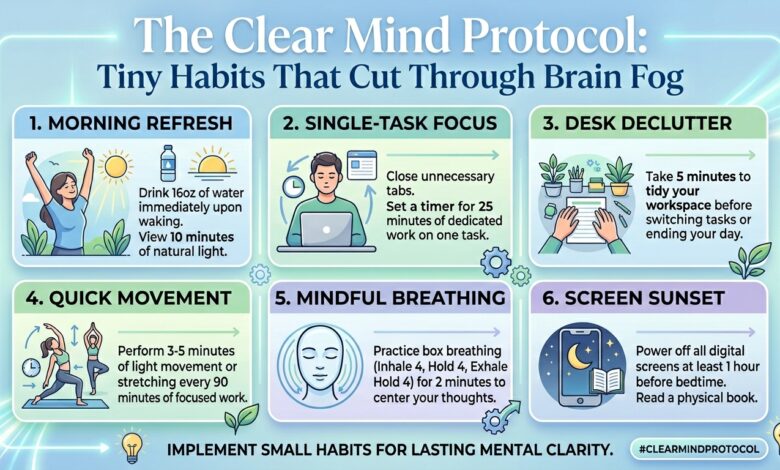
The Clear Mind Protocol: Tiny Habits That Cut Through Brain Fog
Introduction: Why You Feel Fuzzy (And Why It’s Not Your Fault)
You know the feeling. You walk into a room and forget why. You read a paragraph and immediately forget what it said. You sit down to work, and your brain feels like a browser with forty-seven tabs open—all of them frozen.
This is brain fog. And it is an epidemic.
We blame aging. We blame lack of sleep. We blame that third cup of coffee. But the real culprits are invisible: chronic low-grade inflammation, overstimulation of the default mode network (the brain’s “wandering” system), and the constant context-switching that modern life demands.
The good news? You do not need a digital detox retreat or a month-long meditation course. You need tiny habits. Small, specific, low-effort actions that act like a defragmentation tool for your brain.
This guide contains twenty-three micro-interventions. Each takes less than three minutes. Each is backed by neuroscience or behavioral psychology. Each is designed to be stacked onto existing behaviors so you never have to “find time” for clarity. Clarity becomes automatic.
Part 1: The Visual Field Reset (Tiny Habits for Your Eyes)
Your eyes are not just windows to the world. They are direct neural highways to your brain’s alertness centers. When your eyes are locked on a screen at a fixed distance for hours, the ciliary muscles cramp, the blink rate drops by 66%, and your brain interprets this as a threat state.
Tiny Habit #1: The 20-20-20 Rule (Actualized)
Every twenty minutes, look at something twenty feet away for twenty seconds. That is the standard advice. Here is the upgrade: while looking at that distant object, blink—slowly and deliberately—five times. Blinking resets the tear film and sends a “safe” signal to the trigeminal nerve.
Tiny Habit #2: The Peripheral Glance
Without moving your head, soften your gaze so you can see the edges of your peripheral vision (left, right, up, down). Hold for ten seconds. This shifts your brain from focused (sympathetic) mode to panoramic (parasympathetic) mode. The science: activating peripheral vision reduces activity in the amygdala—your brain’s fear center.
Tiny Habit #3: The One-Blue-Sky Look
If you are indoors, find a window. Look at the sky (not the sun). Observe the color. Is it blue? Grey? Hazy? This takes five seconds. Natural light in the visible blue spectrum suppresses melatonin and increases serotonin. A micro-dose of outdoor light is more effective for alertness than a second coffee.
Part 2: The Auditory Detox (Tiny Habits for Your Ears)
Your brain cannot filter out background noise. It processes every sound—the HVAC hum, the distant conversation, the refrigerator compressor—as a low-priority threat. This constant sub-auditory processing drains cognitive bandwidth.
Tiny Habit #4: The Three-Breath Listening Pause
Stop whatever you are doing. Close your eyes. Listen to the quietest sound you can hear for three breaths. It might be the hum of a lightbulb. It might be your own heartbeat. This is not meditation. It is auditory sharpening. It trains your brain to differentiate signal from noise.
Tiny Habit #5: The One-Earbud Rule
If you listen to music or podcasts while working, switch to one earbud. Leave the other ear open to ambient sound. Why? Binaural hearing keeps your vestibular system (balance and spatial awareness) engaged. When you block both ears, your brain increases internal noise (rumination, anxiety) to compensate for the lack of external input.
Tiny Habit #6: The Thirty-Second Silence
Before you start a cognitively demanding task, take thirty seconds of complete silence. No music. No talking. No thinking about what you will do. Just silence. This allows the default mode network to “settle” before you engage the task-positive network.
Part 3: The Nasal Reset (Tiny Habits for Breathing)
Mouth breathing is a hidden epidemic. It bypasses the nasal turbinates, which filter, warm, and humidify air. More critically, mouth breathing reduces nitric oxide production by 90%. Nitric oxide is a vasodilator—it opens blood vessels in the brain, improving oxygen delivery and cognitive function.
Tiny Habit #7: The One-Nostril Check
Place a finger under your nose. Exhale. Which nostril has more airflow? If you cannot tell, you are likely mouth breathing. The habit: become aware of your nasal airway three times per day (morning, noon, evening).
Tiny Habit #8: The Hum Reset
Hum your favorite song for ten seconds (under your breath is fine). Humming increases nasal nitric oxide by fifteen-fold. It also stimulates the vagus nerve, which runs from your brainstem to your gut and is the primary highway for your parasympathetic (calm) nervous system.
Tiny Habit #9: The Sip-Swallow-Sniff
Before you take a drink of water, first sniff the water. Yes, sniff it. Water has a smell (subtle, but present). This activates the olfactory nerve, which is directly connected to the limbic system (memory and emotion). Then take a sip, swallow, and sniff again. This three-second ritual anchors your attention in the present moment.
Part 4: The Posture Pivot (Tiny Habits for Your Spine)
Your brain consumes 20% of your body’s oxygen and glucose. That flow travels through the carotid and vertebral arteries—both of which pass through your neck. Forward head posture (text neck) compresses these arteries and reduces cerebral blood flow by up to 30%.
Tiny Habit #10: The Chin Tuck
While sitting, pull your chin straight back (do not tilt your head up or down). You should feel a gentle stretch at the base of your skull. Hold for three seconds. Release. Do this three times. This re-aligns the atlas (C1 vertebra) and opens the suboccipital muscles.
Tiny Habit #11: The Earlobe Lift
Reach up and gently pull your earlobes upward and backward. Hold for five seconds. This releases the sternocleidomastoid (SCM) muscles, which are often chronically tight in desk workers. A relaxed SCM reduces tension headaches and improves proprioception (your brain’s sense of where your body is in space).
Tiny Habit #12: The Seated Cat-Cow
While sitting at your desk, place your hands on your knees. Inhale: arch your back, look slightly up, push your chest forward. Exhale: round your back, tuck your chin, pull your navel toward your spine. Do this five times. This hydrates the spinal discs and stimulates the vagus nerve.
Part 5: The Cognitive Load Dump (Tiny Habits for Your Working Memory)
Your working memory can hold approximately four items for about twenty seconds. Every open loop—every “I need to remember to call the plumber” or “I should reply to that email”—occupies a slot. Most people are walking around with a working memory utilization rate of 90% or higher. No wonder you feel foggy.
Tiny Habit #13: The Two-Minute Brain Dump
Take a physical sticky note. Write down everything that is currently in your head. Do not organize. Do not prioritize. Just dump. This transfers cognitive load from fragile working memory to external memory. The act of writing (not typing) activates the reticular activating system (RAS), which filters relevant information.
Tiny Habit #14: The “One Tab” Rule for Thoughts
After your brain dump, circle exactly one item. That is the only thing you are allowed to think about for the next five minutes. The rest do not exist. This prevents “attentional residue”—the phenomenon where your brain continues to process unfinished tasks in the background.
Tiny Habit #15: The Done List (Not the To-Do List)
At the end of your work period, write down three things you completed. Not the big wins. The small ones. “Replied to Sarah.” “Drank water.” “Stood up three times.” The brain releases dopamine upon perceiving progress, not upon completing big goals. A done list is a dopamine dispenser.
Part 6: The Hydration Micro-Adjustment (Tiny Habits for Electrolytes)
Dehydration of just 1-2% of body weight impairs cognitive performance, particularly attention and working memory. But drinking plain water is not enough. You need electrolytes—specifically sodium and potassium—to facilitate nerve transmission.
Tiny Habit #16: The Salt Pinch
Before your first glass of water in the morning, put a tiny pinch of sea salt or Himalayan pink salt on your tongue. Let it dissolve. This provides sodium, which is essential for the sodium-potassium pump that generates nerve impulses. Do not overdo it—a pinch, not a palmful.
Tiny Habit #17: The Lemon Squeeze
Add a squeeze of lemon to one glass of water per day. Lemon contains potassium and citrate. Potassium supports nerve signaling. Citrate supports the Krebs cycle (cellular energy production). This is not about taste. It is about cellular biology.
Tiny Habit #18: The Temperature Contrast
Drink one glass of cool water (not ice cold) followed by a few sips of warm water. The temperature contrast stimulates the trigeminal nerve, which runs through your face and jaw. This nerve has direct connections to the brainstem’s arousal centers.
Part 7: The Micro-Win Loop (Tiny Habits for Dopamine Regulation)
Brain fog is often a symptom of dopamine dysregulation. When your dopamine receptors are flooded by high-frequency stimuli (social media, video games, sugar), your brain downregulates sensitivity. Normal activities—reading, working, conversing—feel dull. You feel foggy.
Tiny Habit #19: The One-Task Pomodoro
Set a timer for five minutes. Choose one task. Do nothing else for five minutes. When the timer goes off, stop immediately—even if you want to continue. This builds “completion cues” that trigger dopamine release. Five minutes of focus is infinitely more valuable than thirty minutes of distracted half-work.
Tiny Habit #20: The Anticipatory Pleasure Pause
Before you do something you enjoy (drink coffee, eat a snack, check your phone), pause for three seconds and consciously anticipate the pleasure. Dopamine is released during anticipation, not during consumption. By pausing, you amplify the natural dopamine response without increasing the stimulus.
Tiny Habit #21: The Gratitude Glance
Look at one object in your immediate environment. Say (out loud or silently): “I appreciate that this [object] exists.” Example: “I appreciate that this pen exists. It lets me write down my thoughts.” This activates the ventromedial prefrontal cortex, which is involved in reward processing and positive affect.
Part 8: The Environmental Anchor (Tiny Habits for Context)
Your brain associates specific contexts with specific mental states. The bed is for sleep. The couch is for Netflix. The desk is for work. When these boundaries blur, your brain cannot efficiently switch modes. You feel foggy because your brain is trying to be in two places at once.
Tiny Habit #22: The Object Anchor
Place one physical object on your desk that is used only for focused work. It could be a specific pen, a small stone, or a coaster. When you sit down, touch that object. When you leave, move it to a different location. This is a Pavlovian anchor. Your brain learns: object present = focus mode.
Tiny Habit #23: The Doorway Reset
Every time you walk through a doorway, take one conscious breath. Doorways act as “event boundaries” for the brain—they trigger a memory reset. Instead of fighting this (and feeling frustrated when you forget why you entered a room), use it. The breath becomes the new context.
Part 9: The Implementation Protocol (How to Make These Stick)
You now have twenty-three tiny habits. Attempting all of them will guarantee failure. Here is the actual protocol.
The Selection Process:
Choose exactly three habits from this list. Not four. Not five. Three. The criteria:
- One visual/eye habit (e.g., 20-20-20 with blinking)
- One breathing/nasal habit (e.g., the Hum Reset)
- One cognitive load habit (e.g., the Two-Minute Brain Dump)
The Stacking Formula:
Attach each tiny habit to an existing trigger.
- “When I sit down at my desk, I will do the Chin Tuck.”
- “When I finish a task, I will do the Three-Breath Listening Pause.”
- “When I stand up from my chair, I will do the Doorway Reset.”
The Never-Miss-Twice Rule:
If you miss a day, forgive yourself instantly. Do not double up. Do not feel guilty. Simply do the tiny habit the next day. Two misses in a row is the only failure.
The Sixty-Six Day Contract:
Commit to these three habits for sixty-six days. Do not evaluate before day sixty-seven. The brain takes approximately sixty-six days to automate a new behavior (University College London study). Your only job is repetition.
Conclusion: Clarity Is Not a Destination
You will never achieve permanent, perfect mental clarity. Brain fog is not a bug in human biology. It is a feature—a signal that something in your environment, posture, hydration, or cognitive load needs attention.
The goal is not to eliminate fogginess forever. The goal is to build a toolkit of tiny responses that clear the fog when it appears.
A ten-second chin tuck will not change your life. But a ten-second chin tuck, performed every time you feel your neck tighten, over the course of a year, is 365 reminders that you are in control of your physiology.