The Identity Shift: A Science-Based Framework for Building Habits That Actually Last
Introduction: Why You Keep Breaking Promises to Yourself
You have done it a hundred times. You buy the running shoes. You download the meditation app. You vow to wake up early. For three days, you are a new person. By day ten, the shoes are in the closet, the app is buried in a folder, and the alarm is silenced with a grunt.
This is not a failure of willpower. It is a failure of architecture.
Most people approach habits like they are assembling IKEA furniture—follow the steps, get the result. But habits are not furniture. They are neural pathways. You cannot “install” a habit. You must grow one. And growth requires the right soil, water, and sunlight.
This guide is not about motivation. Motivation is a firework—loud, bright, and gone. This is about engineering. We are going to dismantle the psychology of lasting behavior change and rebuild it from the ground up. No toxic positivity. No hustle culture. Just neuroscience, behavioral design, and a brutally honest framework that works.
Part 1: The Fundamental Mistake (Goal Setting vs. Identity Shifting)
Here is the truth that the self-help industry does not want you to hear: Goals are useless for long-term change.
Think about the last time you set a goal. “I want to lose 10 kilograms.” “I want to write a book.” “I want to save $5,000.” Did you achieve it? Maybe. Did you keep the weight off? Did you write the second book? Did you continue saving?
Probably not.
Why goals fail: Goals have a finish line. The moment you cross it, the behavior that got you there becomes unnecessary. You do not need to run anymore. You do not need to save anymore. You revert to your baseline.
The solution: Identity-based habits.
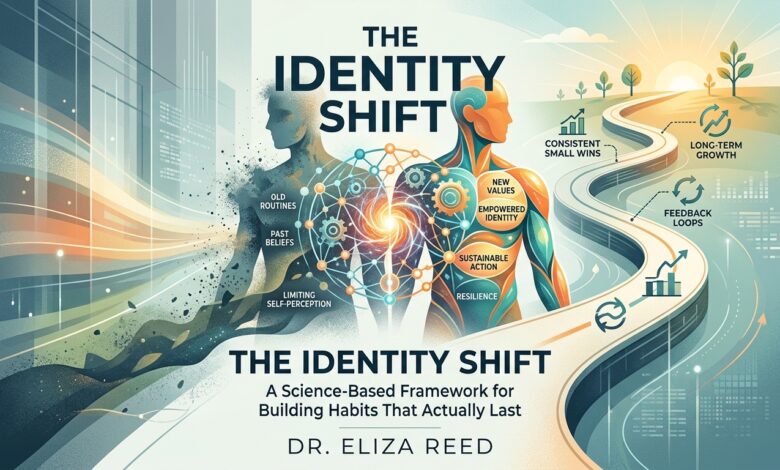
Instead of “I want to run a marathon” (goal), shift to “I am a runner” (identity). Instead of “I want to write a book,” shift to “I am a writer.” Instead of “I want to quit smoking,” shift to “I am not a smoker.”
When your behavior is aligned with your identity, you are not trying to do something. You are being someone. And the brain protects identity fiercely.
The Optimization Protocol: Write down the person you want to become. Not what you want to have or achieve. Who do you want to be? Now, ask: “What does that person do every single day?” That is your habit list.
Part 2: The Neuroscience of Sticking (Why Your Brain Fights Change)
Your brain is not designed to make you happy. It is designed to keep you alive. And alive means predictable.
The basal ganglia—the part of your brain responsible for automatic behaviors—loves routine. It is an energy-saving device. When you try to change a habit, your prefrontal cortex (the conscious, effortful brain) has to fight the basal ganglia. And the basal ganglia has been training for your entire life. It is stronger. It is faster. It will win every time unless you use strategy.
The Habit Loop (Charles Duhigg):
- Cue: A trigger that tells your brain to go into automatic mode.
- Craving: The motivation to change your internal state.
- Response: The actual habit you perform.
- Reward: The benefit that teaches your brain to repeat the loop.
Why new habits die: You try to change the Response without understanding the Cue, Craving, or Reward. You cannot just “stop eating sugar.” You have to understand: What is the cue? (3:00 PM boredom). What is the craving? (Energy boost). What is the reward? (Temporary focus).
The Fix: Do not fight the loop. Hack it. Keep the same Cue and Reward. Change the Response.
- Old loop: 3:00 PM (Cue) → Low energy (Craving) → Eat a cookie (Response) → Sugar rush (Reward).
- New loop: 3:00 PM (Cue) → Low energy (Craving) → Drink green tea + do 10 jumping jacks (Response) → Oxygen + mild caffeine (Reward).
Part 3: The Two-Minute Rule (How to Stop Procrastinating Forever)
The single biggest reason habits fail is that people start too big. They go from zero to one hour at the gym. They go from watching Netflix to writing 2,000 words. This is like trying to fly a 747 after reading a pamphlet.
The Optimization Protocol: The Two-Minute Rule.
Make the new habit so easy that you cannot say no.
- “Run three miles” becomes “Put on running shoes.”
- “Write a chapter” becomes “Write one sentence.”
- “Meditate for 20 minutes” becomes “Sit on meditation cushion.”
- “Eat healthy” becomes “Cut one vegetable.”
Why this works: The hardest part of any habit is the initiation phase. Once you start, the friction drops dramatically. Putting on running shoes often leads to a five-minute walk, which leads to a run. Writing one sentence often leads to a paragraph. Sitting on the cushion often leads to a full meditation.
Do not optimize the habit. Optimize the start. Master the art of showing up. Frequency matters more than duration. Five minutes every day is infinitely better than one hour once a week.
Part 4: Habit Stacking (Using Existing Loops to Build New Ones)
Trying to remember to do a new habit is cognitively expensive. Your willpower is a finite resource. By 5:00 PM, after making hundreds of decisions, your “decision fatigue” is real. You will forget. You will skip.
The Optimization Protocol: Habit Stacking.
Attach the new habit to an existing, automatic habit.
The formula: “After [CURRENT HABIT], I will [NEW HABIT].”
- “After I pour my morning coffee, I will write down my three priorities for the day.”
- “After I use the bathroom after waking up, I will do 10 pushups.”
- “After I sit down for dinner, I will take one deep breath before touching my fork.”
- “After I park my car at work, I will listen to one language learning podcast on the walk in.”
Why this works: Your existing habits are neural superhighways. You do not have to think about brushing your teeth or making coffee. By stacking a tiny new behavior on top, you are using the momentum of an existing highway to pave a small new road. Within weeks, the new road becomes part of the highway.
Pro Tip: Stack behaviors in the same location and at the same time. Context is a powerful trigger. Your brain associates the kitchen with eating, the desk with working, the bed with sleeping. Do not meditate in bed. Do not work in bed. Respect context.
Part 5: The Environment Design (Making Good Habits Easy, Bad Habits Hard)
Willpower is overrated. Environment is underrated.
Every behavior has a friction cost. The more steps between you and a habit, the less likely you are to do it. The more steps between you and a bad habit, the less likely you are to do that.
The Optimization Protocol: The Friction Audit.
Walk through your home and workplace. For every good habit you want, ask: How can I reduce friction to zero? For every bad habit you want to break, ask: How can I add friction?
Examples:
- Want to exercise in the morning? Sleep in your workout clothes. Put your shoes next to the bed. Roll your yoga mat out on the floor before you sleep. Friction: Zero.
- Want to stop eating junk food? Do not buy it. If it is not in the house, you cannot eat it at 10:00 PM. If your family buys it, put it in an opaque container in the hardest-to-reach shelf. Add a rubber band. Add tape. Add friction.
- Want to read more? Put a physical book on your pillow every morning. To get into bed, you have to move the book. You will likely open it.
- Want to scroll less on your phone? Delete social media apps. Log out of every account. Turn on grayscale mode. Put the phone in a drawer. Better yet, buy a $10 alarm clock and charge your phone in the kitchen.
Part 6: The Never-Break-Two Rule (Managing Inevitable Failure)
You will break your habit. It is not a matter of if, but when. You will be tired. You will travel. You will get sick. Your child will wake up crying. The car will break down.
The difference between people who succeed and people who fail is not that successful people never miss. It is that they miss intelligently.
The Optimization Protocol: The Never-Break-Two Rule.
Never, under any circumstances, miss a habit twice in a row.
- One miss: You did not run on Monday. That is fine. Life happens.
- Two misses in a row: You did not run on Monday or Tuesday. This is the danger zone. Missing twice breaks the chain. It tells your brain that the habit is optional. It creates a new identity: “I am someone who stops running.”
The Protocol: If you miss once, forgive yourself immediately. Guilt is a useless emotion for habit formation. Do not double your effort tomorrow to “make up for it.” That leads to burnout. Simply show up. Do the two-minute version. Keep the chain alive.
Part 7: Tracking Without Obsessing (Measurement That Works)
What gets measured gets managed. But what gets overmeasured gets abandoned. Spreadsheets and bullet journals work for Type A personalities. For the rest of humanity, they are a chore that becomes another failed habit.
The Optimization Protocol: The Paperclip Method.
Use a simple, visual, satisfying tracker.
- For daily habits: Get a wall calendar and a red marker. Every day you do the habit, put a big X. Do not break the chain. (This is Jerry Seinfeld’s method).
- For hourly habits: Move a paperclip from one pocket to another every time you complete a unit (e.g., every glass of water, every 30 minutes of focus).
- For digital minimalists: Use a simple app like “Habit” or “Streaks.” No more than three habits tracked at once.
The warning: Tracking is a tool, not the goal. If you find yourself spending more time designing your tracker than doing the habit, delete the tracker. Go back to the Two-Minute Rule.
Part 8: Social Accountability (The Cheat Code)
The brain is a social organ. We are wired to care what others think. You can use this biology to your advantage.
The Optimization Protocol: Commitment Devices.
- The Public Pledge: Tell three people (friends, family, a social media audience) exactly what you are going to do and when. Shame is a powerful motivator.
- The Accountability Partner: Find one person with a similar goal. Text each other every day. “Did you do the thing?” No judgment. Just reporting.
- The Financial Stake: Use a service like StickK. Put $50 on the line. If you fail, the money goes to a charity you hate (or a friend you do not want to pay). Loss aversion is twice as powerful as gain seeking.
Part 9: The Patience Contract (Why 21 Days Is a Lie)
You have heard the myth: “It takes 21 days to form a habit.” This came from a 1960s book about plastic surgery patients adjusting to their new faces. It has nothing to do with behavior.
The Science: A study at University College London found that it takes 66 days on average for a behavior to become automatic. For some people, it takes 18 days. For others, 254 days. It depends on the complexity of the habit.
The Optimization Protocol: The 66-Day Contract.
Make a commitment with yourself: “I will do this behavior every day for 66 days. On day 67, I am allowed to decide if it is a habit.”
Do not evaluate progress on day 10. Do not get discouraged on day 30. The brain does not rewire on your schedule. It rewires on its own schedule through repetition. Your only job is to show up.
Conclusion: The Habit Is the Goal
Here is the final paradox of lasting habits.
You started wanting to lose weight, earn more money, or learn a skill. Those are outcomes. But if you build the habit correctly, you will realize something surprising: The habit itself becomes the reward.
The runner does not run to lose weight. The runner runs because she is a runner. The writer does not write to finish a book. The writer writes because he is a writer. The habit is no longer a means to an end. It is part of identity. It is part of the self.
That is the ultimate optimization. When you stop trying to be disciplined and simply are the person who does the thing, effort disappears. Motivation becomes irrelevant. The habit just is.
Start absurdly small. Stack on existing loops. Design your environment. Never miss twice. Wait 66 days.